


You have the spreadsheet. A sprawling list of competitors, their features, and their pricing. Yet, instead of clarity, you feel a rising sense of unease. Have you missed someone critical? How does this mountain of data translate into a winning strategy you can confidently present to your stakeholders? The truth is, a truly effective competitive landscape analysis for new products is less about exhaustive cataloging and more about strategic discovery. It’s about finding the story, not just listing the characters.
This guide moves beyond the checklist. We will empower you to uncover the narrative within the market-to identify not just who your rivals are, but where they aren’t. You will learn to pinpoint the strategic gaps and unmet customer needs where your new product can thrive, transforming your analysis from a defensive document into a confident, defensible launch plan.
Key Takeaways
- Discover how to shift your focus from a simple competitor checklist to identifying the unoccupied market territory where your new product can truly succeed.
- Go beyond feature-for-feature comparisons by mapping the market’s core ‘Jobs to Be Done’ to uncover what customers actually need.
- Transform your competitive landscape analysis for new products by learning where to find intelligence-like customer reviews-that reveals recurring complaints and unmet needs.
- Learn to translate your analytical insights into a compelling value proposition that clearly defines your unique position in the market.
Beyond the Checklist: Why New Products Demand a Different Lens
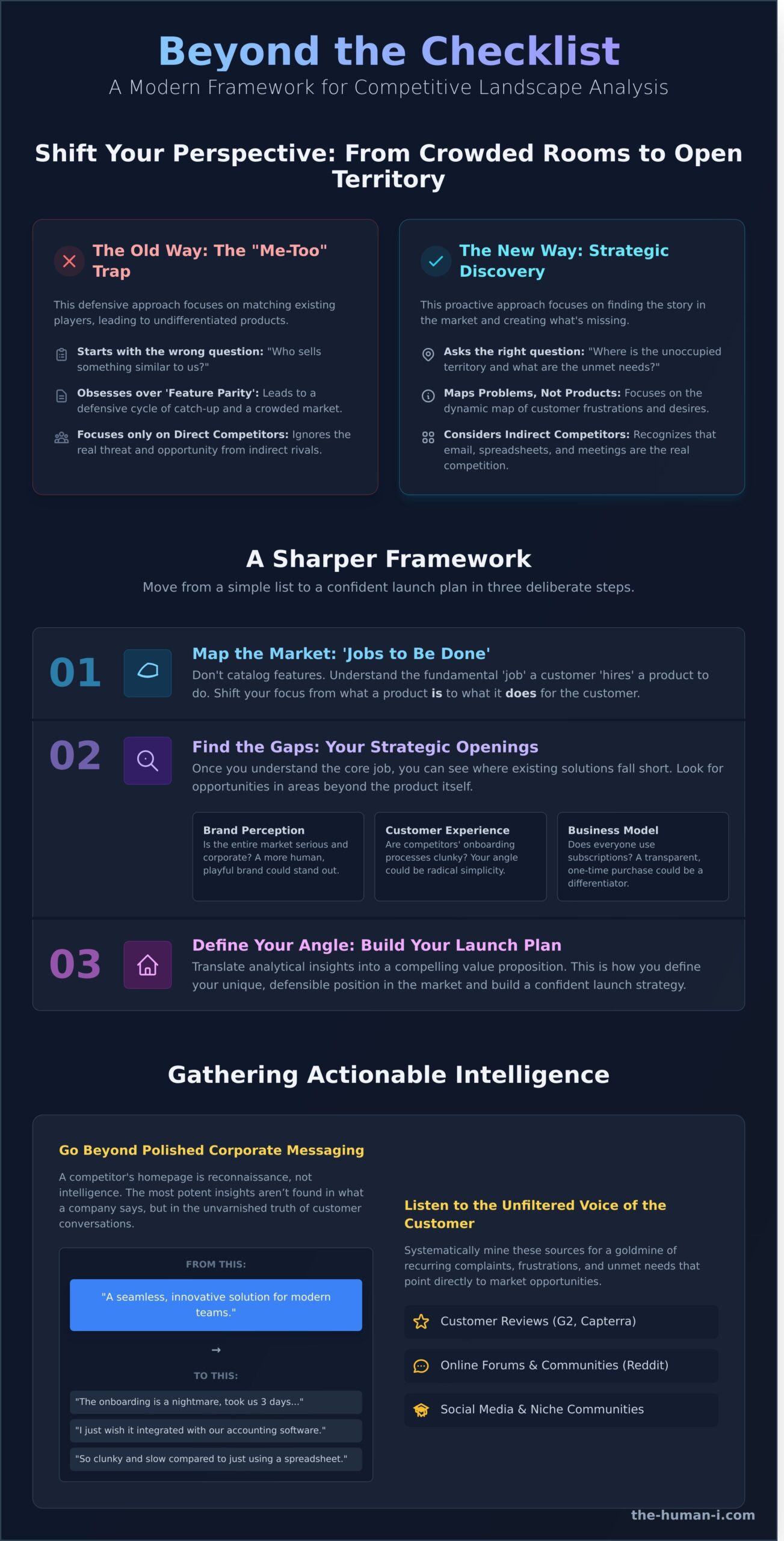
Most competitor analysis begins with the wrong question: “Who sells something similar to us?” This approach is a relic, a backward-glance in a market that only rewards forward momentum. An effective competitive landscape analysis for new products requires a fundamental shift in perspective. The goal isn’t to benchmark features against existing players; it’s to uncover unoccupied territory where a new idea can thrive.
Instead of mapping products, we must map the problems customers are trying to solve. A true competitive landscape for an innovator isn’t a static list of companies but a dynamic map of customer needs, frustrations, and unmet desires. This is where real opportunity is found-not by building a better version of what exists, but by creating what is missing entirely.
Direct vs. Indirect Competitors
The most common pitfall in a new product launch is focusing solely on direct competitors-the obvious players offering a similar solution. The real threat, and the greater opportunity, often lies with indirect rivals. These are the disparate tools, habits, and workarounds customers use to solve the same core problem. For a new collaboration tool, the competition isn’t just Slack or Teams; it’s email, spreadsheets, and even the “quick sync” meeting that wastes an hour.
The Risk of ‘Feature Parity’ Thinking
A feature-for-feature comparison is a recipe for irrelevance. It pushes teams into a defensive cycle of catch-up, inevitably leading to a ‘me-too’ product that becomes just another echo in a crowded room. The strategic win isn’t in matching a competitor’s checklist. It’s in discovering the deep gaps in their experience, their positioning, or their business model. The most powerful competitive landscape analysis for new products focuses not on what rivals do, but on what they fundamentally don’t do for the customer.
A Sharper Framework: Map the Market, Find the Gaps, Define Your Angle
A conventional feature-by-feature spreadsheet isn’t enough to secure a successful launch. To truly uncover opportunity, you need a more strategic lens. A powerful competitive landscape analysis for new products moves beyond a simple list of rivals and instead follows a deliberate, three-part framework: Map the underlying customer need, identify the gaps in how it’s being met, and define your unique angle of attack.
Mapping the ‘Jobs to Be Done’ (JTBD)
Instead of cataloging competitor features, start by understanding the fundamental ‘job’ a customer is ‘hiring’ a product to do. The JTBD theory reframes the market around customer motivation. People don’t buy a product; they hire it to make progress in their lives. This shift from features to outcomes is the first step in uncovering real insight, a core part of how we shape strategy in our solutions.
Identifying Strategic Gaps
Once you understand the core jobs your customers need done, you can see where existing solutions fall short. These gaps are your openings. They often appear in areas beyond the product itself. A robust analysis, as detailed in this Competitive Landscape Guide, should look for opportunities in these key areas:
- Brand Perception: Is the entire market serious and corporate? A more human, even playful, brand could stand out immediately.
- Customer Experience: Are competitor onboarding processes notoriously complex and clunky? Your angle could be radical simplicity and a seamless user journey.
- Business Model: Does every major player lock customers into a recurring subscription? A transparent, one-time purchase option could be a powerful differentiator.
This disciplined approach to your competitive landscape analysis for new products ensures you aren’t just building another “me-too” solution. By mapping the true need and identifying where others fail to deliver, you can define an angle that is not only unique but deeply resonant with the customers you aim to serve.
Gathering Intelligence: Where to Find Actionable Insight
A cursory glance at a competitor’s homepage is reconnaissance, not intelligence. A meaningful competitive landscape analysis for new products demands that we move beyond polished corporate messaging and dig for the unvarnished truth. The most potent insights aren’t found in what a company says about itself, but in the signals it sends and the conversations happening around it. This is where you uncover the strategic gaps and unmet needs that create opportunity.
Listening to the Customer’s Voice
The unfiltered voice of the customer is where corporate polish wears thin, revealing a goldmine of frustrations and desires. This raw feedback is more valuable than any mission statement. By systematically mining these sources, you can identify the precise language people use to describe their problems-the key to crafting a message that truly resonates.
- Review Platforms: Sites like G2, Capterra, and Trustpilot reveal recurring complaints about features, pricing, or customer support.
- Community Forums: Niche subreddits and industry forums show how power users and enthusiasts actually use products and what they wish was different.
- Social Media Comments: Scan the comments on a competitor’s ads and organic posts to gauge real-time sentiment and reactions to their messaging.
Decoding Brand and Marketing Signals
Every marketing message is a strategic choice-a declaration of who a company serves and, just as importantly, who it ignores. Analyzing their advertising, content, and tone of voice reveals their core emotional promises and strategic intent. Are they positioning themselves as the premium, expert choice or the accessible, budget-friendly option? Understanding their positioning illuminates their perceived strengths and potential blind spots you can exploit.
While digital tools can help track a competitor’s footprint, the real art is in interpretation. Raw data without strategic context is just noise. To build a truly effective framework, it helps to understand the foundational principles of analysis. For a deeper dive, this Essential Guide to Competitive Landscape Analysis provides a robust overview. The goal isn’t to collect vanity metrics, but to synthesize disparate pieces of information into a clear picture of the market you’re about to enter.
From Insight to Action: Building Your Launch Strategy
A thorough analysis is a powerful starting point, but it remains a purely academic exercise without a clear path to action. The data you’ve gathered from your competitive landscape analysis for new products is not the destination; it is the raw material. Now, it’s time to build.
The insights you’ve uncovered are the foundation for a launch strategy that is targeted, differentiated, and resonant. This is where you translate market knowledge into market power, shaping every decision from product positioning to your first marketing campaign.
Crafting a Differentiated Value Proposition
Your findings must crystallize into a sharp, defensible value proposition. This statement defines your unique space in the market. A simple but effective framework to start is:
- Unlike [competitors], we are the only [your product category] that [offers this unique benefit].
This isn’t just a tagline; it becomes the north star for your product and marketing. It’s the core of the strategic work our team has deep expertise in, turning market insight into a commanding position.
Informing Your Go-to-Market Plan
This clarity directly informs your go-to-market plan. Instead of anchoring your price to a competitor’s, you can price based on the distinct value you deliver. Your marketing narrative follows suit, speaking directly to the underserved audience you’ve found.
Which channels are competitors oversaturating with noise? Your opportunity lies in the less crowded spaces they’ve ignored. Your launch shouldn’t be a shout into the void; it should be a carefully crafted whisper to the right people, addressing the specific pain points your research uncovered.
The Human Element: Where Data Meets Wisdom
Analytics platforms and market reports are powerful, but they only provide the raw materials. They can tell you what is happening in the market, but they can’t tell you why. A truly effective competitive landscape analysis for new products doesn’t end with a spreadsheet of features and price points; it begins there. True advantage comes from applying curiosity, empathy, and strategic interpretation to the numbers.
It’s about digging deeper to understand the human motivations that shape market trends. Why did a competitor suddenly pivot their messaging? What unmet customer need is driving the success of a niche player? Answering these questions requires more than data; it requires wisdom. This blend of rigorous analysis and profound human insight is the foundation of our entire approach.
Beyond the Data
The most potent insights emerge when disparate data points are connected to form a cohesive story. This is an act of synthesis that requires a deep, practiced understanding of brand strategy and consumer behaviour. It’s the ability to see the narrative hidden within the noise, a skill honed through experience, not programmed into an algorithm. Our team at Human Instinct is built on this very principle.
Partnering for a Clearer Perspective
When you are deeply invested in a new product launch, it can be nearly impossible to see the competitive environment with complete objectivity. You’re too close to the project, and your perspective can be shaped by internal assumptions. An external partner provides an unbiased, expert view, helping to uncover the crucial blind spots that can derail a launch. This fresh perspective is often the key to unlocking a winning strategy. Learn more about our team and the philosophy that guides our work.
Beyond the Map: Where Analysis Becomes Advantage
Ultimately, launching a new product successfully isn’t about ticking boxes on a generic checklist. It’s about adopting a sharper lens-seeing the market not just as a collection of data points, but as a dynamic human ecosystem. The most powerful frameworks push beyond simple competitor tracking to uncover the unspoken needs and unserved gaps where your product can uniquely thrive. A truly effective competitive landscape analysis for new products is not a static report; it’s a living roadmap that transforms raw insight into decisive action.
This is the space where insight, data, and wisdom meet-our foundational approach at Human Instinct. With a proven track record in shaping new product development for leaders in Financial Services, Automotive, and Technology, we specialize in uncovering the nuanced story behind the numbers. We empower our partners to make the bold, strategic moves that define market leaders.
Ready to find your strategic opening? Contact us to discuss your new product.
The right perspective doesn’t just show you where you stand; it reveals where you can lead. Your market is waiting.
Frequently Asked Questions
How is this different from a standard competitor analysis?
A standard analysis often becomes a feature-for-feature comparison against existing rivals. A competitive landscape analysis for new products is fundamentally different; it’s a strategic exploration to find an underserved niche before you launch. The focus shifts from direct replication to discovering the “why” behind customer choices, empowering you to shape a truly differentiated offering from day one and avoid a saturated market.
What are the best free tools for competitive landscape analysis?
Valuable insight doesn’t always require a large budget. Leverage Google Trends to gauge market interest and compare solution popularity over time. Use the advanced search functions within social media platforms to find raw customer sentiment about competitors. Tools like AnswerThePublic can reveal the precise questions your target audience is asking, offering a direct line into their core problems and priorities.
How often should I perform this analysis for a new product?
This isn’t a single event but a continuous discipline. A deep competitive landscape analysis for new products is critical during the pre-launch strategy phase to define your position. Revisit it upon launch to gauge initial reactions and then establish a quarterly review. This cadence ensures your strategy stays attuned to market shifts and emerging threats, preventing your initial advantage from eroding over time.
What’s the biggest mistake companies make when analyzing competitors?
The most common misstep is a narrow focus on direct competitors, which leads to a reactive game of feature-matching. This myopia ignores the greater threat from indirect or substitute solutions-the different ways customers solve the same core problem. True insight comes from understanding the entire customer ecosystem and all their choices, not just the ones that look like your product.
How do I analyze competitors in a completely new market category?
When creating a new category, your primary competitors are existing behaviors and imperfect workarounds. Analyze these “substitute solutions” to understand the problem you are truly solving. Look to analogous markets: who has successfully solved a similar type of problem for a different audience? Their strategies and customer adoption patterns can provide an invaluable blueprint for your own launch.
Can a SWOT analysis be useful for a new product launch?
Absolutely. A SWOT analysis is a powerful strategic tool, but its true value is unlocked when you apply it not just to your product, but to your key competitors as well. By mapping their strengths, weaknesses, opportunities, and threats, you uncover their vulnerabilities. This insight empowers you to position your new product to exploit their weaknesses and neutralize their strengths, carving out a defensible market position.



