


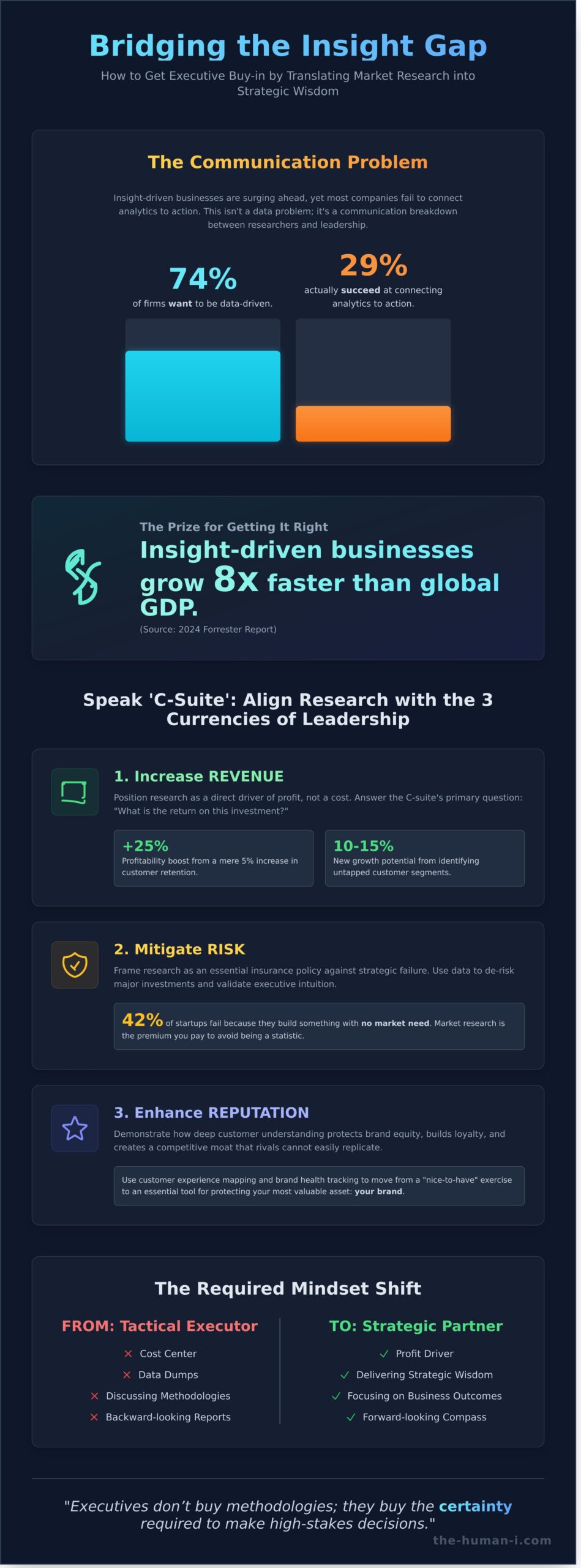
According to a 2024 Forrester report, insight-driven businesses are growing eight times faster than global GDP. Yet in those same companies, while 74% of firms want to be data-driven, only 29% are actually successful at connecting analytics to action. This isn’t a data problem; it’s a communication problem.
You already see the power in your work. You’ve uncovered the critical ‘why’ behind customer behavior and identified the clear path forward. The frustration is getting leadership to see it too, especially when budgets are prioritized for execution, not discovery. This guide is built to change that perception. We’ll show you exactly how to get executive buy-in for market research by shifting your approach from presenting findings to delivering strategic wisdom. You’ll learn to translate complex data into the language of revenue, risk, and return that the C-suite understands and acts upon.
Together, we’ll walk through a framework for aligning your proposals with high-level business goals, crafting a compelling financial case, and elevating your role from tactical executor to indispensable strategic partner.
Key Takeaways
- Learn to reframe market research from a cost center into a strategic engine for profit by bridging the critical ‘Insight Gap’ at the executive level.
- Master the language of the C-suite by aligning your research proposals directly to the three currencies they value most: Revenue, Risk, and Reputation.
- Discover why a compelling narrative consistently outperforms a data dump, and learn the discipline of storytelling to make your insights unforgettable.
- Explore a practical framework for how to get executive buy-in for market research, beginning with a pilot approach that proves ROI before you ask for a major investment.
The Insight Gap: Why Executives Overlook Market Research
You’ve seen the look. You present a deck filled with compelling data, rich verbatims, and clear statistical significance, only to be met with a polite nod and a swift pivot to the next agenda item. The budget for a follow-up study is quietly shelved. This isn’t a failure of your data; it’s a failure to bridge the Insight Gap.
The Insight Gap is the chasm between raw research findings and the strategic imperatives that drive a C-suite. It’s why leadership often views research as a cost center, a line item on the P&L, rather than a direct driver of profit. According to a 2023 CMO Survey, only 31.3% of marketing leaders can quantitatively prove the short-term impact of their spending. Without a clear link to revenue or risk mitigation, research becomes a “nice to have” instead of a necessity.
Compounding this is the curse of knowledge. Executives who have spent decades in an industry often believe they instinctively understand their audience. Their past successes serve as a powerful confirmation bias, making them resistant to insights that challenge their worldview. They don’t need a survey to tell them what they think they already know.
This problem is accelerating. By 2026, the C-suite won’t be impressed by traditional, data-heavy reports. They are already saturated with dashboards and analytics. The demand isn’t for more information; it’s for the wisdom to make sense of it. The key to learning how to get executive buy-in for market research is closing this gap by translating findings into the language of business outcomes.
The Language Disconnect
Your team celebrates a 15% lift in engagement rates; your CEO wants to know how it impacts market share. You talk about focus groups; they talk about de-risking a ten-million-dollar investment. The language is tactical, but the need is strategic. Remember this: Executives don’t buy methodologies; they buy the certainty required to make high-stakes decisions.
Research as a Strategic Asset
The most effective way to reframe the conversation is to position research not as a backward-looking report card, but as a forward-looking strategic compass. It’s about moving from “looking for” answers to “finding” the kind of transformative insight that refreshes stagnant brands. Genuine market research is the essential foundation of intelligent brand strategy and development. At Human Instinct, we bridge this gap by applying wisdom to data, transforming complex findings into the strategic clarity leaders need to act with confidence.
Speaking ‘C-Suite’: Aligning Research with Business Drivers
Your executive team operates on a different wavelength. To secure their investment, you must stop talking about methodologies and start speaking their language. The C-suite trades in three primary currencies: Revenue, Risk, and Reputation. The secret to how to get executive buy-in for market research is framing every insight, every discovery, and every proposal within these powerful pillars. It’s not about data points; it’s about decision-making intelligence.
Market research ceases to be a cost center when it’s positioned as a direct driver of growth and a mitigator of expensive mistakes. It becomes an indispensable strategic tool that empowers leadership, protects brand equity, and unlocks new commercial opportunities.
Connecting to the Bottom Line
Every research proposal must answer the unspoken question: “What is the return?” For qualitative work, this can feel abstract, but it’s not. If insights from 15 in-depth interviews prevent a $500,000 product launch from targeting the wrong audience, that’s a tangible, multi-million dollar impact. Similarly, customer experience mapping isn’t just a feel-good exercise. According to Bain & Company, a mere 5% increase in customer retention can boost profitability by over 25%. That’s the direct line from customer insight to LTV. The most potent proposals use robust market segmentation services to identify and size untapped revenue streams, often revealing customer cohorts that can drive 10-15% of new growth.
Risk Mitigation and Brand Health
Beyond revenue, research acts as a critical insurance policy against strategic failure. A staggering 42% of startups fail because they build something with no market need, a finding from CB Insights. Market research is the premium you pay to de-risk a major pivot or a new product investment. It’s also the most effective way to validate or challenge executive intuition without causing friction. The goal isn’t to prove someone wrong; it’s to use data to collectively find the right path forward. This is a core tenet of how to tie audience research to business strategy effectively. A regular ‘Brand Evaluation’ can also identify stagnant narratives or shifting perceptions 12 months before they erode sales, giving you time to recalibrate and protect your most valuable asset: your reputation.
Ultimately, understanding how to get executive buy-in for market research requires a shift in perspective. You aren’t asking for a budget. You’re presenting a data-backed plan to increase revenue, protect the brand, and de-risk the future. When framed this way, it’s not an expense; it’s one of the wisest investments a business can make.
The Power of Narrative: Storytelling vs. Data Dumping
The fastest way to lose an executive’s attention is with a 50-slide deck packed with charts and numbers. A 2021 study by Microsoft confirmed the average human attention span is just 8.25 seconds. Your data-heavy presentation is obsolete before you reach slide three. Executives don’t make decisions based on raw data; they are moved by meaning. The discipline of storytelling isn’t about fabricating a tale. It’s about distilling complex information into a compelling business journey that connects insight to impact.
True influence comes from uncovering the ‘why’ behind the ‘what’. Instead of presenting a chart showing a 40% drop-off on your checkout page, show a 60-second video clip from a user test where a frustrated customer abandons their cart. Let the leadership team hear the sigh and see the confused expression. This is the shift from abstract data points to experiential evidence, and it’s profoundly more persuasive.
Finding the ‘Human’ in the Data
Your data represents real people with real problems. The most effective way to convey market trends is to anchor them in a human story. Instead of stating “customer churn increased by 15% in Q3,” talk about David, a loyal customer for five years who left after three consecutive negative support experiences. This is a critical lesson in how to get executive buy-in for market research; you must make the abstract feel personal. A single, well-placed customer insight can carry more weight than a thousand rows of spreadsheet data.
Structuring the Strategic Pitch
Frame your findings not as a report, but as a journey of discovery. Your role is that of a wise mentor, not a technical analyst. Use a simple framework to guide the conversation and position your insights as a clear call to action:
- The Question: “We set out to understand why our new feature adoption was lagging.”
- The Discovery: “What we found wasn’t a feature problem, but a communication problem. Over 65% of our target users didn’t know the feature existed or what problem it solved.”
- The Action: “Based on this, we recommend a targeted educational campaign that we project will lift adoption by 30% in 90 days.”
This structure transforms a summary of facts into a strategic narrative. It demonstrates that you haven’t just collected data; you’ve uncovered wisdom and forged a clear path forward, making the decision to invest both logical and compelling.
A 4-Step Framework for Securing Research Investment
Convincing leadership to invest in market research isn’t about a single, perfect presentation. It’s a strategic campaign. You need a methodical approach that de-risks the decision for executives and proves the value of insight before asking for a significant budget. This four-step framework moves beyond simply asking for money and instead builds a case so compelling that the investment becomes an obvious next step.
Step 1: The Pilot Approach
Before you ask for a budget to map the entire world, ask for a rowboat to explore the harbor. A pilot project is your proof of concept. Its goal is to deliver a tangible, high-impact win on a small scale, building the political capital you need for larger initiatives. Choose a project that addresses a visible and irritating business problem, like a recent 10% dip in customer satisfaction scores or a stalled product adoption rate. Define success with precision: “We will identify the top three friction points in our onboarding process within 30 days.” This isn’t just research; it’s a targeted strike. A focused customer experience analysis is often the ideal pilot, as it directly connects insight to revenue drivers like retention and loyalty.
Step 2: Stakeholder Mapping
Your proposal won’t be read in a vacuum. It lands in a complex ecosystem of competing priorities and internal politics. The key to navigating this is to map your stakeholders, identifying not just who holds the budget but who feels the pain your research will solve. Find your champions in Product, Sales, or Marketing. These are the leaders who are tired of guessing. For them, your research isn’t a cost; it’s a lifeline. Equally important is identifying potential blockers, those who may feel threatened by data that challenges their long-held assumptions. A successful strategy on how to get executive buy-in for market research involves building a coalition of support before you ever enter the boardroom.
Step 3: The Business Case
Your business case must be a model of clarity and brevity. Forget the 40-page deck; aim for a single, powerful page that an executive can absorb in five minutes. It should connect your proposed research directly to a critical business outcome. Don’t talk about methodologies; talk about money, market share, and risk mitigation. Frame your request around a core business objective.
- The Problem: Q1 customer churn increased by 15%, costing us an estimated $500,000 in ARR.
- The Research: A targeted qualitative study to uncover the root causes of this churn.
- The Expected Outcome: Deliver an action plan projected to reduce churn by 5% within six months, representing a 3x ROI on the research investment.
Step 4: The Strategic Roadmap
The final step is to show what happens after the research is done. This is where most proposals fail. Don’t just deliver a report full of findings; present a clear roadmap from insight to execution. Show exactly how a specific discovery will inform a new marketing campaign, a product feature adjustment, or a sales training module. This demonstrates that you’re not just an information gatherer but a strategic partner dedicated to driving growth. When you reframe the budget objection from “We don’t have the money” to “We can’t afford to operate blindly,” you change the entire conversation. After all, data-driven organizations are 23 times more likely to acquire customers than their peers, according to McKinsey. That’s the kind of number that gets attention.
If you’re ready to build a business case that executives can’t ignore, let’s uncover the insights that will secure your investment.
The Human Instinct Approach: Empowering Leadership Through Wisdom
Data is everywhere. It’s a commodity. Yet, a 2023 report from Forrester found that less than 48% of business decisions are based on quantitative information and analytics. Why the disconnect? Because data isn’t the destination. It’s the raw material. The real challenge is transforming that data into insight, and then elevating insight into wisdom-the confident knowledge of what to do next. This final layer is what empowers leadership and secures investment.
An external partner provides the objective lens necessary for high-stakes brand evaluation. Internal teams, no matter how skilled, often carry inherent biases that can cloud judgment. Stagnant growth isn’t just a line on a chart; it’s a symptom of a brand that has lost its narrative clarity. We’ve seen brands that fail to refresh their strategy suffer an average 12% decline in market share over just three years. Breaking this cycle requires a new story, one built from data but told with human understanding. This is how you move from presenting numbers to presenting a clear, unavoidable path forward.
The most effective method for how to get executive buy-in for market research involves reframing the entire conversation. You aren’t just presenting findings; you’re delivering a data-driven narrative that illuminates unseen opportunities and unarticulated customer needs. It’s the difference between showing a map and charting the course.
Why Wisdom Matters in 2026
Gartner predicts that by 2026, over 70% of organizations will suffer from ‘insight scarcity’ despite having an abundance of data. Having the numbers is not the same as knowing what they mean for your brand’s future. Our ‘Our Talent’ model ensures every project is led by seasoned experts with decades of experience in strategy and brand planning. They provide the wisdom that turns a research deck into a strategic asset. To see how this applies to your specific challenges, contact Human Instinct for a strategic consultation.
Closing Thoughts: The Journey of Discovery
We are guided by the philosophy of chef Ferran Adria: “With creativity, it’s not what you look for that’s important but what you find.” True market research is a journey of discovery, not a simple exercise in validation. It’s about uncovering the unexpected truths that have the power to transform your business. Our promise is research that doesn’t just inform your next move, but reshapes the game board entirely.
So, the next time you think about how to get executive buy-in for market research, change your approach. Stop asking for permission to spend. Start offering the wisdom that leads directly to growth.
Empower Your Leadership, Secure Your Investment
Securing investment for market research isn’t about overwhelming executives with spreadsheets. It’s about shifting your approach from data-dumping to strategic storytelling. By aligning your proposal with core business drivers like revenue and risk, you reframe research from a cost center into an essential source of wisdom. The challenge of how to get executive buy-in for market research is won by translating numbers into a compelling narrative that empowers confident decision-making.
At Human Instinct, our senior team brings a wealth of experience in storytelling and brand planning. We deliver the data-driven insights that refresh stagnant brands for global leaders across the Financial Services, Tech, and Automotive sectors.
Ready to turn your data into strategic wisdom? Discover our solutions.
Your next great strategic move is waiting to be discovered. It’s time to give it a voice.
Frequently Asked Questions
How do I explain the ROI of qualitative market research to a CFO?
Frame qualitative research as strategic risk mitigation, not a cost center. For example, uncovering a key customer frustration can de-risk a new product launch, where 45% of launches fail, by identifying fatal flaws before development. By investing a small fraction of the product budget into upfront insight, you’re essentially insuring the entire project against market rejection. This shifts the conversation from expense to intelligent investment, a language any CFO understands.
What is the best way to handle an executive who is skeptical of research data?
Address a skeptical executive by connecting research directly to a business problem they already care about. Don’t just present data; tell a story that solves their puzzle. For instance, link a surprising customer insight directly to a recent 10% dip in regional sales. Showcasing how the research explains a tangible, pre-existing business metric makes the data relevant and undeniable. It transforms abstract findings into a concrete solution for their P&L.
How much of the marketing budget should be allocated to market research?
Allocate between 5-10% of your total marketing budget to market research. According to the August 2023 CMO Survey, companies dedicate an average of 6.4% of their marketing budgets to research and intelligence. For new product launches or market entries, you should aim for the higher end of that range to mitigate risk. This figure provides a data-backed benchmark to justify your request and positions it as a standard, prudent investment.
Can I get buy-in for market research without a formal presentation?
Yes, you can secure buy-in through strategic, informal conversations. Share a single, powerful customer quote or a surprising data point in a one-on-one meeting or a brief email. Frame it as an interesting discovery that could impact a key project. This ‘soft-launch’ approach piques curiosity without the pressure of a formal pitch. By planting these insightful seeds with key stakeholders, you build momentum and create advocates before you ever book a conference room.
How do I ensure research insights are actually implemented after buy-in?
Ensure implementation by making research insights actionable and assigning ownership from the start. Translate key findings into specific recommendations, each with a designated owner and a timeline. For example, an insight about customer service friction should be assigned to the Head of CX with a 30-day action plan. Integrate these actions into existing project management systems like Asana or Jira. This transforms the research from a report into a tangible, trackable workstream.
What are the key differences between audience research and business strategy?
Audience research is the ‘who’ and ‘why’; business strategy is the ‘what’ and ‘how.’ Audience research uncovers the needs, motivations, and pain points of your customers, providing foundational insight. Business strategy uses that insight to make decisions about positioning, product development, and market entry. Think of it this way: research provides the map of the terrain, while strategy is the route you decide to take through it. One cannot be effective without the other.
How does market segmentation help in getting executive buy-in?
Market segmentation is a powerful tool for demonstrating focus and financial prudence, which is key to how to get executive buy-in for market research. Instead of proposing to study ‘everyone,’ you can present a plan to understand a high-value segment responsible for 60% of your revenue. This targeted approach makes the research scope manageable and the potential ROI clear. It shows you’ve already done strategic thinking, making it easier for leaders to see the value and approve the investment.



