


What if the price on a proposal has almost nothing to do with the true cost of your investment? It’s a frustrating process leaders face every budget cycle when evaluating brand consulting fees. You’re staring at a stack of proposals, trying to compare partners who speak entirely different languages. The fear of investing five or six figures into a recycled strategy deck that gathers digital dust is palpable. It makes justifying the ROI of “brand strategy” feel less like a business case and more like a leap of faith.
This guide delivers the clarity you need. We’re moving beyond vague price lists to provide a durable framework for your 2026 budget. You’ll learn how to evaluate the profound value of strategic insight over the simple collection of data. Together, we’ll uncover the crucial difference between execution and strategy, calculate the hidden cost of choosing the wrong partner, and equip you to invest with the confidence that comes from genuine understanding.
Key Takeaways
- Understand how to calculate the “Cost of Error,” reframing your consulting spend as a critical investment that safeguards against market failure.
- Identify which pricing model-project-based or retainer-best aligns with your specific strategic goals, from product launches to long-term brand management.
- Uncover the hidden factors that shape brand consulting fees, moving beyond the hourly rate to understand the value of deep research and market complexity.
- Learn why defining your objectives before requesting a quote is the most crucial step in managing your budget and achieving a transformative result.
Beyond the Hourly Rate: Why Brand Consulting Fees Reflect Wisdom, Not Time
The conversation around brand consulting is changing. By 2026, the market won’t be paying for “hands” to execute tasks; it will be investing in “heads” to deliver transformative strategy. The old model of billing by the hour is becoming obsolete because it measures the wrong thing. It equates activity with progress and time with value, a formula that completely misses the point of strategic counsel.
A single, pivotal insight delivered in a 30-minute call can reshape a company’s trajectory for the next decade. That insight isn’t born in those 30 minutes. It’s the culmination of years of experience, of pattern recognition across industries, and of a deep understanding of human behavior. This is the core of our “Human Instinct” philosophy: it’s where hard data meets profound wisdom. You aren’t paying for the time it takes to say the words; you’re investing in the accumulated experience that makes those words the right ones.
Data is a Commodity; Wisdom is the Premium
Anyone can buy a market report. Data is abundant and accessible. But a 50-page report is just noise without interpretation. The real value lies in uncovering the narrative hidden within the numbers. A report tells you what is happening; a strategic roadmap tells you why it’s happening and what to do next. That’s the critical distinction. We see Our Solutions as the bridge that transforms raw data into a clear, actionable plan for growth.
The Price of Stagnation vs. The Fee for Growth
What is the cost of doing nothing? It isn’t zero. A stagnant brand quietly bleeds resources through declining customer loyalty, missed market opportunities, and an inability to attract top talent. A 5% drop in customer retention can decrease profitability by over 25%, according to research from Bain & Company. This slow erosion is far more expensive than a strategic refresh.
Opting for “cheap” consulting often magnifies these costs. Misguided advice that ignores fundamental brand management principles can lead to expensive errors, like a rebrand that alienates your core audience and requires a multi-million-dollar course correction. The right brand consulting fees aren’t a cost center. They are a calculated investment in clarity and direction. Strategic insight isn’t an expense; it’s the ultimate insurance policy against irrelevance.
The 3 Primary Pricing Models for Brand Strategy in 2026
Understanding brand consulting fees begins with recognizing that the old model of simply paying for time is becoming obsolete. By 2026, the most effective consulting relationships are built on value, partnership, and shared outcomes. The structure of an engagement reveals a consultant’s philosophy; it tells you if they see themselves as a temporary vendor or a long-term strategic partner. Here are the three dominant models you’ll encounter.
The Transformation Project (One-Time Investment)
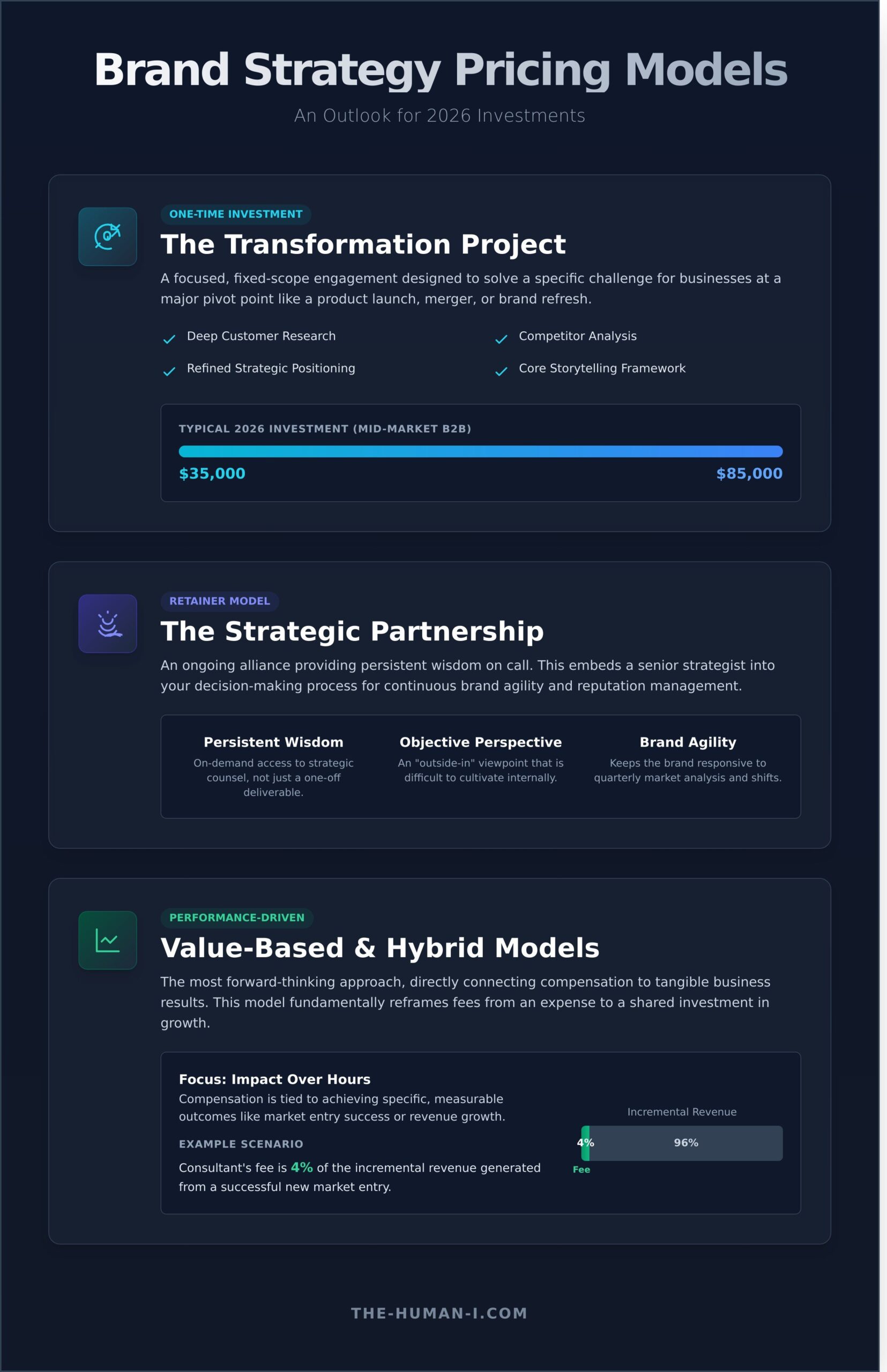
This is a focused, fixed-scope engagement designed to solve a specific challenge. It’s ideal for businesses at a major pivot point: preparing for a product launch, undergoing a merger, or refreshing a brand that has lost its edge. For a mid-market B2B company, a comprehensive brand evaluation and market segmentation project in 2026 typically ranges from $35,000 to $85,000. This investment should deliver more than a new logo; expect deep customer research, competitor analysis, a refined strategic position, and the core “storytelling” framework that will guide your marketing for the next 18-24 months.
The Strategic Partnership (Retainers)
A retainer model shifts the relationship from a one-time project to an ongoing strategic alliance. This is less about a single deliverable and more about having persistent wisdom on call. Instead of a brand strategy that gathers dust, ongoing reputation measurement and quarterly market analysis keep your brand agile and responsive. The primary benefit is embedding a senior strategist into your executive decision-making process, providing an objective, outside-in perspective that is nearly impossible to cultivate internally. This model grants direct access to a deep well of strategic Expertise, from insight to storytelling.
Value-Based and Hybrid Models
The most forward-thinking models directly connect a consultant’s compensation to the tangible business results they help create. Value-based pricing isn’t about hours; it’s about impact. For instance, a consultant’s fee might be 4% of the incremental revenue generated from a successful new market entry. This approach fundamentally reframes the discussion around what branding services cost by shifting the focus from consultant time to client value.
Hybrid models offer a powerful balance. They combine the stability of a modest monthly retainer (e.g., $7,500/month) with performance-driven incentives. These bonuses are tied to hitting specific, pre-agreed KPIs, such as a 15% increase in market share or a 5-point lift in Net Promoter Score (NPS) within 12 months. This structure de-risks the investment for you while powerfully motivating your consulting partner to drive for exceptional results. The structure of brand consulting fees should always reflect a partnership, not just a transaction. Choosing the right path forward starts with a meaningful conversation about your brand’s future.
The Invisible Drivers: What Actually Determines Your Consulting Fee?
A price tag on a brand consulting engagement isn’t arbitrary. It’s a direct reflection of the complexity, risk, and intellectual rigor required to solve your specific problem. The final number is shaped by powerful, often unseen, variables that separate a simple brand refresh from a foundational strategic shift. Understanding these drivers is the first step in assessing value. The entire process is a discipline; professional bodies like IMC USA even offer detailed guides on how to set your consulting fees to ensure the price aligns with the immense value delivered.
The depth of the final deliverable is a primary factor. Are you seeking a high-level, 20-page strategic narrative to align your leadership team? Or do you need a granular, 150-page implementation guide with message matrices for five distinct audience segments, channel-specific content pillars, and a full KPI framework? The former sets the vision; the latter provides the blueprint for execution. The latter requires hundreds of additional hours, which is reflected in the cost.
The Complexity of the Customer Journey
Mapping a customer journey isn’t a simple flowchart. It’s a deep, ethnographic exercise. A project that requires analyzing 25 “moments of truth” across a global, multi-language customer base will cost substantially more than one mapping 5 touchpoints in a single domestic market. The real value, however, comes from storytelling, translating thousands of data points into a clear, actionable narrative that empowers your team to make smarter decisions.
Industry-Specific Nuances
Your industry’s landscape profoundly impacts strategic costs. A B2B brand strategy in finance must navigate complex SEC and FINRA regulations, often requiring 40+ hours of legal and compliance review. In a high-stakes market like private wealth management, where a single reputational error can cost a firm 20% of its Assets Under Management, the senior talent required to provide sound strategic counsel commands a premium. This isn’t a place for junior teams; it requires a wealth of experience.
Ultimately, these drivers demonstrate that higher brand consulting fees are not about paying for time, but for outcomes. You are investing in a partner’s ability to navigate complexity, mitigate significant risk, and uncover the critical insights that will shape the future of your business. The more difficult the problem, the more valuable the solution.
Measuring the ROI: How a $50k Fee Saves a $5M Market Mistake
Viewing brand strategy as an expense is a fundamental error in judgment. It’s not a cost center; it’s a powerful form of risk mitigation. According to research from Harvard Business School professor Clayton Christensen, an estimated 95% of the 30,000 new consumer products launched each year fail. The “Cost of Error” for a single misaligned product launch can easily spiral into the millions, encompassing everything from R&D and manufacturing to a full-scale marketing blitz.
Consider a hypothetical $5 million market mistake:
- $1M in sunk R&D costs
- $1.5M in manufacturing and supply chain setup
- $2M in a launch marketing campaign
- $500k in personnel and operational overhead
Suddenly, the conversation around brand consulting fees shifts. A $50,000 investment in foundational strategy isn’t an expense; it’s an insurance policy against a catastrophic loss. It’s the critical process of asking the right questions before committing millions to the wrong answers.
The Strategic Guardrail
Deep strategic insight acts as a guardrail against costly assumptions. It prevents “creative for the sake of creative” by grounding every decision in validated human truth. A brand evaluation is a mandatory pre-investment step, using reputation measurement and sentiment analysis to identify and neutralize potential PR crises before they ever ignite, saving a company from the seven-figure clean-up costs that follow a public misstep.
This disciplined approach transforms brand from a subjective art into a quantifiable asset. While your company may not be Apple, Brand Finance’s 2023 valuation of its brand at $299.3 billion proves that brand equity is a tangible, powerful force on the balance sheet. Strategic consulting is the work that builds and protects that asset over the long term.
Efficiency Through Segmentation
The ROI becomes even clearer when you look at efficiency. Precise market segmentation offers a stark mathematical advantage. Instead of wasting 80% of your marketing budget speaking to the wrong people, data-driven audience identification focuses every dollar on prospects with the highest propensity to convert. This dramatically lowers Customer Acquisition Costs (CAC) and accelerates growth.
This efficiency extends directly to Customer Lifetime Value (CLV). A deep dive into customer experience (CX) mapping uncovers the specific friction points that cause churn. By systematically removing them, you improve retention. And as research from Bain & Company confirms, a mere 5% increase in customer retention can boost profitability by 25% to 95%. The initial investment in brand consulting fees pays dividends for years in the form of a loyal, high-value customer base.
Ultimately, ROI in a human-centric strategy is the financial return generated by understanding and meeting genuine human needs, which manifests as reduced waste and increased customer loyalty. This level of strategic clarity is what separates market leaders from market followers. Uncover the insights that will shape your brand’s future.
Navigating the Engagement: How to Budget for Strategic Transformation
A proposal is more than a price list; it’s a blueprint for your future. Budgeting for brand consulting isn’t about paying for a new logo or a catchy tagline. It’s an investment in strategic transformation. Before you ever ask for a quote, you must define what that transformation looks like. Without clear objectives, you’re just shopping for a service, not investing in a solution.
The most critical line item on any proposal is the Discovery Phase. This isn’t just administrative prep work; it’s the entire foundation. It’s where data, insight, and wisdom converge to diagnose the real challenges and uncover the most potent opportunities. Expect this phase to account for 25-40% of the total project cost. Any firm that skimps here is offering a cosmetic fix, not a strategic overhaul. They are treating the symptom, not the cause.
This is why low-cost proposals are often the most expensive mistake a company can make. Be wary of red flags that signal a superficial approach:
- The Instant Solution: A detailed creative plan delivered before they’ve spent a single hour understanding your business, your customers, or your competitive landscape.
- Vague Deliverables: A line item for “Brand Strategy” with no clear breakdown of the research, workshops, and analysis that inform it.
- The Bait-and-Switch Team: You are sold by a senior partner, but the work is executed by a junior team. A 2023 report from Forrester noted that strategic alignment fails in over 60% of projects where senior client stakeholders don’t have direct, consistent access to the consulting firm’s senior talent.
Defining Your Success Metrics
What does a “brand refresh” actually mean for your bottom line? Is it a 15% lift in customer lifetime value or a 20% reduction in sales cycle length? Ask a potential partner how they translate raw data into actionable wisdom. This process is central to how we work; you can see our philosophy in action to understand our approach. True partners help you define success before they ever discuss the scope of work.
Taking the First Step
Shifting from “looking” to “finding” the right partner requires a commitment to senior-to-senior alignment. Your leadership team must have a direct line to their senior strategists. This is where trust is built and real transformation is born. If you’re ready to move beyond evaluating generic brand consulting fees and start a meaningful conversation, we’re here to listen. Contact Human Instinct to discuss your brand’s next chapter.
Your Next Strategic Investment: Clarity
As we look toward 2026, the most effective leaders won’t see brand strategy as an expense. They’ll see it as a critical investment. Remember that the right partnership is about acquiring wisdom, not just renting time, and that a strategic investment of $50k is designed to prevent a $5M market mistake. Understanding the value drivers behind brand consulting fees is the first step toward securing your company’s future relevance and growth.
This is where our work begins. At Human Instinct, insight, data, and wisdom meet to solve complex challenges for leaders in Financial Services, Automotive, and Tech. Our senior-led teams bring decades of strategic storytelling experience to uncover the powerful truths that will connect your brand with its customers. Ready to find the insight your brand is missing? Let’s talk.
Your brand’s most powerful chapter is waiting to be written.
Frequently Asked Questions About Brand Consulting Fees
What is the average brand consulting fee for a mid-market company in 2026?
For a mid-market company in 2026, a comprehensive brand strategy project is projected to range from $45,000 to $90,000. This forecast, based on a 6% annual market adjustment from 2024 rates reported by the Society for Professional Consultants, reflects the growing need for specialized digital and CX integration. The final investment depends on the project’s scope, from a focused brand audit to a full-scale market repositioning initiative.
How does brand strategy pricing differ from a graphic design or logo fee?
Brand strategy pricing addresses the foundational ‘why’ of your business, while a logo fee covers the visual ‘what’. A logo design project might cost $5,000 to $15,000. In contrast, a brand strategy project costing upwards of $50,000 defines your market position, messaging, and customer personas. This makes the strategic work at least 3 to 5 times more comprehensive and crucial for sustainable, long-term growth.
Why do some brand consultants charge a monthly retainer?
A monthly retainer is for ongoing brand stewardship and implementation, moving beyond a single project. About 40% of top-tier consultancies, according to a 2023 AAAA survey, use this model for long-term partnerships. It facilitates continuous performance tracking, market analysis, and agile adjustments to strategy, ensuring the brand remains relevant and consistently executed across all channels month after month.
What should be included in a standard brand evaluation project fee?
A standard brand evaluation fee should cover at least four core deliverables: a competitive landscape analysis, a quantitative customer perception survey of at least 200 respondents, an internal brand culture audit, and a final insights report with actionable recommendations. This isn’t just a summary; it’s a strategic blueprint that details your brand’s current health and provides a clear path for differentiation and growth.
Is value-based pricing common in brand consulting?
Yes, value-based pricing is increasingly common, with an estimated 55% of boutique strategy firms now adopting this model over hourly rates. Instead of billing for time, the fee is tied directly to the projected business impact. For example, if a brand repositioning is projected to increase market share by 3%, the fee would be a pre-agreed fraction of that anticipated revenue gain, directly aligning the consultant’s success with the client’s.
How much does customer experience mapping typically cost?
A comprehensive customer experience (CX) mapping project typically costs between $20,000 and $60,000. The price depends on the number of customer personas being mapped (usually 3-5) and the quantity of touchpoints analyzed. A project at the higher end of that range would include qualitative interviews with at least 20 customers and detailed journey visualizations for both digital and physical interactions.
Does a higher fee always guarantee better strategic insight?
No, a higher fee doesn’t automatically guarantee superior insight, but it should correlate with deeper expertise and more robust resources. A premium fee, often 25-40% above the market average, typically provides access to a consultancy’s senior partners, proprietary research data, and a proven methodology. You should scrutinize the team’s track record and the project’s deliverables, not just the price tag, to ensure you’re investing in wisdom.
Can brand consulting fees be justified as a capital expenditure?
Yes, brand consulting fees can often be justified as a capital expenditure (CapEx) instead of an operating expense (OpEx). Under accounting standards like ASC 350, costs related to creating or significantly enhancing an intangible asset like a brand’s market position can be capitalized. This treats the investment as a long-term asset that provides value over several years, which more accurately reflects the impact of strategic brand work.



