


Your company is swimming in customer data, yet your market segments feel as generic as ever. You’re targeting the same broad industries as your competitors, and your messaging struggles to resonate because it’s designed to speak to everyone-and therefore, no one. This familiar challenge isn’t a lack of information; it’s the absence of wisdom to transform that data into a powerful, insight-driven b2b market segmentation strategy.
This guide is designed to move you beyond the limitations of traditional firmographics and toward a deeper understanding of your customers. We will provide a clear framework to uncover the nuanced needs, motivations, and buying behaviors that define your most valuable customer groups. You’ll gain the ability to shape a defensible go-to-market plan, craft messaging that truly connects, and allocate your resources with the confident precision required to drive meaningful growth in 2026 and beyond.
Key Takeaways
- Discover why traditional segmentation based on firmographics often leads to competing for the same accounts in overly saturated markets.
- Learn a modern framework that blends quantitative data with deep human insight to uncover your most valuable and underserved customer segments.
- Translate your findings into a powerful go-to-market plan by activating your new b2b market segmentation strategy across your entire commercial team.
- Understand that segmentation is an iterative process and identify the key metrics needed to measure its effectiveness and ensure sustained growth.
The Foundation: Understanding Core B2B Segmentation Models
At its core, B2B market segmentation is the strategic process of dividing complex business markets into distinct, measurable, and actionable groups. Its primary purpose is to empower businesses to move beyond generic outreach and instead shape highly relevant messaging, targeted product development, and precise sales efforts. By understanding the core principles of market segmentation, you can transform data into a clear map of your commercial landscape.
An effective b2b market segmentation strategy doesn’t rely on a single method. Instead, it begins by layering foundational models to build a multi-dimensional view of potential customers. These initial layers provide the essential context upon which deeper, more nuanced insights are built. Think of them not as the final answer, but as the critical starting point for uncovering high-value opportunities.
Firmographic Segmentation: The ‘Who’ and ‘Where’
Firmographics are the essential, quantifiable characteristics of a business, much like demographics are for individuals. This data typically includes:
- Company Size (employee count)
- Annual Revenue
- Industry (using SIC or NAICS codes)
- Geographic Location
This model is invaluable for defining your Total Addressable Market (TAM) and creating broad initial prospect lists. However, its primary limitation is its lack of depth; it tells you about the company, but reveals nothing about the decision-makers or their specific needs within it.
Technographic Segmentation: The ‘What They Use’
Technographic segmentation categorizes companies by the specific technology stack they employ, from their CRM and marketing automation platforms to their cloud infrastructure. For technology firms, this insight is a powerful qualifier. Knowing a prospect uses a complementary system can signal an integration opportunity, while identifying a competitor’s software can highlight a potential displacement target. The risk, however, lies in assumption; this data shows what they use, but not how well they use it or their satisfaction with it.
Beyond Data: Why Traditional Segmentation Strategies Fall Short
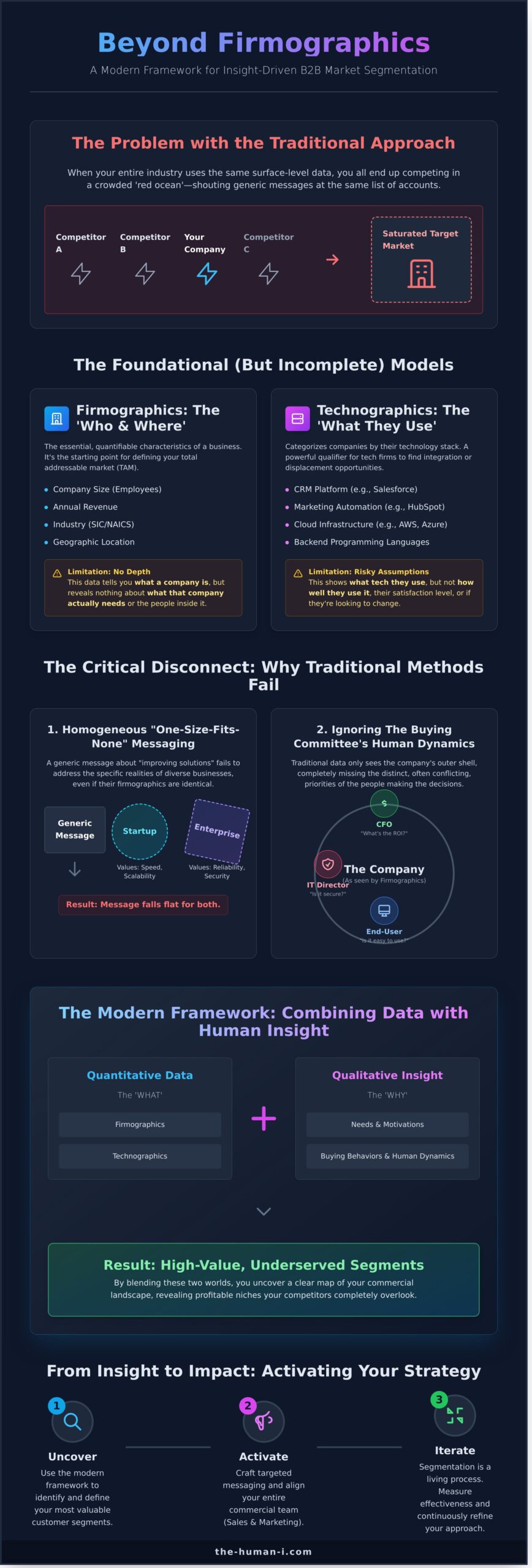
For decades, B2B marketers have relied on firmographics-industry, company size, revenue, location-as the bedrock of their segmentation. The logic seems sound: target companies that look like your best customers. But this raises a critical question: in a hyper-competitive market, is “good enough” truly sufficient? When your entire industry uses the same data to target the same list of accounts, you enter a crowded ‘red ocean’ where differentiation is nearly impossible. Everyone is shouting, but no one is being heard.
This data-centric approach creates a fundamental disconnect. It tells you what a company is but offers no insight into what that company needs. True strategic advantage is found by moving beyond surface-level data to uncover the unique challenges, motivations, and human dynamics that drive purchasing decisions.
The Problem of Homogeneous Messaging
Consider two companies in the software industry. One is a high-growth, venture-backed startup focused on rapid market penetration. The other is a stable, legacy enterprise prioritizing operational efficiency and security. While their firmographics are identical, their needs are worlds apart. The startup values speed and scalability, while the enterprise demands reliability and seamless integration with existing systems. A generic message about “improving software solutions” will resonate with neither, falling flat because it fails to address their specific operational realities.
Ignoring the Buying Committee’s Human Dynamics
Traditional segmentation also overlooks a crucial truth of B2B sales: companies don’t make decisions, people do. A modern b2b market segmentation strategy must account for the complex web of individuals involved in any significant purchase. The CFO is driven by ROI and total cost of ownership. The IT Director is concerned with security and implementation. The end-user department head is focused on features and usability. These stakeholders have distinct, often conflicting, priorities. To truly connect, you must understand the specific value each person seeks. As detailed in the Harvard Business Review’s framework on The B2B Elements of Value, these needs extend far beyond price and product features into areas like risk reduction, strategic impact, and individual career goals. Ignoring these human factors is like trying to solve a puzzle with half the pieces missing.
A Modern Framework: Combining Data with Human Insight
Static, one-dimensional segmentation no longer provides the competitive edge modern businesses require. The most effective approach is a dynamic, multi-layered framework where quantitative data provides structure and qualitative insight provides meaning. This is not about choosing one method over another; it is about layering them to build a complete, actionable picture of your market. An effective b2b market segmentation strategy moves beyond simple classification to uncover the deep-seated motivations driving purchase decisions. This strategic fusion of data and human understanding is central to our comprehensive solutions.
Layer 1: Start with Strategic Firmographics
The foundation of any robust model begins with firmographics, but with a strategic filter. Instead of targeting a broad industry like “Financial Services,” refine your focus based on your Ideal Customer Profile (ICP). This means zeroing in on specific sub-verticals (e.g., fintech payment processors), growth stages (e.g., Series B funding), or technology stacks. This initial step sharpens your focus, narrowing the field to the most relevant companies before you invest in deeper analysis.
Layer 2: Add Needs-Based & Psychographic Insights
This layer uncovers the “why” behind customer behavior. Needs-based segmentation groups customers by the specific challenges they are trying to solve or the jobs they need to get done. Layering on B2B psychographics helps you understand the buyer’s professional goals, perceived risks, and attitudes toward innovation. While many traditional B2B market segmentation models stop at the firmographic level, gathering this deeper data through interviews and surveys is what transforms a good strategy into a great one.
Layer 3: Incorporate Behavioral Data
The final layer provides proof of intent through action. Behavioral segmentation groups accounts and key contacts based on their direct interactions with your brand. This data is a powerful indicator of engagement and current priorities. Key examples include:
- Content consumption (e.g., downloading a specific whitepaper)
- Product or feature usage patterns in a trial
- Purchase history and customer service interactions
- Website engagement and webinar attendance
This data empowers you to prioritize segments that are actively demonstrating interest, ensuring your sales and marketing efforts are focused where they will have the greatest impact.
Activating Your Segments: From Insight to Go-to-Market Strategy
Rigorous analysis and insightful segmentation are foundational, but their true value is only realised through action. A B2B market segmentation strategy that remains a theoretical document is a missed opportunity. The critical next step is to embed these newfound customer truths across your entire go-to-market approach, transforming insight into tangible commercial results. This process ensures that every customer-facing function-from marketing to product to sales-is aligned and empowered.
Translating deep customer understanding into a cohesive, business-wide activation plan is part of our core expertise. It involves a deliberate, cross-functional effort to shape how you communicate, what you build, and how you sell.
Developing Value Propositions and Messaging
Your segments have distinct needs, priorities, and pain points. Your messaging must reflect this reality. For each high-priority segment, craft a unique value proposition that speaks directly to their world. Use this simple but powerful framework to guide your copy, content, and creative:
- For [Segment X: e.g., Mid-Market CFOs]
- who struggles with [Primary Pain: e.g., manual, error-prone financial reporting]
- our solution provides [Key Benefit: e.g., automated, real-time data consolidation that ensures compliance and frees up strategic resources].
Informing Product Development and Roadmaps
A powerful b2b market segmentation strategy uncovers the unmet needs and frustrations of your most valuable customer groups. This insight is gold for your product team. By understanding what your key segments truly require, you can prioritize your product roadmap to build features that deliver maximum impact. This transforms market research from a validation exercise into a source of sustainable competitive advantage, ensuring you build what matters most.
Empowering Sales with Targeted Enablement
Equip your sales team with the intelligence they need to win. Translate segment profiles into practical sales enablement tools like battle cards, targeted talking points, and persona-based discovery questions. When your sales professionals understand the specific business priorities, challenges, and language of each segment, they can build rapport faster and articulate value more persuasively. This focused approach shortens sales cycles and measurably improves win rates.
Measuring Success & Partnering for Strategic Insight
Implementing a new segmentation model is a significant achievement, but it’s the beginning of a journey, not the destination. An effective b2b market segmentation strategy is a living framework that must be measured, refined, and adapted over time. The market is dynamic; your customers evolve, and your strategy must evolve with them. Consistent evaluation ensures your efforts remain sharp, relevant, and drive sustainable growth.
Key Metrics for Evaluating Your Strategy
To transform your segmentation from a theoretical exercise into a powerful commercial tool, you must track its impact with precision. By monitoring key performance indicators (KPIs) for each segment, you can uncover which groups are most profitable and where to focus your resources. We recommend building a dedicated dashboard to monitor:
- Customer Acquisition Cost (CAC) per Segment: Are you efficiently acquiring high-value customers in your target segments?
- Lifetime Value (LTV) per Segment: Which segments deliver the most long-term value and loyalty?
- Lead-to-Opportunity Conversion Rates: How effectively is your messaging resonating with each segment?
- Sales Cycle Length by Segment: Are you closing deals faster with certain groups?
When to Seek an External Partner
While internal teams possess invaluable product and company knowledge, an external perspective can be the catalyst for true transformation. If you’re facing stagnant growth, considering entry into a new market, or simply lack the dedicated resources for deep analysis, it may be time to engage a specialist. An expert partner can challenge internal biases and uncover blind spots that are often invisible from the inside.
This is where data becomes wisdom. Our team of experts brings decades of cross-industry experience to help you not only gather the right data but also interpret its story. We empower you to refine your b2b market segmentation strategy with confidence and clarity.
Ready to uncover the deeper insights that will shape your company’s future? Contact us to discuss how we can elevate your strategy.
Beyond Segmentation: Uncovering the Wisdom in Your Market
As we look toward 2026, it’s clear that the old playbooks are no longer sufficient. True market leadership stems not from static firmographics but from a dynamic understanding of your customers’ motivations, challenges, and unarticulated needs. The most powerful b2b market segmentation strategy is one that fuses robust quantitative data with deep qualitative insight, transforming abstract customer groups into actionable, human-centric go-to-market plans.
Turning this framework into a competitive advantage requires a partner who sees beyond the spreadsheet. At Human Instinct, we specialize in the synthesis where insight, data, and wisdom meet. With proven success delivering transformative results for leaders in the Financial Services, Automotive, and Technology sectors, our expertise in brand evaluation and customer experience mapping helps uncover the powerful narratives that drive your market. Uncover the strategic narratives in your market. Partner with Human Instinct.
Your deepest customer insights are waiting to be discovered. The journey to finding them with clarity and confidence starts now.
Frequently Asked Questions
What are the 4 main types of B2B market segmentation?
The four primary types of B2B segmentation provide a framework for understanding your market. Firmographic segmentation classifies companies by attributes like industry, size, and revenue. Geographic segmentation groups them by location. Behavioral segmentation focuses on purchasing patterns and technology usage. Finally, needs-based segmentation groups customers by the specific challenges they face and the solutions they seek, offering the deepest level of insight for strategic messaging.
What is a practical example of a B2B segmentation strategy?
Consider a SaaS company that provides cybersecurity solutions. A practical strategy would be to segment the market not just by company size but by specific needs. One segment might be “Mid-sized financial firms in North America that are required to meet new data compliance regulations.” This combines firmographic (size, industry), geographic (location), and needs-based (compliance drivers) data to create a highly specific, actionable target audience for tailored marketing campaigns.
How is B2B market segmentation different from B2C?
The core difference lies in the customer and the buying process. B2C segmentation focuses on individual consumers, using demographics and psychographics to understand personal motivations. B2B segmentation targets entire organizations, relying on firmographics to understand company characteristics. B2B decisions are often made by a committee, driven by logic and ROI, and involve a much longer, more complex sales cycle than the typically faster, emotionally-driven purchases in B2C.
What are the key benefits of a well-defined B2B segmentation strategy?
A well-defined b2b market segmentation strategy empowers your organization to use resources with precision and impact. It enables highly personalized marketing and sales messaging that resonates with specific pain points, leading to higher conversion rates. Furthermore, it informs product development by aligning your roadmap with the needs of your most valuable customer segments. Ultimately, it fosters deeper customer relationships and drives more sustainable, profitable growth.
How often should you review and update your market segments?
We advise a comprehensive review of your market segments on an annual basis. However, markets are not static. It is wise to reassess your segments whenever a significant event occurs, such as a major shift in the competitive landscape, the launch of a new product line, or a change in overarching business strategy. Agility is key; outdated segments can lead to misaligned efforts and missed opportunities for growth and innovation.
What data is most important for creating effective B2B segments?
The most powerful segmentation emerges from a synthesis of quantitative and qualitative data. Start with firmographic data (company size, industry) and behavioral data (product usage, purchase history) to build a foundational structure. Then, enrich this with qualitative insights gathered from your sales team and direct customer interviews. This uncovers the crucial context-the “why” behind the “what”-revealing true customer needs, motivations, and purchasing drivers.



