


If your brand strategy feels like “coloring in” to your CFO, it’s not their lack of imagination that’s the problem; it’s your vocabulary. You’ve likely felt the sting of a boardroom presentation where your vision was dismissed as “fluff” because it didn’t immediately tie back to next month’s sales targets. The challenge of convincing leadership to invest in brand often fails because we talk about feelings while they talk about fiscal quarters. According to a 2023 study by the LinkedIn B2B Institute, 95% of B2B buyers aren’t in the market at any given time. This means that failing to invest in long-term brand health isn’t just a creative oversight; it’s a strategic risk to your future pipeline.
It’s time to stop defending brand and start proving it. You deserve a seat at the table where insight, data, and wisdom carry more weight than a slide deck of mood boards. This article provides a clear roadmap to translate your strategy into the precise language of leadership. We’ll explore specific ROI metrics, like the 20% lift in sales performance Nielsen attributed to brand awareness in 2021, to demonstrate how brand health links directly to market segmentation and growth. By the end, you’ll have the tools to build a case that even the most skeptical board member can’t ignore.
Key Takeaways
- Reframe brand spending from a line-item cost to a strategic asset by identifying the “marketing spend” traps that often trigger premature budget cuts.
- Master the language of leadership by connecting brand health to hard metrics like CAC, LTV, and the efficiency of a reduced “price premium.”
- Quantify the “Stagnation Tax” to expose the hidden financial risks of doing nothing, providing a high-stakes argument for convincing leadership to invest in brand.
- Follow a disciplined four-step framework to audit your current equity and pinpoint exactly where your narrative is failing to meet modern customer expectations.
- Move beyond raw data by leveraging strategic storytelling to turn cold evidence into a business case that feels both human and inevitable.
Why Leadership Resists Brand Spending (and How to Reframe It)
The friction between the marketing department and the C-suite is a tale as old as commerce. While you see a vital engine for growth, leadership often sees a black hole for cash. In many boardrooms, brand is relegated to the “discretionary” pile. When the 2023 Gartner CMO Spend Survey revealed that marketing budgets dropped to 9.1% of total revenue, brand awareness was frequently the first victim. This happens because we’ve allowed brand to be defined as a cost rather than capital.
Moving the needle requires a shift in language. You aren’t asking for a bigger megaphone; you’re building strategic infrastructure. Convincing leadership to invest in brand means proving that brand is the floor, not the ceiling. It’s the difference between buying a one-time lead and owning the market’s preference. At Human Instinct, we believe that when insight, data, and wisdom meet, the business case becomes undeniable.
The ‘Coloring In’ Misconception
CEOs often fear “creative” projects because they lack guardrails. They worry about subjective debates over hex codes while the sales pipeline stagnates. This “coloring in” myth persists because brand is too often presented as aesthetics rather than evidence. We need to move from “looking” for cool ideas to “finding” strategic truths. Success isn’t about a prettier logo; it’s about using insight to solve a specific business friction that 68% of customers cite as the reason they switch providers. It’s about strategy, not just sketches.
Brand as an Intangible Asset
Brand equity isn’t just a marketing metric; it’s a financial reality. Intangible assets now make up 90% of the S&P 500’s total value, according to the 2020 Ocean Tomo Intangible Asset Market Value Study. Brand is the container for all your future value. It’s what allows you to charge a premium and reduces your cost per acquisition over time. If your current identity feels stuck in the past, you can explore our solutions for refreshing stagnant brands. Convincing leadership to invest in brand becomes easier when you frame it as protecting the company’s long-term enterprise value.
The Language of Brand Investment ROI
Executive boards don’t buy into “vibes”. They buy into growth. When you’re convincing leadership to invest in brand, you have to pivot from aesthetic arguments to economic ones. Think of brand as the ultimate efficiency play. It’s the difference between pushing a product uphill and having the market pull it toward them. Brand equity acts as a lubricant for the entire business machine, reducing friction at every touchpoint.
Efficiency isn’t just a buzzword; it’s measurable. High-equity brands experience significantly less sales friction. When a prospect already knows and trusts you, the sales cycle shortens and conversion rates climb. Data from the Kantar BrandZ index shows that brand-led companies outperformed the S&P 500 by a staggering 74% between 2006 and 2018. That’s not a coincidence. It’s a direct result of mindshare preceding market share. In any competitive category, the brand that owns the most mental real estate eventually owns the most market share.
Hard Metrics for Soft Assets
To win over a CFO, focus on Customer Acquisition Cost (CAC). A 2021 study by Prophet found that strong brands enjoy a 31% lower CAC because their reputation does the heavy lifting before the first sales call is even made. This efficiency extends to the Lifetime Value (LTV) of a customer, as brand loyalty acts as a natural barrier to churn.
- Price Premium: Interbrand’s research highlights that companies with high brand clarity command a 20% price premium over unbranded alternatives. This is the financial delta between a commodity and a legacy.
- Long-term ROI: Investing in a cohesive brand strategy ensures that every dollar spent on marketing compounds over time rather than resetting every quarter.
- Reduced Sales Friction: Sales teams spend 40% less time “explaining who we are” when the brand has already established authority in the prospect’s mind.
The Talent and Culture ROI
Brand investment isn’t only an outward-facing strategy. It’s a powerful tool for internal operational efficiency. LinkedIn research confirms that companies with strong employer brands see a 50% reduction in cost per hire and a 28% drop in turnover rates. When people believe in the brand they work for, they’re more productive and stay longer.
Culture isn’t a “soft” HR initiative; it’s a driver of the bottom line. An aligned internal brand reduces the need for heavy-handed management and constant course correction. Our team brings a wealth of experience to help you align these internal values with external growth. By framing the conversation around these hard numbers, convincing leadership to invest in brand becomes a logical business decision rather than a creative request. Explore our solutions to see how we bridge the gap between culture and commercial success.
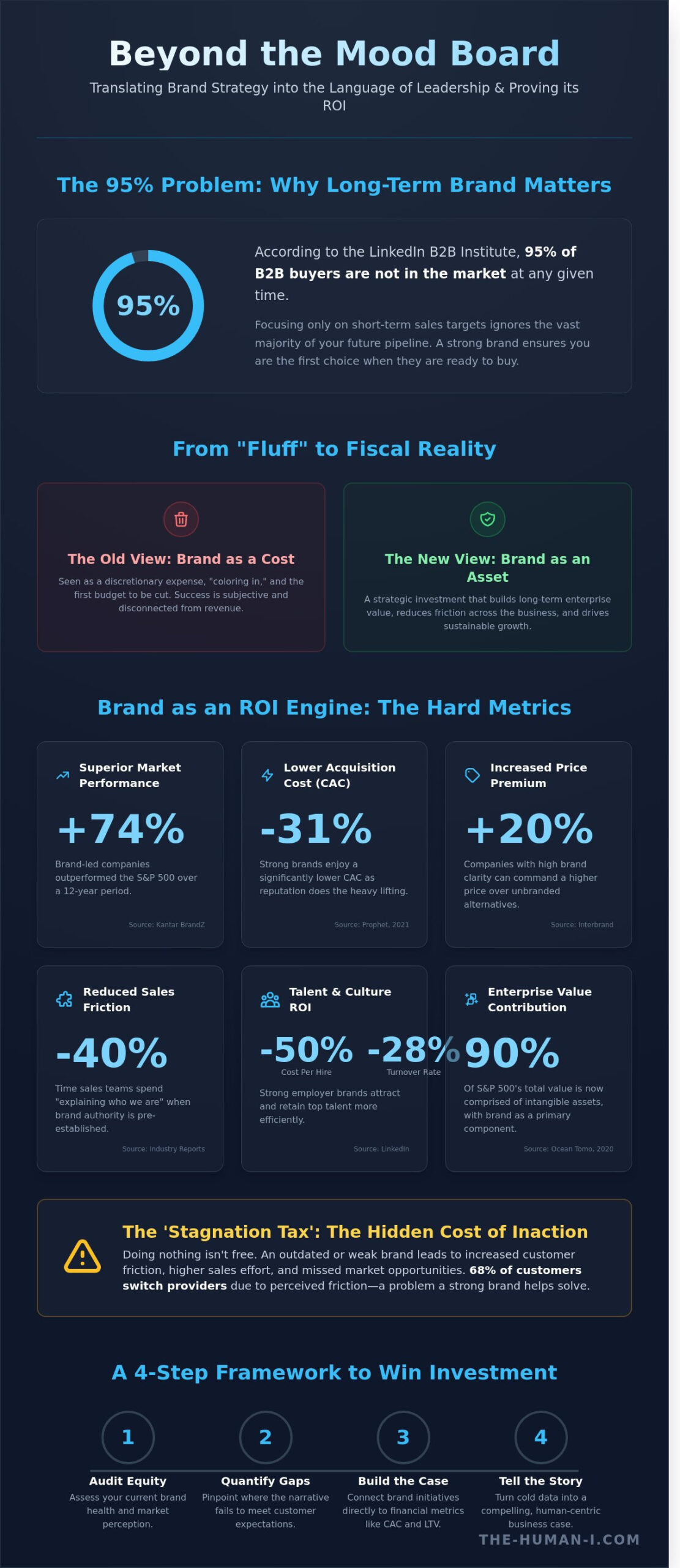
Identifying the ‘Stagnation Tax’: The Risk of Doing Nothing
Many boards view brand building as a discretionary expense, something to address only when the “real” work of sales and operations is finished. This mindset ignores the Stagnation Tax. This tax isn’t a line item on your P&L, but it’s real. It’s the quiet, compounding cost of a brand that has lost its pulse. It manifests as a 20% increase in customer acquisition costs or a 15% dip in lead conversion that leadership can’t quite explain. When you’re convincing leadership to invest in brand, you’re asking them to stop paying for a narrative that no longer connects with the market.
The danger of remaining “safe” is that you eventually become a legacy brand in a disruptor’s world. While you lean on your heritage, rivals are stealing market share by speaking to the current needs of your audience. Staying the course isn’t a neutral act; it’s a strategic retreat. Every month you spend with an outdated narrative is a month you hand over your competitive edge to more agile, insight-driven challengers.
The Cost of Inaction
In high-velocity sectors like Fintech or Enterprise SaaS, “wait and see” is a high-risk gamble. A 2023 study by Bain & Company found that incumbent firms are losing up to 35% of new revenue to challenger brands that lead with a clear, human-centric purpose. Doing nothing isn’t a safe harbor. It’s a choice to remain static while the world moves on. If your brand narrative hasn’t evolved significantly since 2021, you’re likely invisible to the newest generation of buyers who prioritize experience and digital relevance over historical longevity.
Spotting a Stagnant Narrative
A brand narrative doesn’t die overnight; it slowly loses its human connection. You can spot the decline through three specific indicators:
- The Jargon Trap: Your messaging is cluttered with technical specs and industry buzzwords that obscure the actual human benefit of your service.
- The Value Gap: Your sales team relies heavily on discounts and price-cutting because the brand story no longer carries enough weight to support a premium.
- The Experience Disconnect: Your customer experience mapping reveals friction points that your brand promise simply ignores, leading to a fragmented user journey.
Diagnosing these gaps requires the kind of strategic expertise that looks beyond the surface. Without a deep dive into the data and wisdom of your audience, you risk becoming an artifact. Convincing leadership to invest in brand today is the only way to ensure you aren’t paying the Stagnation Tax for years to come.
4 Steps to Convincing Leadership to Invest in Brand
Winning over the C-suite requires a shift from aesthetic arguments to economic ones. When you’re convincing leadership to invest in brand, you aren’t asking for a bigger budget for visuals; you’re proposing a more efficient engine for growth. A 2023 McKinsey report found that companies with strong brand clarity deliver 2.5x higher total returns to shareholders compared to their competitors. Moving the needle starts with a structured, four-phase approach that prioritizes data over decoration.
- Phase 1: Audit and Evidence. Start with a “Brand Evaluation” to strip away subjectivity and reveal the cold, hard facts of your market position.
- Phase 2: The Gap Analysis. Pinpoint exactly where your current identity creates friction in the customer journey or leads to lost leads.
- Phase 3: The Growth Roadmap. Link brand pillars to specific revenue targets and B2B market segmentation strategies.
- Phase 4: The Pilot Program. Launch a targeted 90-day test to prove ROI in a controlled environment before committing to a global rollout.
Start with Brand Evaluation
Evaluation starts with a diagnostic mindset. An objective audit is a much easier sell than a creative overhaul because it relies on data rather than gut feeling. Use heatmaps, customer sentiment scores, and competitor benchmarking to remove personal bias from the room. Framing this as a diagnostic tool makes it feel like a necessary business check-up. You aren’t being critical of the past; you’re identifying the 15% of brand touchpoints that are currently leaking potential revenue and hindering performance.
Connecting to Market Segmentation
Strategy bridges the gap between identity and the ideal buyer. Brand investment is the key that unlocks sophisticated B2B market segmentation. It’s the vital link between “who we are” and “who we serve.” To map this out, identify three core brand pillars. If your pillar is “Radical Transparency,” map that directly to the “Skeptical Buyer” segment who values detailed technical documentation. This logic proves that branding isn’t just about looking good. It’s about being relevant to the people who sign the checks. By convincing leadership to invest in brand through this lens, you show them a direct path to increased market share.
Phase 4 reduces the perceived risk of a full rebrand. Propose a pilot program in a single territory or product line. This 12-week experiment allows the team to gather real-world data on conversion lifts and engagement. It’s a low-stakes way to demonstrate that strategic brand shifts lead to tangible financial gains, making the case for a full-scale investment undeniable.
Moving from Data to Wisdom: The Human Instinct Edge
Data is a comfort blanket for the risk-averse. While spreadsheets provide a sense of security, they rarely spark the conviction needed for a total brand pivot. A 2023 study by McKinsey found that while 85% of CEOs believe brand is critical, only 40% feel their marketing data actually proves its value. This disconnect is where most strategies fail. Convincing leadership to invest in brand isn’t about buried rows in a CSV file; it’s about shifting from looking at numbers to finding a narrative that feels inevitable.
Storytelling is the bridge between a budget line item and a strategic imperative. When you frame a brand refresh as a solution to a specific market friction, the investment stops looking like a cost and starts looking like a necessity. It’s about moving beyond what you look for and focusing on what you find. Effective storytelling takes the “what” of your data and explains the “why” of your future growth, making the business case impossible to ignore.
Insight, Data, and Wisdom
Human Instinct operates at the intersection of three specific pillars: insight, data, and wisdom. This combination creates a bulletproof case for investment by addressing both the logic of the CFO and the intuition of the CEO. We don’t just hand over a report; we provide a roadmap for refreshing ailing or stagnant brands. Our approach ensures your brand strategy is grounded in reality but aimed at transformation. You can learn more about our team and how we blend these disciplines to uncover hidden opportunities that others miss.
- Data: The empirical foundation that validates the market reality.
- Insight: The identification of patterns and human behaviors that drive choice.
- Wisdom: The strategic experience required to turn those patterns into a competitive advantage.
Your Next Step
Convincing leadership to invest in brand shouldn’t feel like an uphill battle. It’s time to stop looking for answers and start finding them. We offer a low-stakes initial brand audit to identify where your current identity is leaking value or failing to connect with new audiences. Whether you’re refreshing a legacy brand or launching a new venture, the time to act is before the market forces your hand. Stagnancy is the only true risk in a shifting economy. Contact Human Instinct to begin your evaluation and turn your brand into your most resilient asset.
Move Beyond the Spreadsheet to Strategic Growth
Building a case for brand isn’t about chasing vanity metrics; it’s about securing future cash flows. You’ve seen how the stagnation tax erodes market share when competitors evolve while your business stays still. By translating brand health into the language of ROI and using a structured framework, convincing leadership to invest in brand becomes a strategic conversation rather than a budget plea. In sectors like Financial Services and Automotive, brand equity often accounts for more than 30% of total enterprise value, making it a financial risk too large to ignore.
Human Instinct provides a wealth of experience across Insight, Strategy, and Storytelling to help you bridge the gap between raw data and actionable wisdom. Our data-driven brand evaluations remove the guesswork that often stalls executive decisions. We’ve established a track record of success across Tech and Automotive industries by turning complex analytics into compelling narratives. It’s time to stop looking for answers and start finding them.
Ready to refresh your stagnant brand? Contact Human Instinct today.
The path from a spreadsheet to a powerful market presence is clearer than you think. You have the tools and the insight to lead this transformation with confidence.
Frequently Asked Questions
Is brand investment considered a capital expenditure or an operating expense?
Accountants usually classify brand work as an operating expense (OpEx) because it’s difficult to value as a physical asset. Under IAS 38, some development costs can be capitalized if they meet specific criteria. It’s a strategic choice. This decision impacts your EBITDA, so it’s vital to consult your finance team before the project begins.
How much should a company typically invest in brand strategy?
Allocate 1% to 2% of your total annual revenue specifically for brand strategy and identity development. Gartner’s 2023 data shows marketing budgets average 9.1% of revenue. Brand strategy should claim a significant portion of that investment. It’s about finding the right audience. If you’re entering a new market, that figure often hits 5% to establish a presence.
Can you measure the ROI of a brand refresh in under six months?
You can’t measure full ROI in six months because brand building is a marathon. Research by Les Binet and Peter Field shows that while sales tactics work quickly, brand building takes 6 to 24 months to drive profit. You might see a 12% lift in search volume early on. Be patient. The true financial payoff requires consistent data tracking over several quarters.
What happens if leadership agrees to the visual identity but not the strategy?
Adopting new visuals without a strategy creates a hollow shell that eventually confuses your audience. A 2022 study by Lucidpress revealed that inconsistent brand delivery can slash revenue by 33% over time. Without a strategic foundation, your logo is just a decorative cost. This disconnect is often the biggest hurdle when convincing leadership to invest in brand as a growth engine.
How do I involve the CFO in the brand strategy process early on?
Bring the CFO in by presenting brand as a tool to lower the cost of capital and increase Customer Lifetime Value. Use data from the 2023 BrandZ report to show how strong brands recover from market crashes 40% faster than weaker competitors. This evidence is vital. It’s the most effective way of convincing leadership to invest in brand as a long term risk mitigation strategy.
What is the difference between brand investment and marketing spend?
Brand investment builds the mental shortcuts that make people choose you, while marketing spend triggers the immediate transaction. Think of brand as the 95% of your audience not currently buying, based on Ehrenberg-Bass Institute research. Marketing spend focuses on the 5% who are ready to purchase today. One creates demand. The other harvests it.



