


What if your expensive real-time dashboard is actually blinding you to the truth? Most marketing leaders spend roughly 15 hours every month staring at colorful charts that offer plenty of “what” but zero “why.” When weighing brand health tracking software vs service, it’s easy to get seduced by the sleek interface of a SaaS platform. However, a 2023 industry report found that 62% of CMOs feel paralyzed by data that lacks actionable context. You don’t need more metrics to manage; you need the wisdom to interpret them.
You’ve likely felt that nagging disconnect when your brand awareness scores climb while your actual market share remains stagnant. It’s an exhausting cycle of dashboard fatigue that leaves you unable to link brand health to the bottom line. This article provides a clear roadmap to help you decide whether a DIY tool or a strategic partner is the right engine for your brand’s next evolution. We’ll explore how to shift from merely monitoring change to understanding exactly why it matters for your 2025 growth strategy.
Key Takeaways
- Identify the “dashboard trap” where passive monitoring masquerades as strategy, and learn to distinguish surface-level metrics from profound brand insights.
- Navigate the brand health tracking software vs service trade-off to decide if your brand needs the agile speed of a DIY tool or the deep wisdom of a strategic partner.
- Audit your internal team’s capability to determine if you have the storytelling talent required to turn a “black box” of data into a clear roadmap for growth.
- Discover how to move beyond the “what” of real-time sentiment shifts to uncover the underlying “why” that refreshes stagnant brands.
- Learn why the most successful brands prioritize finding what is important over simply looking for data, turning raw information into actionable wisdom.
The Dashboard Dilemma: Why Tracking Software Isn’t Always the Answer
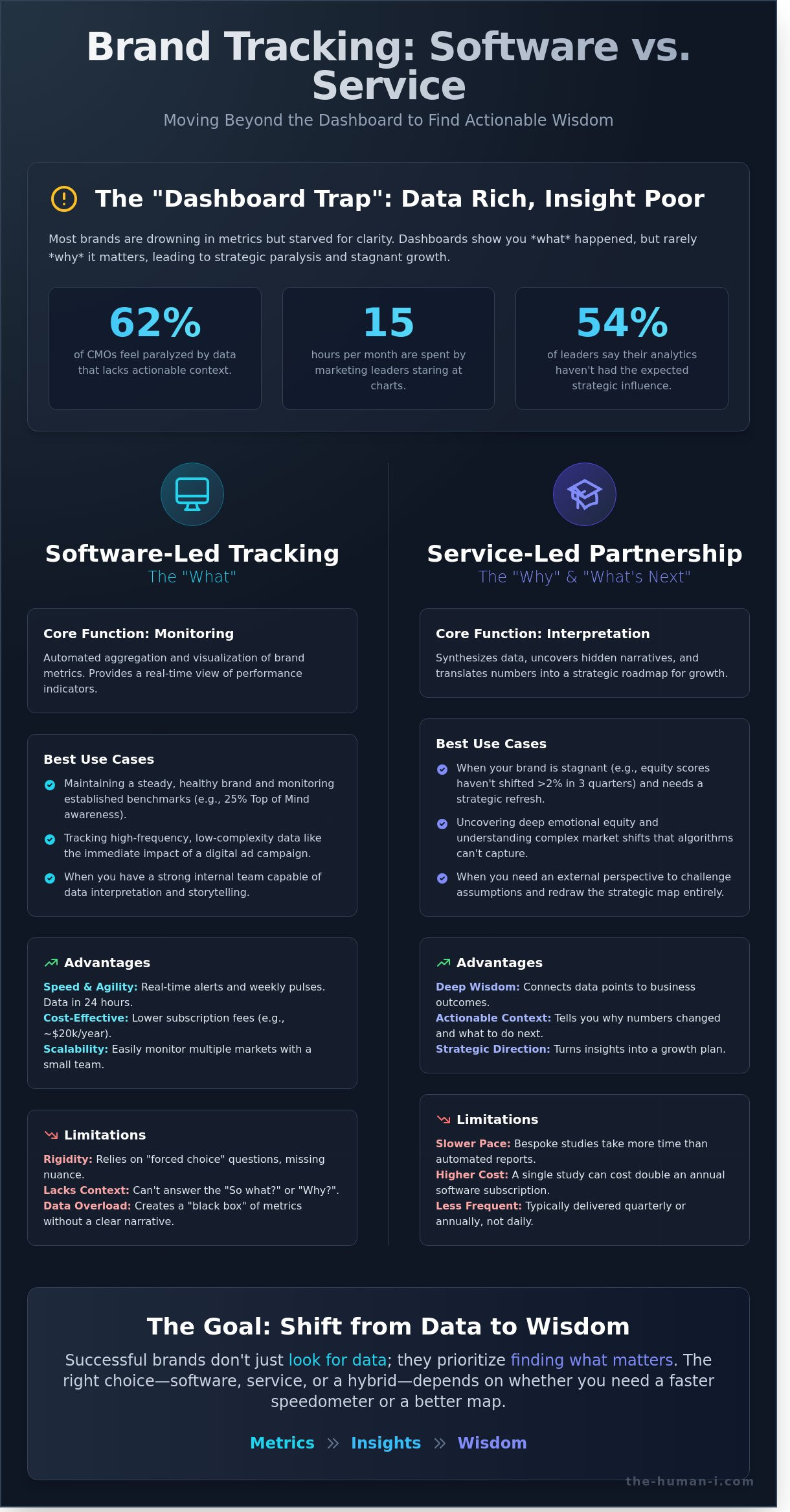
Most brand managers feel a momentary sense of relief when they log into a sleek, colorful user interface. It’s a trap. This “passive monitoring” creates a comfortable rhythm that often leads to brand stagnation. You’re watching the dial, but the car isn’t moving. The fundamental tension in the brand health tracking software vs service debate lies in the difference between activity and progress. Tracking metrics is a clerical task; uncovering profound brand insights is a creative one.
A 2023 Gartner survey revealed that 54% of senior marketing leaders believe their data analytics haven’t had the influence they expected on strategic decisions. This gap exists because software is designed to look for data, not to find what matters. As Ferran Adria famously suggested, the importance lies in the discovery, not the search. Ailing brands don’t need a faster real-time data feed. They need to understand why their 12 month growth trajectory has flatlined despite “green” indicators on their screen.
- Metrics tell you what happened yesterday.
- Insights tell you how to change tomorrow.
- Wisdom tells you which data points to ignore entirely.
The Illusion of Control in DIY Platforms
Software provides a false sense of strategic security. It’s easy to mistake a high “share of voice” score for actual market influence. Without a guiding narrative, you’re left with data overload. These platforms are built to aggregate, not to synthesize. They rarely answer the “So what?” question that determines your next $1 million investment. You’re left with a 24/7 view of the symptoms while the underlying brand disease goes untreated.
When Stagnation Requires a Strategic Refresh
If your brand equity scores haven’t shifted more than 2% in the last three quarters, your tracking tool is failing you. It has become background noise. Identifying new audiences requires more than just an algorithm; it requires strategic insight that challenges your existing assumptions. External expertise acts as the antidote to stagnant thinking. A fresh perspective doesn’t just look at the same dashboard; it redraws the map entirely to find the “why” behind the numbers.
Software-Led Tracking: Efficiency, Speed, and the Agile Advantage
Software is the high-performance engine of the modern marketing department. It offers a level of relentless consistency that humans often struggle to maintain. When weighing brand health tracking software vs service, the software side wins on pure velocity. You get data delivered to a dashboard within 24 hours of a survey launch. It’s cost-effective; a standard SaaS subscription might cost $20,000 a year, while a bespoke consultancy study could easily double that for a single report.
The agile paradigm has shifted focus from bloated annual trackers to lean, weekly pulses. Since 2022, roughly 68% of CMOs have prioritized faster feedback loops over exhaustive detail. Software facilitates this through standardized templates and automated distribution. These tools provide real-time alerts. If your brand sentiment dips by 4% on a Tuesday morning, you’ll see the notification by lunch. This scalability allows a single brand manager to monitor performance across 15 different global markets without the overhead of a massive consulting team.
The Best Use Cases for Software
Establishing a steady heartbeat is where automation shines. If your brand is established and healthy, you likely only need to ensure your “Top of Mind” awareness remains at its 25% benchmark. Automation is perfect for this type of maintenance. It’s also the right choice for monitoring the immediate “echo” of a specific digital ad campaign. You can see the needle move in real time, managing high-frequency, low-complexity data points that don’t require deep interpretation.
Where Software Reaches Its Limits
The trade-off for speed is often rigidity. Most platforms rely on “forced choice” questions that don’t allow for nuance or surprise. They struggle to capture the “why” behind the “what.” A dashboard might show a 12% increase in brand favorability, but it won’t tell you if that’s due to your new sustainability initiative or a competitor’s supply chain failure. Deep emotional equity is messy; it’s rarely captured in a standardized drop-down menu. Choosing between brand health tracking software vs service requires understanding that automation cannot replace the 25 years of senior strategic experience required to turn a data point into a business pivot. To see how we combine these tools with deeper thinking, explore our solutions for a more nuanced perspective.
Brand Tracking Services: Where Data Meets Wisdom
Software tells you that 42% of your target audience recognizes your logo. A service tells you that half of them associate it with a legacy you’ve already outgrown. This distinction defines the brand health tracking software vs service choice. Software captures the “what,” but a service uncovers the “why.” At Human Instinct, we believe data is the raw material, while wisdom is the finished product. We blend analytical precision with human intuition to help brands make decisions that stick.
Uncovering the Narratives That Drive Engagement
Standardized surveys usually miss the emotional friction that drives or kills a sale. Real evaluation requires looking beyond the spreadsheet to find the human story. Our work focuses on our solutions for refreshing brand narratives that have lost their spark. We pinpoint the specific moments in a customer journey where software fails to capture nuances. For instance, a 12% dip in brand favorability might stem from a subtle tonal shift in your customer service that an algorithm simply cannot categorize. We identify these fractures before they become structural breaks.
Customization is the heartbeat of this process. We don’t believe in the “one size fits all” model that 85% of software platforms rely on. Instead, we tailor our evaluation to your specific sector. Whether you are navigating the complexities of high-end retail or the fast-paced world of tech, we adjust the lens to focus on the metrics that actually drive your bottom line.
Strategic Partnership vs. Vendor Relationship
A vendor provides a tool. A partner provides a direction. We prioritize listening before we offer a single recommendation. This human element is what turns a mountain of raw data into a three year roadmap for growth. We find that the brand health tracking software vs service debate often ends when a client realizes they don’t need more charts; they need more clarity.
Recent industry reports show that 64% of marketing leaders feel overwhelmed by the volume of data they receive from automated platforms. We solve this by filtering the noise. We don’t just deliver findings; we provide the strategic clarity to help you find what truly matters. By transforming raw numbers into actionable storytelling, we empower your team to act with confidence rather than hesitation.
- Insight: Moving beyond the surface to find the core truth of your brand.
- Data: Using rigorous metrics as the foundation for every strategy.
- Wisdom: Applying years of expertise to make data work for your future.
Software vs. Service: A Framework for Decision Makers
Choosing between brand health tracking software vs service isn’t a binary choice about technology. It’s a strategic decision about your brand’s future. A 2023 Gartner study revealed that 60% of marketing data goes unused because teams lack the time or talent to interpret it. Before signing a SaaS contract, ask if you’re buying a tool or a solution. Data is abundant, but wisdom is rare.
- Internal Capability: Do you have a strategist who can turn a 2% dip in brand equity into an actionable pivot? If your team is already at capacity, a new dashboard is just another chore.
- Market Nuance: If you operate in a specialized niche, off-the-shelf algorithms often miss the subtle cultural context that drives 80% of consumer behavior.
- Timing: A “business as usual” year might survive on automated pings. A year involving a major refresh or a $500,000 product launch demands the depth only a service provides.
Assessing Your Internal Insight Maturity
Your team’s maturity level dictates your needs. If your analysts are already drowning in dashboards, adding another login won’t help. You need to decide if you want a platform to manage or a deep dive into expertise that delivers answers. Many high-performing brands now adopt a hybrid model. They use software for daily pulse checks but hire specialists for quarterly strategic deep dives. This ensures data never exists in a vacuum. It turns numbers into a narrative.
Calculating the Real ROI of Brand Health Tracking
Cheap data often becomes the most expensive mistake a CMO can make. A $10,000 DIY survey might seem like a bargain. However, if it misses a shift in market segmentation, it can lead to $100,000 in misallocated ad spend. Professional brand evaluation justifies its cost by identifying the specific 15% of your audience that generates the majority of your profit. Wisdom is about finding what matters, not just looking at what’s easy to measure. We help you find the signals in the noise through our bespoke brand health solutions.
Human Instinct: Moving Beyond the Black Box
Software is a mirror. It shows you what is there, but it rarely explains why the reflection looks tired or how to fix it. At Human Instinct, we provide the insight that refreshes ailing or stagnant brands by looking past the automated dashboard. We believe the real value isn’t in the data itself, but in the wisdom extracted from it. Our senior team brings over 20 years of experience in brand planning and storytelling to ensure you aren’t just staring at a screen of metrics.
We follow a simple but profound rule: it’s not what you look for that’s important, it’s what you find. While most tools are programmed to look for specific, pre-defined KPIs, our consultants uncover the hidden patterns that software misses. When weighing brand health tracking software vs service, remember that software is a commodity. Wisdom is a competitive advantage. We transform data collection into brand transformation by identifying new audiences and defining clear, actionable strategies.
A Holistic Approach to Brand Evaluation
We don’t view brand health through a single lens. Our approach integrates market segmentation, CX mapping, and reputation measurement to create a 360-degree view of your market position. This methodology empowers brands to stop reacting to the market and start shaping their own future narratives. By applying 15 years of cross-industry expertise, we help you understand the “why” behind consumer behavior. Learn more about our philosophy of data and wisdom to see how we bridge the gap between numbers and strategy.
Ready to Refresh Your Brand?
Stagnation is the greatest risk to any modern brand. Analysis shows that brands failing to evolve lose up to 20% of their market share to more agile competitors within a three-year window. Now is the time to move beyond superficial tracking and invest in deep, strategic clarity. If you’re ready to stop monitoring your brand’s decline and start engineering its growth, start a conversation with a Human Instinct consultant. Don’t just track your health; build your future.
Move Beyond the Dashboard to Real Brand Clarity
Dashboards deliver metrics by the minute, but they rarely explain why your brand equity shifted 4% during a critical campaign. The choice between brand health tracking software vs service isn’t just a budget line item; it’s a strategic decision about whether you want an automated readout or a nuanced roadmap. While software offers 100% efficiency for tracking daily fluctuations, it often leaves you staring at a black box when you need deep, actionable answers.
Human Instinct bridges this gap by ensuring insight, data, and wisdom meet in every report. Our senior talent brings 20 years of leadership experience to the table, delivering 30+ case studies that range from complex Financial Services to fast-moving Health & Beauty brands. We don’t just look for data; we find the specific 12% growth opportunity hidden behind the noise. It’s time to stop scrolling through charts and start shaping your brand’s future with clarity and confidence.
Refresh your brand with Human Instinct
Your brand’s next chapter starts with a sharper perspective.
Frequently Asked Questions
Is brand health tracking software enough for a small business?
Software alone often leaves small businesses with a pile of metrics but no map. While a dashboard shows your Net Promoter Score is 40, it won’t explain why your churn increased by 12 percent last quarter. Small businesses with a documented strategy are 30 percent more likely to see growth according to a 2023 BDC study. You need the wisdom to turn those numbers into a narrative that actually changes your bottom line.
What is the main difference between a brand tracking tool and a service?
The core of the brand health tracking software vs service debate is the gap between data and insight. A tool is a thermometer that tells you the temperature. A service is a doctor who diagnoses why you have a fever. Services provide the human intelligence required to spot patterns that algorithms miss, such as a subtle shift in 2024 consumer sentiment that requires a strategic pivot.
How often should a brand undergo a full health evaluation?
You should monitor key metrics monthly, but a full health evaluation belongs on your annual calendar. Research from the 2023 Brand Finance report suggests 68 percent of market leaders perform a deep dive audit every 12 months. This cadence ensures your strategy stays fresh without getting lost in the noise of weekly fluctuations. It’s about finding the long term truth rather than reacting to temporary blips.
Can a brand tracking service help with new product development?
Services uncover the unmet needs that spark successful innovation by looking beyond the surface. Since 75 percent of new consumer products fail within their first year according to Nielsen data, having a strategic partner to test concepts against current brand perception is vital. They help you find the white space in the market that a standard software dashboard would likely overlook during the research phase.
Does software-led tracking provide competitive benchmarking?
Software provides the what of your competitors, like a 15 percent increase in social mentions, but it fails to explain the how. A service goes deeper by analyzing the emotional resonance of a competitor’s 2024 campaign. This helps you differentiate your own brand’s voice and positioning. Relying solely on software for your brand health tracking software vs service choice means you might miss the strategic intent behind a rival’s moves.
Why is storytelling important in brand health tracking?
Storytelling transforms dry statistics into a compelling strategy that your entire team can follow. Data tells you that 45 percent of customers are indifferent, but storytelling explains the specific customer journey that led them there. It’s the bridge between a spreadsheet and a solution. This approach refreshes stagnant brands by making the data human and actionable for stakeholders who need to see the bigger picture.
What should I look for in a brand strategy consulting firm?
Look for a firm that prioritizes wisdom over raw data and employs a senior team with at least 15 years of experience. You want a partner who understands the disciplines of insight, strategy, and storytelling. They shouldn’t just look for data; they should find the hidden truths that empower your brand to grow. Ensure they have a proven track record of transforming stagnant brands into market leaders through precise, intellectual rigor.



