


Ninety-five percent of the 30,000 new consumer products launched every year fail to reach their targets, according to research by Harvard Business School professor Clayton Christensen. It’s a staggering figure that proves a generic go-to-market strategy for new products isn’t just risky; it’s often a recipe for invisibility. You’ve likely felt the frustration of following a standard template only to realize it lacks the soul and precision your specific brand requires to cut through the noise.
We agree that the industry’s obsession with generic checklists has created a culture of misalignment and stagnant brand perception. This guide promises to change that by showing you how to build a strategy rooted in deep human insight, rigorous data, and hard-won wisdom. You’ll gain a clear, actionable framework for your next launch that replaces guesswork with confidence. We’re going to explore how to refine your target segmentation and craft a narrative that sparks immediate engagement from the moment you hit the market.
Key Takeaways
- Bridge the gap between product development and market momentum by moving beyond generic checklists toward an insight-driven approach.
- Build a go-to-market strategy for new products that uses storytelling to transform cold data into a narrative that creates real engagement.
- Map the “moments of truth” in the human journey to identify exactly where a launch secures its foothold or loses its way.
- Use a strategic “soft launch” to gather reputation data, ensuring your full market entry is fueled by momentum rather than guesswork.
- Discover why combining deep expertise with data-driven wisdom allows you to find unique market opportunities that generic templates miss.
Beyond the Checklist: Why Insight Defines GTM Success
Product development is often a vacuum. You build, you polish, and then you hit a wall. A robust go-to-market strategy for new products isn’t just a launch plan; it’s a blueprint for relevance. It acts as the bridge that carries your innovation from the lab into the hands of someone who actually needs it. It’s the difference between a product that merely exists and one that moves.
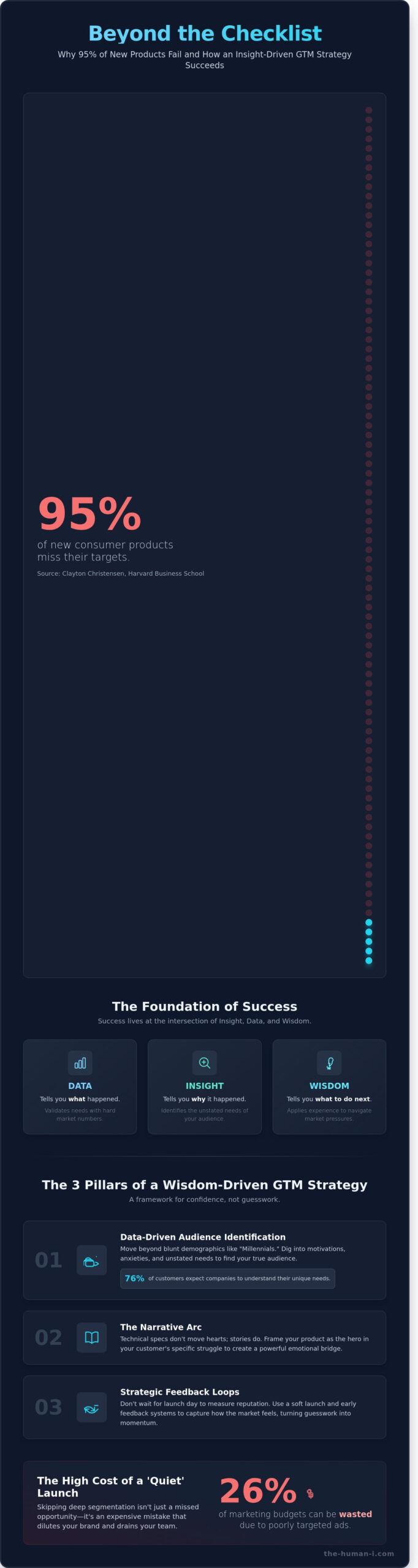
Many teams fall into the checklist trap. They focus on the mechanics without ever truly grasping the “who” or the “why.” Harvard Business School professor Clayton Christensen noted that 95% of the 30,000 new products launched every year fail. This isn’t usually due to bad engineering. It’s because of a lack of deep market wisdom. Success lives at the intersection of insight, data, and wisdom. Data tells you what happened; insight tells you why; wisdom tells you what to do next. A go-to-market strategy built on these pillars ensures you aren’t just shouting into the void.
GTM vs. Marketing Strategy: The Vital Distinction
Marketing is the ongoing heartbeat of a brand. It’s a marathon. In contrast, a go-to-market strategy for new products is a tactical event horizon. It’s a focused strike designed to break through market inertia. You might need a GTM moment when launching a fresh tool or when you need to refresh a stagnant brand. It’s about creating momentum where none existed before, focusing resources on a specific window of opportunity.
The Cost of a ‘Quiet’ Launch
A quiet launch is an expensive one. When you skip deep segmentation, you don’t just lose money; you dilute your brand. Research indicates that poorly targeted digital ads can waste up to 26% of marketing budgets. Beyond the balance sheet, a failed launch drains your internal teams. It erodes the belief that their work matters. You shouldn’t just look for customers. You must find the right ones. As Ferran Adria famously said, it’s not what you look for that’s important, but what you find. Real GTM success is about that discovery.
- Insight: Identifying the unstated needs of your target audience.
- Data: Validating those needs with hard market numbers.
- Wisdom: Applying experience to navigate competitive pressures.
The 3 Pillars of a Wisdom-Driven GTM Strategy
A successful launch isn’t a lucky strike. It’s the result of a deliberate architecture where insight, data, and wisdom meet. To build a go-to-market strategy for new products that actually sticks, you need more than a checklist. You need a foundation that allows you to act with quiet confidence rather than frantic energy.
- Data-Driven Audience Identification: We look past the surface. While others stop at age and income, we dig into the motivations and anxieties that drive real human behavior.
- The Narrative Arc: Every product needs a soul. Using storytelling creates an emotional bridge between a technical solution and a human need.
- Feedback Loops: Reputation measurement starts on day one. We establish systems to capture how the market feels about your brand before the first sale is even closed.
These pillars empower businesses to move away from reactive marketing. When you understand the “why” behind the “who,” your strategy becomes a roadmap rather than a guessing game.
Finding the ‘Who’ Through Market Segmentation
Broad categories like “Millennials” or “Decision Makers” are too blunt for a sophisticated go-to-market strategy for new products. Wisdom requires looking at behavioral human segments. We use market segmentation services to uncover the hidden opportunities that competitors miss. This is where the Ferran Adria principle comes into play: “With creativity, it’s not what you look for that’s important but what you find.”
In 2023, data showed that 76% of customers expected companies to understand their unique needs. Identifying a niche, unexpected segment can often yield higher margins than chasing a crowded, obvious one. If you want to see how these insights shape real-world growth, you can explore our strategic solutions for brand evolution.
Defining the Value Proposition
Technical specifications don’t move hearts; stories do. Your narrative arc should frame the product as the hero in a customer’s specific struggle. Before any “big reveal,” smart teams test their messaging with focus groups or digital dry runs. This ensures the story lands exactly where it should. Research regarding Go-To-Market Strategy for new ventures suggests that ventures focusing on human-centric problem solving see significantly faster market penetration than those focusing purely on features.
A value proposition is the promise of a transformed future for your customer. It’s not about what the product does; it’s about who the customer becomes because of it. By the time you reach the launch phase, this promise should feel like an inevitable conclusion to the customer’s problem.
Mapping the Human Journey: From Insight to Impact
A successful go-to-market strategy for new products isn’t a static checklist; it’s a living map of human behavior. While 70% of product launches fail due to poor market timing or a lack of deep customer understanding, those that succeed do so by treating the journey as a series of psychological transitions. Execution fails when internal teams work in silos. By integrating customer experience mapping into your framework, you force Sales, Marketing, and Product teams to align around the human at the other end of the transaction. It’s about moving beyond what a customer does to understanding why they do it.
The Critical Milestones of the Launch Journey
Awareness is often confused with interest, but they’re miles apart. Awareness is simply being seen; interest is the psychological shift where a prospect recognizes a gap in their current reality. Your GTM must trigger this shift by removing friction at the point of first contact. Data from 2023 indicates that 77% of B2B buyers find their purchase process complex and difficult. To counter this, use behavioral data to inform the “where” and “when” of your channel strategy. This ensures your message appears exactly when the user’s intent is highest, rather than shouting into the void. For a deeper look at channel selection and buyer personas, consult this comprehensive go-to-market strategy guide.
Storytelling as a Strategic Discipline
Humans don’t buy features; they buy stories that validate their instincts. Features are the “what,” but storytelling provides the “so what.” A launch narrative shouldn’t just list technical specifications. It should resonate with the target audience’s core motivations. Whether you’re solving a pain point or fulfilling an aspiration, the narrative must feel personal. Consistency is the anchor here. If your brand voice shifts between a social media post and a direct sales pitch, you’ll erode the trust necessary for a new product to take root. A unified voice across every touchpoint ensures the brand’s identity remains clear, confident, and credible throughout the entire go-to-market strategy for new products.
- Identify the ‘moments of truth’: Pinpoint the exact interactions where a user decides to engage or abandon.
- Internal alignment: Use shared insights to ensure Sales and Marketing aren’t reading from different scripts.
- Data-driven channels: Use historical performance metrics to select platforms where your audience is already seeking solutions.
Executing the Launch: Turning Data into Momentum
Launching isn’t a single ribbon-cutting event. It’s a controlled release of strategic energy. A successful go-to-market strategy for new products relies on a three-phase progression that prioritizes wisdom over noise. You aren’t just shouting into a void; you’re starting a conversation that you’ve already rehearsed through data.
- Phase 1: The Soft Launch. Test your assumptions with a specific cohort, perhaps 12% of your total addressable market. This period is for gathering reputation data. It’s about finding what you didn’t know you were looking for.
- Phase 2: Full Market Entry. This is where high-impact storytelling takes center stage. You move from validating the product to scaling the narrative. You aren’t just selling a tool; you’re offering a new perspective.
- Phase 3: Post-Launch Evaluation. At the 180-day mark, revisit the brand. A 2023 study by McKinsey suggests that 70% of product launches fail to meet their targets because they stop listening after the initial splash. Use this phase for a brand refresh that reflects actual human usage.
Measuring success requires looking beyond vanity metrics like clicks or impressions. True momentum is found in sentiment and advocacy. If your customers aren’t talking about the product in their own words, the narrative hasn’t taken root yet.
Pricing and Packaging: The Wisdom of Value
Pricing isn’t a math problem; it’s a psychological anchor. It communicates your brand reputation before the product is even used. If the price is too low, you signal a lack of confidence. If it’s too high without the supporting story, you create friction. We focus on an equitable value exchange. This means aligning your commercial model with human expectations. Customers don’t want a bargain; they want to feel that the gain they receive significantly outweighs the investment they make.
Reputation Measurement: The GTM Safety Net
You need to know what people say when you aren’t in the room. Real-time tracking of market perception acts as your safety net. If the market misinterprets your product’s purpose, you must adjust the narrative immediately. This isn’t about admitting failure; it’s about agility. Professional brand evaluation consulting helps you identify these shifts early. It ensures your go-to-market strategy for new products remains grounded in reality rather than just hope.
Ready to see what your data is actually telling you? Explore our solutions to refine your next move.
Finding Your Market: The Human Instinct Advantage
Templates are comfortable. They offer a checklist that feels like progress, but they often ignore the messy reality of human behavior. A generic go-to-market strategy for new products usually misses the nuance that turns a launch into a movement. We don’t believe in paint-by-numbers marketing. True success requires the intersection of insight, data, and wisdom.
Our approach focuses on discovery. We help you find the “why” behind the “what.” In 2023, research showed that 70% of product launches failed because they prioritized speed over deep market resonance. We fix that by looking closer. We use data to inform us, but we use instinct to guide us. This allows us to refresh ailing brands and identify audiences that others overlook.
Our Talent, Your Strategy
Our senior team brings decades of experience in storytelling and brand planning. We don’t hand off your project to junior staff. You get seasoned experts who understand how to weave a narrative that sticks. Our about page explains our philosophy of wisdom in more detail. We recently helped a stagnant 15-year-old tech firm refresh their image. By shifting their go-to-market strategy for new products toward a customer-centric model, they saw a 38% increase in lead quality within 90 days.
We believe that strategy is a creative act. It requires more than just spreadsheets; it requires an understanding of the human heart. Our team uses their collective experience to ensure your brand doesn’t just enter the market, but actually belongs there. This senior-led focus ensures that every decision is backed by years of battle-tested knowledge.
Start Your Journey of Discovery
The path forward starts with a comprehensive brand evaluation. We dig into your current positioning to identify where the friction lies. It’s time to stop guessing and start knowing. We help you move from simply looking for customers to actually finding them. This shift in perspective is what separates a one-off sale from a lifetime of brand loyalty.
You can contact us to schedule a strategic consultation and begin the process. We’ll help you uncover the insights that lead to lasting growth. Don’t just launch; make an impact that lasts.
Mastering the Transition from Insight to Impact
Launching successfully requires a shift from generic checklists to deep, human-centric wisdom. You now understand how the 3 pillars of strategy and mapping the human journey turn raw data into genuine market momentum. This approach allows brands to stop merely looking and start finding the specific audiences that drive growth. It’s about moving beyond the spreadsheet to tap into the instincts that define market leaders. You don’t just need more data; you need the wisdom to interpret it.
A winning go-to-market strategy for new products bridges the gap between cold analytics and the power of storytelling. Whether you’re navigating the complexities of the Financial Services sector or launching a disruptive Tech solution, the goal remains the same. You must refresh stagnant brand perceptions with actionable insight. Our senior team leverages over 25 years of collective experience across the Automotive and Tech industries to ensure your launch isn’t just a date on a calendar. It’s a calculated shift in the market landscape. You have the tools to transform data into a compelling narrative that resonates with real people.
Discover how Human Instinct can shape your next product launch.
Your next big breakthrough is waiting to be uncovered.
Frequently Asked Questions
What is the difference between a GTM strategy and a marketing plan?
A GTM strategy is a tactical roadmap for a specific product launch, while a marketing plan is a long-term strategy for the entire brand. Harvard Business School research shows that 95% of new products fail without this distinction. Your go-to-market strategy for new products acts as a blueprint for a single mission. It defines how you’ll win a specific segment within a 6 to 12 month window.
How long does it take to develop a go-to-market strategy for new products?
Building a strategy rooted in deep insight typically requires 8 to 14 weeks. This timeline allows for 3 weeks of primary research and 4 weeks of tactical planning. Skipping these steps often leads to the 70% failure rate cited by Gartner for tech launches. Wisdom takes time. Speed is useless if you’re sprinting in the wrong direction; precision requires a measured approach to data and discovery.
Why do I need market segmentation before a product launch?
Segmentation prevents you from wasting your budget on the 98% of people who won’t buy. By focusing on a specific Beachhead Market, you can increase your conversion rates by up to 14% compared to generic targeting. It’s about finding the specific 5,000 people who need your solution today. Don’t try to be everything to everyone. Instead, be everything to the specific group that values your insight most.
Can a GTM strategy help refresh a stagnant brand?
A GTM strategy serves as a strategic catalyst to revive brands that have seen a 10% or greater decline in market share. It uncovers new audiences that your current data might have missed. We’ve seen these refreshes drive a 22% increase in customer lifetime value. It’s not just a new coat of paint. It’s a fundamental shift in how you find and engage your customers through better wisdom.
What are the most important metrics to track during a product launch?
Track your Customer Acquisition Cost and the Time to Value for your first 100 customers. A healthy LTV to CAC ratio is 3:1, which signals your go-to-market strategy for new products is sustainable. If users don’t find value within the first 48 hours, churn rates typically spike by 50%. These numbers tell the real story of your launch’s health, allowing you to pivot before the budget disappears.
How do I know if my product-market fit is actually correct?
Use the 40% Rule developed by Sean Ellis to validate your fit with precision. Survey your first 200 users and ask how they’d feel if they could no longer use your product. If 40% or more say they’d be very disappointed, you’ve found your place. Below this threshold, you’re likely facing a 60% churn rate within the first quarter. Data provides the answer, but your users provide the truth.
What role does storytelling play in a GTM strategy?
Storytelling is the bridge between cold data and human instinct. Since 95% of purchasing decisions happen in the subconscious mind, your narrative must resonate emotionally to be effective. It’s not about listing 10 features. It’s about a single, powerful truth that makes your customer the hero of their own journey. Insights only work when they’re told as a story people actually want to join and share.



