


Your glowing green Net Promoter Score is lying to you. It’s a hard truth to swallow when you’ve spent the last six months optimizing every touchpoint, yet still see customer retention dip by 14% year over year. Most organizations are drowning in metrics but starving for actual understanding. These hidden challenges in customer experience management often stem from a reliance on dashboards that strip away the human element; they leave you with numbers that lack a soul.
You know that data without insight is just noise, and you’re likely tired of fragmented journeys that feel more like a maze than a relationship. We’re going to bridge that gap. This article promises to reveal why modern CX strategies often fall flat and how you can blend data with human-centric wisdom to create real impact. We’ll explore a clear framework to dismantle internal silos, turn friction into loyalty, and finally transform your data into a story that resonates.
Key Takeaways
- Move beyond software dashboards and redefine CX as the strategic orchestration of how your brand is actually perceived.
- Bridge the gap between cold metrics and human insight to understand why data provides the “what” while only wisdom reveals the “why.”
- Break down the internal silos that create the most fragmented challenges in customer experience management by making journey ownership clear and cohesive.
- Learn to transform friction into a powerful brand narrative, using obstacles as unique opportunities to prove your brand’s character.
- Reclaim your competitive advantage by reintroducing human instinct and empathy into an increasingly data-saturated market.
Why Traditional CX Management is Stalling in 2026
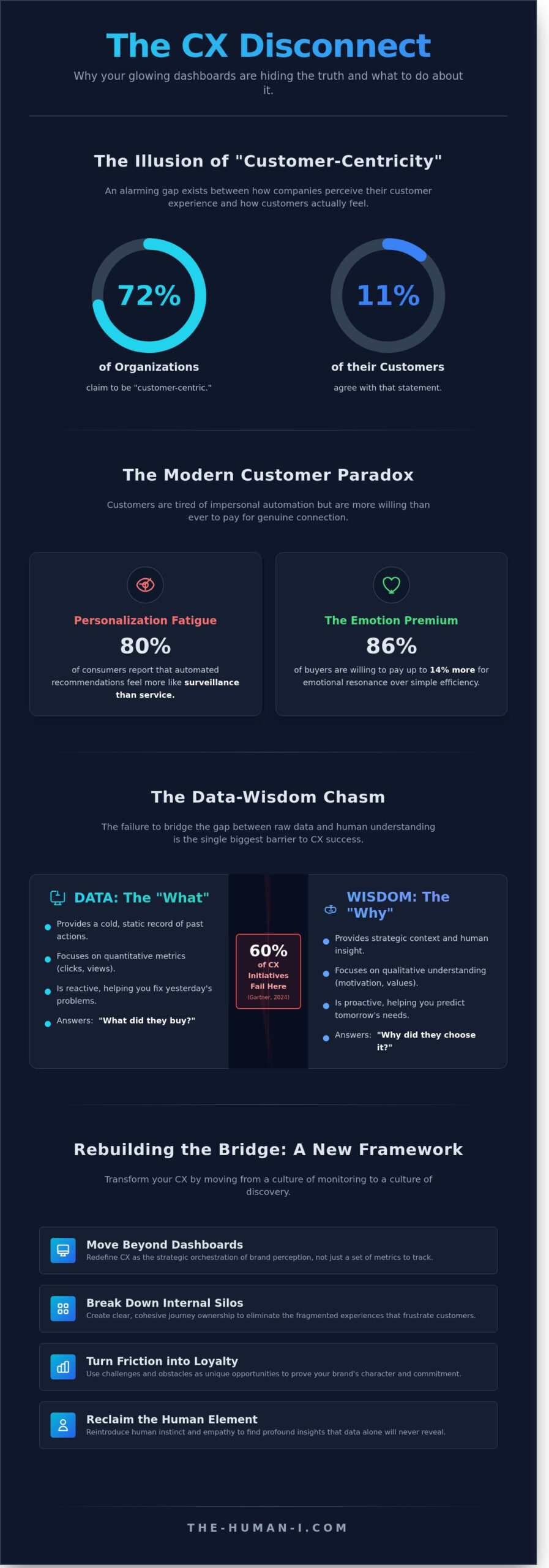
By 2026, the gap between having data and possessing wisdom has become a chasm. CX management isn’t a SaaS subscription you renew every twelve months; it’s the strategic orchestration of brand perception. While 72% of organizations in a 2025 industry survey claimed to be “customer-centric,” only 11% of their customers agreed. This disconnect happens because many firms have traded proactive storytelling for reactive support. They’re fixing leaks instead of building better ships.
One of the most persistent challenges in customer experience management today is the death of “personalization” as a competitive advantage. It’s no longer enough to put a first name in an email subject line. By early 2026, 80% of consumers reported “personalization fatigue,” viewing automated recommendations as surveillance rather than service. We’ve reached a paradox where more customer data often leads to less customer understanding. We know what they bought at 2:00 PM on a Tuesday, but we’ve lost the “why” behind the purchase.
True orchestration requires a shift in focus. It’s about finding the profound insight that refreshes a stagnant brand. You can explore how we approach this through our strategic solutions. We must move beyond the dashboard to see the human instinct driving the numbers.
The Evolution of Customer Expectations
Modern customers judge the full experience over the physical product. In 2026, 86% of buyers are willing to pay a 14% premium for emotional resonance over transactional efficiency. They don’t just want a solution; they want to feel seen. “Good enough” service has become a massive brand risk. If a brand feels like a faceless machine, customers will treat it like one, switching for a lower price point the moment a competitor appears.
The Problem with Tool-First Strategies
Dashboards are designed to simplify, but they often obscure the truth about customer pain. A “green” satisfaction score can hide a thousand tiny frustrations that don’t fit into a multiple-choice survey. Many companies suffer from patchwork survey programs that lack a unifying narrative. They’re looking for data points when they should be finding profound insight. To overcome the challenges in customer experience management, leaders must stop staring at the metrics and start listening to the stories the metrics are trying to tell. It’s about moving from a culture of monitoring to a culture of discovery.
The Data-Wisdom Gap: The Hidden Barrier to CX Success
Most organizations currently drown in data while starving for clarity. The triad of insight, data, and wisdom represents the new frontier for leaders who want to move past superficial metrics. While data provides the “what,” it’s a cold, static record of past actions. Wisdom provides the “why.” It’s the strategic context that prevents a brand from chasing ghosts. One of the primary challenges in customer experience management is the tendency to treat analytics as the destination rather than the starting point.
Misinterpreting customer signals carries a heavy price tag. According to a 2024 Gartner report, 60% of CX initiatives fail because they lack the necessary context to drive actual behavioral change. Without wisdom, a brand might see a drop in churn and celebrate; they miss the fact that customers stayed only because of a lack of alternatives, not loyalty. Bridging the gap between analytics teams and brand planners requires a shared vocabulary. It moves the conversation from “how many clicks” to “what does this person actually value?” When these two groups operate in silos, the result is a fragmented strategy that confuses the consumer. Integrating these disciplines allows companies to create a unified narrative that resonates across every touchpoint.
Turning Raw Data into Strategic Insight
Collecting feedback is a standard procedure; understanding human instinct is a discipline. Most brands gather thousands of data points that only reflect surface-level dissatisfaction. To find the extraordinary insights, you must filter out the noise of common complaints. This is where brand evaluation consulting serves as a foundation. It allows teams to look past the spreadsheet and uncover the underlying motivations that drive long-term brand affinity. By 2026, the winners won’t be those with the most data, but those who can interpret it with the most empathy.
The Role of Wisdom in Decision Making
The most logical, data-driven choice often fails the “human” test. A computer might suggest automating a sensitive customer touchpoint to save 15% in operational costs. Wisdom argues that the emotional damage to the brand’s reputation far outweighs those short-term savings. Using wisdom allows leaders to predict future customer needs before they manifest in a survey. It empowers teams to act on intuition that’s rigorously backed by data. If you’re ready to move beyond the dashboard, exploring our strategic expertise can help align your data with your brand’s human purpose.
Breaking the Silo Mentality in CX Strategy
CX isn’t a department; it’s the brand’s nervous system. Yet, a 2023 study by Forrester revealed that only 11% of companies have a truly unified strategy across all touchpoints. Most organizations suffer from departmental myopia. Marketing sees a persona. Support sees a ticket. Finance sees a cost center. This fragmentation isn’t just an internal annoyance; it’s a direct threat to the bottom line. One of the primary challenges in customer experience management is that these groups rarely share a common vocabulary or a single source of truth.
When CX is everyone’s job, it often becomes no one’s responsibility. This is the #1 organizational hurdle. Marketing, sales, and support departments frequently act like independent states with their own borders and tariffs. A 2024 Salesforce report indicated that 76% of customers expect consistent interactions across departments, yet only 44% feel they actually receive them. Moving toward a unified customer experience mapping approach allows teams to see the gaps between these silos and build a cohesive narrative.
Identifying Key Moments of Truth
The hand-off is the danger zone. When a lead moves from Marketing to Sales, data often vanishes. A 2024 Zendesk report showed 68% of customers repeat their story to different agents. We must map journeys from the customer’s seat. For B2B firms, this means using market segmentation to acknowledge that a CFO’s moment of truth differs from a Project Manager’s.
Gaining Cross-Functional Buy-in
You can’t mandate empathy. To break silos, translate CX value into departmental currencies. For Finance, that is a 15% reduction in churn. For Operations, it is a 20% increase in efficiency. Overcoming these challenges in customer experience management requires a CX Council to align individual KPIs with the brand story. True transformation happens where insight, data, and wisdom meet, ensuring shared accountability.
Turning Journey Friction into Brand Narratives
Friction is usually treated like a bug in the system. Most leaders try to polish it away, hoping for a perfectly seamless path. But a perfectly smooth journey is often entirely forgettable. True brand character emerges when the road gets bumpy. How a company responds to a delivery delay or a technical glitch defines its legacy more than a thousand flawless transactions. These moments represent the primary challenges in customer experience management because they require more than just a script; they require actual wisdom.
A 2023 study by Khoros found that 83% of customers feel more loyal to brands that resolve their complaints effectively. This is where reputation measurement intersects with CX. We don’t just fix a broken link to improve a dashboard metric; we fix it to protect the brand promise. For stagnant brands, these broken touchpoints are actually hidden doors to reinvention. Identifying where the journey stutters allows us to refresh the narrative and prove we’re listening. It turns a logistical failure into a strategic win.
The Power of Storytelling in CX
Customers don’t go home and talk about a 45-second resolution time. They talk about how they felt when an agent understood their specific frustration. Facts provide the foundation, but stories build the house. When a challenge arises, it’s an opportunity to craft a redemption story. Insights help us uncover these narratives, turning a simple logistical hurdle into a human connection that generates engagement. We use these moments to show the person behind the brand, making the experience feel personal rather than transactional.
Measuring What Matters: Beyond NPS
Generic metrics like NPS often fail to capture the nuance of human sentiment. A high score can easily mask growing resentment if the “why” isn’t understood. By 2026, Gartner predicts that 60% of organizations will fail to link CX to value because they rely on surface-level numbers. We need to measure the human impact by integrating deep market research with real-time experience data. This approach moves us past the surface, helping leaders tackle the underlying challenges in customer experience management by seeing the person behind the data point.
Ready to move beyond the numbers? Explore our strategic expertise to see how we transform data into brand wisdom.
Reclaiming the Human Element in Your CX Journey
Dashboards provide a rearview mirror perspective. They tell you where you’ve been, but they rarely explain the “why” behind the “what.” To truly evolve, you have to move beyond the screen and reintroduce “Human Instinct” into your strategic framework. This isn’t about discarding data; it’s about enriching it with the wisdom that only comes from deep, human-centric insight. It’s the final, most critical step in ensuring your brand remains relevant in an increasingly automated world.
Empathy acts as the ultimate differentiator in a market saturated with canned responses and algorithmic predictions. A 2024 PwC report highlighted that 82% of US consumers crave more human interaction in their brand experiences as technology becomes more pervasive. One of the primary challenges in customer experience management today is the “empathy gap” created by over-reliance on digital-first strategies. When you prioritize discovery over superficial analysis, you uncover the emotional drivers that dictate loyalty. Brands that master this human connection gain a competitive edge that technology alone cannot replicate.
Steps to an Insight-Driven CX Refresh
Refreshing your strategy requires a shift from tracking metrics to understanding motivations. Start with these three pillars to realign your CX for 2026:
- Step 1: Conduct a deep-dive brand evaluation. Assess your brand’s current health against the 2026 consumer landscape. A 2023 study by Forrester found that 54% of consumers will stop buying from a brand if they feel the brand’s values don’t align with theirs. You need to know if your promise still rings true.
- Step 2: Map the human journey. Look past digital touchpoints like click-through rates. Map the emotional state of your customer at every turn. Are they anxious, excited, or frustrated? Understanding these “human” moments allows you to intervene with genuine support.
- Step 3: Align your narrative. Your story must be consistent across every segment. Whether you’re talking to Gen Z or Boomers, the core “why” of your brand should remain clear and compelling.
Partnering for Wisdom
External eyes see what internal teams often overlook. There’s a profound difference between looking for a specific result and actually finding a transformative truth. True wisdom is found at the intersection of data and experience. It’s the ability to identify micro-moments where a brand can move from being a utility to being a partner in the customer’s life. By partnering with experts who value depth over speed, you can navigate the challenges in customer experience management with a clear, strategic vision.
Refresh your perspective and stop settling for surface-level data. The future of CX belongs to those who can translate digital signals into human stories. Contact our team of experts to begin your journey of discovery and reclaim the human element in your brand strategy today.
Defining Your Next Chapter in Customer Experience
As we approach 2026, the gap between raw data and actionable wisdom is widening. It’s no longer enough to track metrics on a screen. You’ve got to bridge the internal silos that keep your strategy fragmented and your customers frustrated. Our senior team brings over 20 years of cross-disciplinary expertise in storytelling and strategy to help you turn journey friction into a compelling brand narrative. We’ve consistently helped stagnant brands find new life by moving beyond the dashboard and into the heart of human behavior.
Successfully navigating the challenges in customer experience management requires more than a software update. It demands the kind of intelligent and extraordinary insight our clients frequently highlight in their testimonials. By blending data-driven clarity with deep strategic depth, you can build a customer journey that feels authentically human and remains commercially unstoppable.
Discover how our insight, data, and wisdom meet to refresh your brand.
Your brand’s most insightful era starts now.
Frequently Asked Questions
What are the most common challenges in customer experience management?
The primary challenges in customer experience management involve disconnected data sets and cultural resistance to organizational change. A 2024 Gartner study found that 70% of CX leaders struggle to link CX projects to clear financial outcomes. Beyond the tech stack, the real hurdle is often translating raw metrics into human stories that stakeholders actually care about.
How do internal silos affect the customer journey?
Internal silos fracture the customer journey by creating inconsistent touchpoints and conflicting brand messages. When marketing, sales, and support teams don’t share a unified view, customers end up repeating their issues. Research indicates that 63% of consumers feel like they’re starting over every time they switch channels; this lack of continuity kills brand trust instantly.
Why is data alone insufficient for managing CX?
Data provides the “what” but lacks the “why” that only human wisdom and insight can uncover. While 85% of companies prioritize data collection, most fail to turn those numbers into actionable strategies. You can track a high bounce rate on a landing page, but data won’t tell you if the tone felt patronizing or if the layout felt confusing to your specific audience.
What is the role of brand strategy in customer experience?
Brand strategy acts as the North Star for every customer interaction, ensuring consistency across the entire ecosystem. It’s the filter that helps teams decide which experiences to prioritize and which to ignore. Without a clear strategy, CX becomes a series of reactive fixes rather than a proactive, intentional journey that reflects your core values and promises.
How can businesses measure the ROI of CX management?
Businesses measure CX ROI by tracking improvements in Customer Lifetime Value (CLV) and reduction in churn rates. For example, a 5% increase in customer retention can lead to a 25% to 95% increase in profits according to Bain & Company. Link your CX metrics directly to these financial levers to prove the worth of your initiatives to the C-suite.
What is the difference between customer service and customer experience management?
Customer service is a reactive, single-point interaction, while CX management is the holistic, proactive design of the entire relationship. Service fixes a broken product; CX management ensures the product and the purchase process were intuitive from the start. It’s the difference between responding to a fire and building a fireproof house from the ground up.
How does market segmentation improve CX?
Market segmentation improves CX by allowing brands to tailor experiences to the specific psychological needs of different groups. Instead of a one-size-fits-all approach, you can create high-touch journeys for premium segments and streamlined paths for budget-conscious users. This precision reduces friction and increases the perceived value for every customer type you serve.
Can a brand strategy refresh fix a poor customer experience?
A brand strategy refresh can’t fix a poor experience if the underlying operational issues remain broken. It’s just a coat of paint on a crumbling wall. While a 2023 study showed that 80% of successful rebrands included operational changes, simply changing a logo without fixing the customer journey will only lead to further brand erosion and consumer cynicism.



