


What if the 95% failure rate for new product launches, a figure cited by Harvard Business School professor Clayton Christensen, isn’t caused by a lack of data, but by a lack of perspective? We live in an era where spreadsheets are overflowing, yet internal stakeholders still feel that paralyzing hesitation before hitting the green light. A feasibility study for a new product shouldn’t be a box ticking exercise or a collection of raw numbers. It’s a search for the truth beneath the noise, designed to uncover whether your idea has the grit to survive the friction of the real world.
You likely feel the weight of this decision, knowing that a wrong move costs more than just capital; it costs momentum. We understand that raw data feels overwhelming when it lacks the human insight to give it meaning. This guide shows you how to transform that data into the strategic wisdom required to make a definitive go or no-go decision. We’ll walk through a roadmap that builds genuine confidence in market demand and provides a clear path for development, ensuring your next launch is backed by more than just a hunch.
Key Takeaways
- Bridge the gap between a creative spark and market reality by uncovering the alignment—or lack thereof—between your vision and operational truth.
- Master the “preliminary gut check” to ensure your internal resources and stakeholder goals are synchronized before investing significant capital.
- Learn why a comprehensive feasibility study for a new product must go beyond basic demographics to map the nuanced human experience.
- Evaluate your technical and financial foundations without the “rose-colored glasses” to project ROI based on hard truths rather than optimistic projections.
- Synthesize your findings into a clear “Go/No-Go” narrative that empowers you to either execute with confidence or pivot a stagnant idea.
Stop Guessing: What a Feasibility Study for a New Product Really Uncovers
Innovation often begins with a flash of brilliance, but brilliance alone isn’t enough to sustain a brand. A feasibility study for a new product acts as the vital bridge between a creative spark and a sustainable market presence. It’s the process of transforming raw potential into calculated strategy, ensuring that your vision survives the transition from the whiteboard to the warehouse.
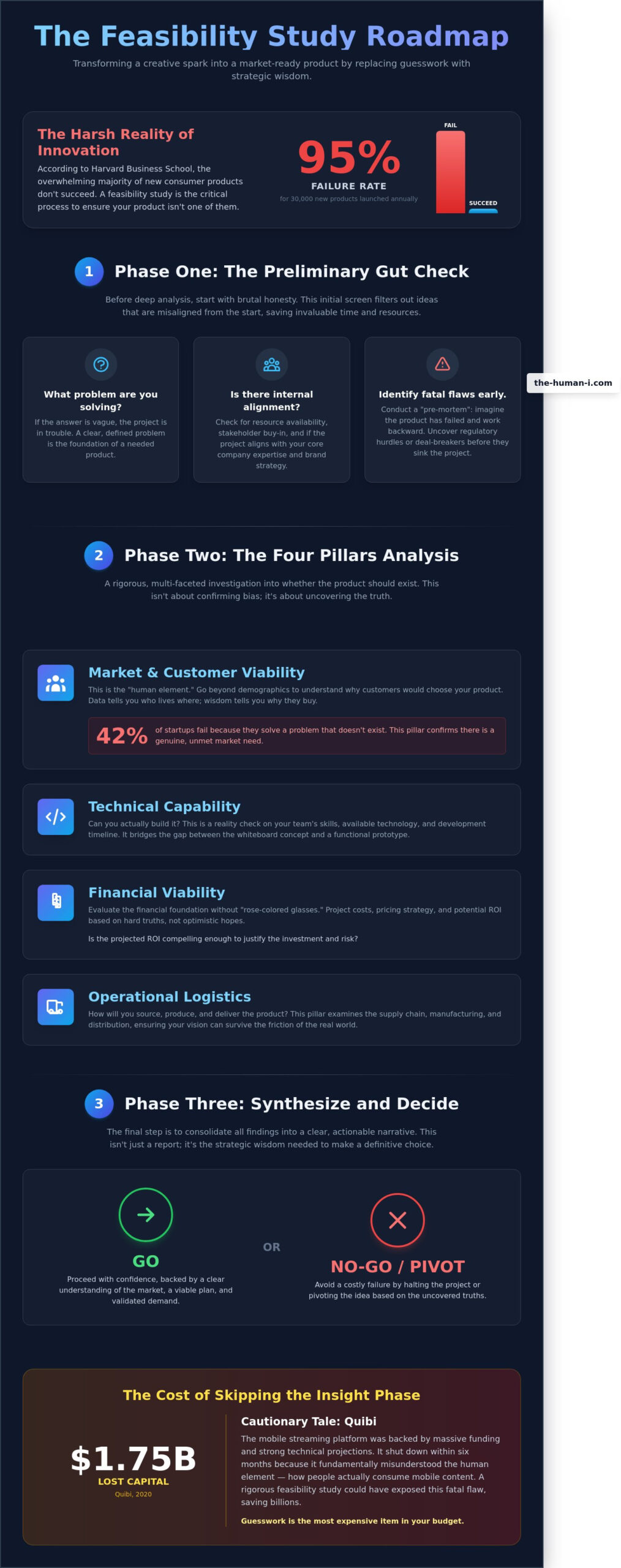
A Feasibility study isn’t just a collection of spreadsheets or a checklist of logistics. It’s a journey into the heart of insight. While a business plan outlines how you’ll run your company, the feasibility phase asks if the product should exist at all. It provides the wisdom needed to pivot before capital is drained. According to Harvard Business School professor Clayton Christensen, 95% of the 30,000 new consumer products launched each year fail. Most of these failures don’t happen because the idea was bad, but because there was a fundamental misalignment between the market’s pulse and the company’s operational reality.
Too often, teams confuse data with wisdom. Data tells you how many people live in a zip code; wisdom tells you why they’ll choose your product over a legacy brand. This study uncovers actionable truths that allow you to move forward with quiet confidence rather than frantic guesswork.
The Anatomy of a Product Reality Check
A rigorous study examines four core pillars: market demand, technical capability, financial viability, and operational logistics. This isn’t about confirming your biases. It’s about discovery. As Ferran Adria famously suggested, the importance lies not in what you look for, but in what you find. You might set out to validate a high-end luxury item only to find that the real opportunity lies in a mid-market subscription model. Integrating a clear brand strategy during this early stage ensures your product doesn’t just function, but actually resonates with the human instinct of your target audience.
The Cost of Skipping the Insight Phase
Guesswork is the most expensive line item in your budget. When you bypass the insight phase, you’re essentially gambling with your brand’s reputation. History is littered with products that looked flawless on paper but failed the human test. Take Quibi, for example. In 2020, the platform raised $1.75 billion based on technical and financial projections. However, it shuttered within six months because it failed to account for how people actually consume mobile content. It lacked the deep-seated market insight that a feasibility study for a new product provides. By investing in wisdom early, you avoid the catastrophic costs of launching a product that nobody asked for.
Phase One: The Preliminary Gut Check
Before diving into spreadsheets and complex market models, you need a moment of brutal honesty. A feasibility study for a new product begins with a simple question: what problem are you actually solving? If the answer feels vague, the project is already in trouble. Research from 2023 suggests that 42% of startups fail because there was no market need. You must define the core tension your product resolves before committing a single dollar to development. This initial clarity acts as the foundation for everything that follows.
Conducting a pre-mortem is an exercise in strategic pessimism. Imagine your product has launched and failed miserably six months later. Work backward to find the cause. This isn’t about being negative; it’s about being prepared. When you perform a feasibility study for a new product, understanding How to Use a Feasibility Study effectively means spotting these deal-breakers during the “gut check” phase. It saves you from the sunken cost fallacy before the costs even exist.
Check your internal pulse. Alignment isn’t just a nod from the board. It’s about resource availability. If your lead engineers are already managing three “priority one” projects, your new product is a distraction, not a direction. It’s vital to determine if the project aligns with your core expertise. This ensures your brand storytelling remains authentic and grounded in what you actually do best. True wisdom lies in knowing when to say no to a good idea to protect a great one.
Identifying Fatal Flaws Early
Regulatory hurdles can kill a project faster than a lack of funding. In the medical tech sector, for instance, a 2022 report noted that FDA clearance delays can add 12 to 24 months to a timeline. If your technical requirements rely on non-existent tech, stop now. Use the “So What?” test. If you describe the solution to a potential customer and their reaction is lukewarm, you’ve found your first major flaw. Insight and data must back your intuition here.
Assessing Internal Readiness
There is a vast difference between “we can build it” and “we should build it.” Capability doesn’t equal strategic fit. Your team needs the hunger to push through the inevitable “trough of sorrow” that follows every launch. If the tools or the passion are missing, the project will stall. Take a moment to look at our solutions to see how we help teams find that elusive strategic clarity and depth.
The Human Element: Market and Customer Viability
Spreadsheets offer comfort, but they don’t buy products. People do. While financial projections provide the skeleton of your plan, the market analysis provides the pulse. A successful feasibility study for a new product requires a shift from viewing customers as data points to seeing them as humans with specific, often irrational, motivations. If 95% of new products fail annually, as Harvard Business School research suggests, it’s usually because the human element was ignored in favor of “safe” secondary data.
Secondary data acts as a safety net, but it’s rarely enough to justify a launch. You need to talk to real humans. Primary research uncovers the “why” behind the “what.” While the USDA guide to feasibility studies outlines the rigorous structural requirements for project success, your market viability depends on nuances that a government report can’t capture. You’re looking for the white space, those gaps in the market where competitors are either over-serving customers with features they don’t want or under-performing on the things they actually value. Identifying this space allows you to own a category rather than just competing in one.
Segmentation Beyond the Spreadsheet
Demographics like age and location are only half the story. In 2023, high-value B2B niche audiences are defined more by their pain points and emotional triggers than their job titles. A procurement officer doesn’t just want a lower price; they want the security of knowing they won’t get fired for a supply chain failure. Identify these emotional drivers to move beyond generic marketing and speak directly to the customer’s instinct for self-preservation or growth.
Mapping the Potential Journey
Integrating customer experience mapping into your feasibility framework helps you visualize the path from discovery to adoption. It’s about spotting the friction points. If a customer has to jump through four hoops to evaluate your product, they’ll quit before they even start. By plotting every touchpoint, you can identify the “kill points” that might sink your product at launch. This foresight ensures your feasibility study for a new product accounts for the actual effort required to change customer behavior, which is often the biggest hurdle to success.
The Hard Truths: Operational and Financial Reality
Ideas are cheap. Execution is where the real work begins. A feasibility study for a new product acts as a cold shower for a heated boardroom; it demands that we look past the allure of innovation to see the gears and grease underneath. Technical feasibility isn’t just about whether a thing can exist. It’s about whether it can exist profitably, sustainably, and at scale.
Financial modeling requires a ruthless eye. A 2023 analysis by CB Insights found that 38% of startups fail because they run out of cash or fail to raise new capital. Your ROI projections shouldn’t reflect your hopes. They must reflect the reality of a market where customer acquisition costs often rise by 20% or more annually in competitive sectors. We look for the wisdom in the numbers, not just the numbers themselves.
Operational logistics require a “what-if” map. If your primary supplier faces a 45-day delay, does your entire launch collapse? Reliability is the quiet backbone of every successful brand. This includes a deep dive into:
- Supply Chain Resilience: Identifying backup vendors and localized sourcing options.
- Production Scalability: Ensuring your manufacturing partner can handle a 300% volume increase if the product goes viral.
- Regulatory Compliance: Navigating GDPR, ISO standards, or industry-specific safety mandates that can result in six-figure fines if ignored.
Can We Actually Build It?
Prototyping isn’t just for show; it’s the moment where theory meets friction. A Minimum Viable Product (MVP) should test your riskiest assumptions first. If you skip this, you risk accumulating massive technical debt. Research from Stripe indicates that developers spend roughly 13 hours per week addressing technical debt. That’s 33% of a standard work week spent fixing the past instead of building the future.
The Cost of Opportunity
Every dollar spent on a new product is a dollar taken from somewhere else. If your current portfolio generates a 12% return, your new venture must convincingly beat that benchmark to justify the pivot. Calculating the true break-even point requires accounting for market volatility. In 2023, global shipping rates saw spikes of 25% in specific corridors. Your model must be resilient enough to survive these shifts without breaking the brand’s promise.
Success requires more than a good idea; it requires a roadmap built on data and wisdom. Explore how we help brands find clarity through our expertise in strategic insight.
From Data to Wisdom: Executing Your New Product Strategy
A feasibility study for a new product shouldn’t end with a dusty PDF sitting in a shared drive. It’s the catalyst for your next era. By the time you reach this stage, you’ve likely spent 12 to 16 weeks gathering market intelligence and stress-testing your assumptions. Now comes the synthesis. You aren’t just looking for a “yes” or “no” decision; you’re looking for the “how.” If the data reveals a 15% gap in market demand compared to your original projections, that isn’t a failure. It’s a pivot point. Wisdom is knowing when to adjust the sails rather than sinking the ship.
Stagnant thinking kills brands. Harvard Business School research suggests that 95% of new products fail each year because they lack a clear market fit. If your original concept doesn’t hold up under the microscope, use the research to find the adjacent possible. Perhaps the product doesn’t work for Gen Z, but the data shows a 40% higher engagement rate with the 55+ demographic. That’s not a “No-Go.” It’s a strategic “Go-Elsewhere.” We turn raw research into a market-shaping strategy by listening to what the data is actually whispering, not just what you hoped it would scream.
Building the Strategic Narrative
When you stand before a board or investors, don’t lead with the methodology. Lead with the future. Your feasibility study for a new product provides the evidence, but your narrative provides the conviction. Investors don’t back spreadsheets; they back visions that are grounded in reality. Frame the results as a roadmap for brand evolution. Show them how this product solves a specific, quantified pain point. Investors respond to clarity. They want to see that you’ve turned raw data into a calculated plan that minimizes risk while maximizing brand equity.
The day after the study ends is when the real work begins. You need a 90-day execution plan that bridges the gap between insight and launch. This involves securing supply chains, finalizing the brand voice, and mapping the customer journey. It’s about moving from the “what” to the “when.”
Your Next Strategic Move
Insight is the foundation, but wisdom is the architecture. Don’t let your data sit in a vacuum. If you need a deeper evaluation of how your brand can cut through the noise and connect with your audience on a human level, you should contact a strategic partner to refine your path forward. We help you find what matters most in the noise of the market. A feasibility study doesn’t just tell you if it works; it tells you how it wins.
Moving Beyond the Blueprint
Launching without a map is a gamble most brands simply can’t afford. A rigorous feasibility study for a new product replaces shaky gut feelings with a solid framework of market viability and operational reality. Our work across the Financial Services, Automotive, and Tech sectors proves that strategic clarity transforms outcomes. It’s not just about crunching numbers; it’s about understanding the human instinct that drives every purchase decision.
Our seasoned experts draw upon a wealth of strategic experience to bridge the gap between raw data and profound wisdom. We focus on the preliminary gut check, the human element of customer demand, and the hard truths of your financial capacity. By the time you move to execution, you’ll have a narrative that resonates and a plan that holds weight. We don’t just look for answers; we find the specific insights that refresh stagnant brands and empower new ones to lead.
Your next innovation deserves more than a “maybe.” It deserves the confidence that comes from deep, disciplined discovery and the storytelling that brings strategy to life.
Ready to uncover the wisdom behind your next big idea? Explore our solutions.
The path from a concept to a market leader is rarely a straight line, but with the right insight, it’s a journey you can take with absolute certainty.
Frequently Asked Questions
What is the main objective of a feasibility study for a new product?
The primary goal is to determine if an idea can survive the reality of the market. It’s about uncovering risks before they become expensive failures. A 2023 report by CB Insights showed that 35% of startups fail because there’s no market need. This process transforms a gut feeling into a strategic roadmap, ensuring that your resources go toward a concept with genuine potential.
How long does a typical product feasibility study take?
Most studies require 4 to 12 weeks to complete. The timeline depends on the complexity of your industry and the depth of data required. A simple consumer goods test might wrap up in 30 days, while a highly regulated medical device could take 90 days or more. It’s a deliberate pace designed to find what’s important, not just what’s obvious. This rhythm ensures every insight is backed by substance.
Can I conduct a feasibility study myself, or do I need a consultant?
You can handle the basics internally, but an external partner provides the objective wisdom needed to challenge your own biases. Internal teams often suffer from confirmation bias, which Harvard Business Review notes affects 75% of business decisions. Bringing in a fresh perspective helps you see the blind spots that internal passion might accidentally overlook. It’s the difference between a simple project and a rigorous strategy.
What is the difference between market research and a feasibility study?
Market research looks at the who and where, while a feasibility study for a new product evaluates the can and should. Research tells you if people like a concept; a feasibility study proves if you can actually build, ship, and profit from it. It combines customer data with technical, financial, and legal realities to provide a holistic view of the path forward. This approach turns data into actionable wisdom.
What happens if the feasibility study says the product is not viable?
You save your capital and pivot to a more promising direction. Finding a no early is a victory, not a defeat. According to the Product Development and Management Association, only 1 in 7 product ideas results in a commercial success. By identifying a non-viable path now, you empower your team to focus their energy on an innovation that actually has the legs to win in the real world.
How much should I budget for a new product feasibility study?
Budgeting varies based on the scope of the project and the level of insight you require. Industry benchmarks from the Small Business Administration suggest that research and planning costs often account for 5% to 15% of the total development budget. Investing this portion upfront acts as an insurance policy. It ensures that the remaining 85% of your capital isn’t spent on a product that the market doesn’t want or need.



