


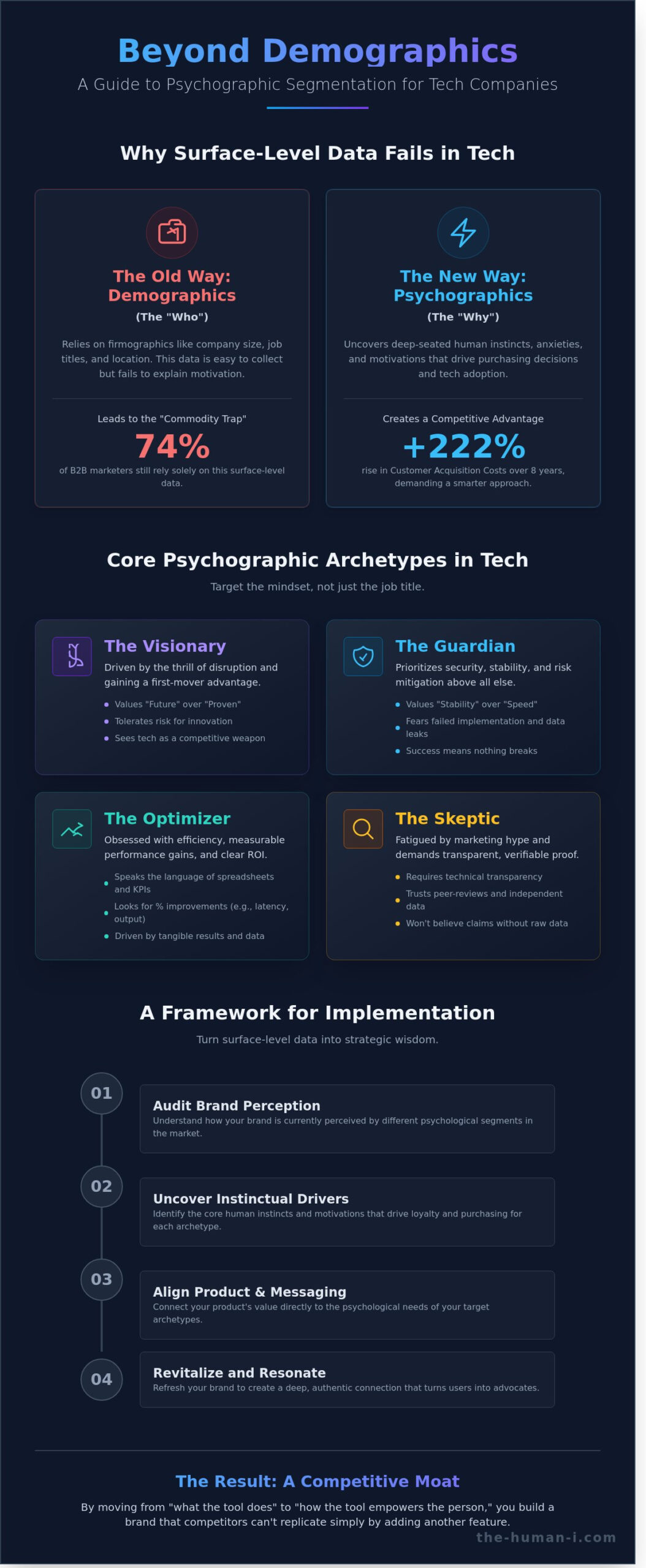
The most expensive mistake in the enterprise world isn’t a bad hire; it’s believing that a better feature set will magically fix a stagnant conversion rate. While a 2023 industry report found that 74% of B2B marketers still rely solely on firmographics like company size or job titles, this surface-level data fails to explain why one lead converts while their identical peer churns. To break this cycle, you must master psychographic segmentation for tech companies. It’s the difference between knowing your buyer’s zip code and understanding the specific anxieties that keep them awake at 2:00 AM.
You’ve likely felt the frustration of watching customer acquisition costs climb by 222% over the last eight years, even as your product team ships updates at record speed. It’s a losing game to compete on a spec sheet that a competitor can replicate by next Monday. This guide will teach you how to move beyond generic demographics to uncover the deep-seated human instincts that drive tech adoption and long-term loyalty. We’ll provide a clear framework for tech-specific psychographics that aligns your product’s value with the raw motivations of your buyers, ensuring your brand resonates with authority and wisdom.
Key Takeaways
- Move beyond demographic data to escape the “commodity trap” by identifying the deep-seated instincts that drive tech adoption.
- Explore the mental archetypes that dictate purchasing decisions, from the disruption-led Visionary to the risk-averse pragmatic.
- Apply psychographic segmentation for tech companies to transform surface-level data into strategic wisdom that resonates with human behavior.
- Use a structured four-step framework to audit your brand perception and uncover the instinctual drivers behind customer loyalty.
- Discover how a psychographic refresh can revitalize a stagnant brand by aligning your reputation with evolving psychological shifts in the market.
Why Tech Companies Fail When They Ignore the “Why”
Tech marketing often falls into a predictable, expensive trap. Engineering teams spend months polishing a feature set, only to find that the market reacts with a collective shrug. This happens because demographics tell you who the buyer is, but they never explain why that person chooses to click. When you ignore the “why,” you enter the commodity trap; a race to the bottom where the only differentiator is price. To break out, you need psychographic segmentation for tech companies. It’s the difference between knowing a lead’s job title and understanding their professional anxieties.
The commodity trap is a death sentence for innovation. When you compete solely on features, you’re essentially telling the market that your product is a utility. Utilities are replaceable. However, when you use psychographic segmentation for tech companies, you position your product as a solution to a specific psychological friction. You’re no longer selling a CRM; you’re selling the confidence to lead a remote team. You’re moving from being a line item in a budget to an essential part of a professional’s identity.
The Limits of Demographic Data in Tech
Firmographics are easy to collect, but they’re shallow. Company size and job titles are no longer sufficient predictors of behavior. In 2024, a “CTO” at a mid-market firm isn’t a monolith. Consider two leads with identical $200,000 budgets:
- The Stabilizer: Prioritizes uptime and fears the career fallout of a failed implementation. They value “proven” over “cutting-edge.”
- The Visionary: Wants to disrupt the status quo and views risk as a necessary cost of innovation. They value “first-mover advantage” over “stability.”
If you send both the same “secure and reliable” pitch, you’ll lose the Visionary every time. Targeting a title instead of a mindset is a recipe for marketing inefficiency and wasted ad spend.
Psychographics as a Competitive Advantage
Moving beyond surface-level data allows you to uncover deep-seated motivations. It’s about building a brand narrative that speaks to internal professional desires, not just technical requirements. According to a 2022 Salesforce report, 73% of customers expect companies to understand their unique needs and expectations. Psychographic insight refreshes stagnant brands by shifting the conversation from “what the tool does” to “how the tool empowers the person.”
This approach does more than just win the initial sale. It reduces churn and increases lifetime value. When a user feels that a platform aligns with their personal professional identity, they become an advocate. They aren’t just using software; they’re fulfilling an instinct. By treating the “IT decision-maker” as a human with instincts, you create a moat that competitors can’t cross simply by adding a new feature. You become a partner in their success, not just another vendor on their spreadsheet.
Core Psychographic Archetypes in the Modern Tech Landscape
Buyers don’t just evaluate your API documentation or your pricing tiers. They subconsciously filter your product through their own mental models. Effective psychographic segmentation for tech companies requires moving past what a customer does to understand why they do it. When you identify the “human instinct” behind the purchase, you stop selling features and start solving internal tensions.
Four primary archetypes dominate the current tech purchasing environment:
- The Visionary: These individuals are driven by the thrill of disruption. They view technology as a competitive weapon and are willing to tolerate early-stage bugs if it means gaining a first-mover advantage. They don’t want a “proven” solution; they want the future.
- The Guardian: Security and risk mitigation are their North Stars. They often sit in IT or compliance roles. For them, a successful implementation is one where nothing breaks and no data leaks. They value stability over speed.
- The Optimizer: Efficiency is their obsession. They look for measurable performance gains, such as a 14% reduction in server latency or a 22% increase in team output. They speak the language of ROI and spreadsheets.
- The Skeptic: These buyers are fatigued by marketing hype. They demand technical transparency, peer-reviewed case studies, and independent validation. They won’t believe your claims until they see the raw data.
Mapping Archetypes to the Adoption Curve
The transition from an early-stage startup to a market leader requires a shift in psychological targeting. Innovators and early adopters are almost exclusively Visionaries. They buy into the “why” of your brand. However, as a product moves toward the early majority, you must pivot your messaging to satisfy the Guardian and the Optimizer. By the time you reach late-stage laggards, your content must address the Skeptic’s deep-seated need for proof. A 2023 study by Gartner revealed that 73% of tech buyers now prioritize “trustworthiness” over “feature richness” during the initial vetting phase, marking a significant shift toward the Guardian and Skeptic mindsets across the board.
B2B vs. B2C Psychographics in Tech
While B2C purchases are often driven by personal identity or lifestyle aspirations, B2B psychographics are tied to professional survival and career trajectory. A high-stakes technical decision isn’t just about the company’s bottom line; it’s about the buyer’s reputation. Success leads to a promotion; failure leads to a security breach or a public project collapse. Balancing corporate logic with these individual psychological drivers is essential. You’re not just selling to a corporation; you’re selling to a person who wants to feel competent and secure in their role. Our team can help you uncover these underlying drivers within your own market to create more resonant messaging.
Professional identity often acts as a silent filter. An engineer might value technical elegance, while a director values organizational alignment. Recognizing these distinctions allows for a more nuanced approach to psychographic segmentation for tech companies, ensuring that every piece of content hits the right emotional note for the specific stakeholder involved.
Data vs. Wisdom: Moving Beyond Surface-Level Personas
Raw data is a map, but wisdom is knowing which path leads to the summit. Most tech firms are drowning in the “what.” They know that 42% of their SaaS subscribers churn after month three, or that their app’s daily active users peak at 10:00 AM. This is useful, but it’s incomplete. Raw data provides the “what”; wisdom provides the “so what.” It uncovers the underlying motivation that turns a static data point into a strategic pivot.
Effective psychographic segmentation for tech companies requires more than a spreadsheet. It demands the Human Instinct triad: a rigorous combination of data, insight, and strategic wisdom. Many organizations fall into the trap of using generic, AI-generated personas. While these tools are fast, they often produce archetypes that feel like cardboard cutouts. They miss the nuanced anxieties of a CTO or the specific aspirations of a developer because they lack the ability to interpret subtle market shifts. Relying on deep expertise allows a brand to see the human behind the screen, interpreting complex signals that an algorithm might ignore.
Collecting Qualitative Insight in a Quantitative World
Data tells you what people did; interviews tell you what they felt. We use focus groups and one-on-one sessions to find the stories that numbers hide. A 2024 study by Forrester indicated that brands using emotional storytelling in their research see a 15% increase in customer loyalty. By asking “Why did this make you feel frustrated?” instead of just “Did you complete the task?”, we move from cold metrics to actionable empathy. This storytelling approach transforms research findings into a narrative that stakeholders can actually use.
Avoiding the Trap of Over-Segmentation
Granularity can be a distraction. If you have 25 different segments, you don’t have a strategy; you have a mess. Wisdom is the filter that separates signal from noise. It’s essential to focus on the 3-4 segments that actually drive 80% of revenue. This focus ensures that psychographic segmentation for tech companies remains a tool for growth rather than an academic exercise. By filtering out the noise, you can dedicate resources to the audiences that offer the highest lifetime value and the strongest brand alignment.
A 4-Step Framework for Psychographic Implementation in Tech
Moving from raw data to human understanding requires a structured approach. It isn’t a guessing game; it’s a search for wisdom within your existing metrics. Successful psychographic segmentation for tech companies follows a path that prioritizes the “why” over the “what.”
- Step 1: Audit your existing brand perception. You probably think your software solves a technical bottleneck. Your customers might actually use it to feel more secure in their roles. A 2022 study by Bain & Company found that while 80% of companies believe they provide a superior experience, only 8% of their customers agree. This gap is where your strategy begins.
- Step 2: Conduct deep-dive research. Stop relying on surface-level surveys. Use ethnographic interviews to uncover instinctual drivers. You want to know what was happening in a buyer’s life the moment they realized they needed a change.
- Step 3: Map segments to the customer journey. A “Risk-Averse Optimizer” behaves differently during onboarding than a “Visionary Early Adopter.” Their journey isn’t a straight line; it’s a series of emotional hurdles that require specific reassurance.
- Step 4: Align messaging and product development. If your primary archetype is a “Legacy Protector,” don’t lead with “disrupting the industry.” Instead, focus on “fortifying the foundation.”
Auditing the Customer Experience
You must identify the key moments where logic gives way to instinct. Salesforce research from 2023 shows that 73% of customers expect companies to understand their unique needs and expectations. Most tech firms fail here because they rely on internal perceptions. They build for the user they want, not the one they have. Uncovering the narratives that are currently failing to engage requires looking at where the “story” of your product breaks down. If your churn rate spikes at month three, it’s often a failure of emotional alignment, not a missing feature.
Aligning Product and Marketing
Effective psychographic segmentation for tech companies ensures that your product roadmap reflects human needs. Use these insights to guide development. If a segment values “autonomy” above all else, prioritize self-service features and API flexibility. When tailoring the sales pitch, match the language to the lead’s archetype. Content should solve the emotional pain of the user. A CTO isn’t just looking for uptime; they’re looking for a night of sleep without a system failure alert. Solve the anxiety, and the sale follows.
Ready to move beyond basic demographics and uncover the instinctual drivers of your audience? Explore our solutions for strategic brand insight.
Refreshing Your Tech Brand with Human Insight
Stagnation is the silent killer of tech brands. When your identity is tied solely to a version number or a list of integrations, you’re one update away from irrelevance. A 2023 Gartner report found that 80% of B2B tech buyers base their final decisions on brand reputation and emotional connection rather than technical specs. This shift proves that feature parity is no longer a competitive advantage; it’s just the entry fee. To survive, you must pivot from being a utility to being a partner.
Reputation measurement serves as the compass for this transformation. It’s not about vanity metrics or social media likes. It’s about quantifying the delta between your brand promise and the customer’s lived experience. Human Instinct’s solutions empower tech leaders to track these psychographic shifts in real time. We help you move beyond the industry average 12% engagement rate by uncovering the deep-seated motivations that drive your users. When you understand the “why” behind the click, your brand stops feeling like a vendor and starts feeling like an ally.
From Insight to Strategic Action
Strategic action requires more than a data dump; it requires a wise mentor to help interpret the noise. We guide brands through the evolution of a “Customer Experience Map” built entirely on psychographic data. This isn’t a generic journey map. It’s a psychological blueprint that identifies exactly where a user feels friction or empowerment. Utilizing psychographic segmentation for tech companies ensures that every department speaks the same human language. When your developers in London and your sales team in New York both understand that your primary user is “security-conscious and risk-averse,” the product roadmap and the pitch deck finally align.
The Future of Tech Segmentation
The convergence of AI and psychographics is ushering in an era of hyper-personalization. By 2025, predictive models will likely forecast customer churn with 95% accuracy by analyzing shifts in sentiment and values. However, data alone is cold. The most successful brands will be those that use AI to scale empathy, not just efficiency. Staying ahead means focusing on the unchanging aspects of human instinct. While software evolves, the human need for belonging, status, and security remains constant. We help you bridge that gap. Contact us to find your next audience and master psychographic segmentation for tech companies today.
Turning Insight into Your Unfair Advantage
Features don’t build empires; understanding human motivation does. Tech products often stall because they solve a functional problem without addressing the emotional driver behind it. By adopting psychographic segmentation for tech companies, you move from tracking clicks to understanding the “why” that fuels every purchase decision. Our 4-step framework ensures your brand isn’t just another utility; it becomes a necessary part of your user’s identity.
Human Instinct draws on 20 years of experience in the tech and financial sectors to turn surface-level data into strategic wisdom. We specialize in bespoke brand evaluations for stagnant firms, helping you uncover the hidden stories within your audience segments. It’s not about gathering more data. It’s about finding the insight that actually moves the needle and refreshes your market position.
Discover how Human Instinct can refresh your brand with deep psychographic insight.
Your next phase of growth starts with a deeper look at the humans you serve.
Frequently Asked Questions
What is the difference between psychographics and demographics in tech marketing?
Demographics outline the skeletal structure of your market, such as job titles, company size, or location. Psychographics provide the heartbeat and soul. While a demographic profile identifies a CTO at a 500 person firm, psychographics reveal if that leader is a risk-averse traditionalist or a visionary disruptor. According to 2023 research from the Journal of Marketing Research, psychographic targeting is 3.5 times more effective at predicting purchase intent than demographics alone.
How do you collect psychographic data for a B2B tech company?
You find wisdom by blending qualitative interviews with digital footprints. Start by conducting Jobs to be Done interviews with 15 loyal customers to uncover their underlying motivations. Supplement this by using tools like SparkToro to analyze the podcasts, social accounts, and publications your audience consumes. A 2022 study showed that analyzing just 250 customer touchpoints can create a behavioral profile accurate enough to predict future software needs with 80% precision.
Can psychographic segmentation really improve ROI for SaaS companies?
Yes, psychographic segmentation for tech companies directly impacts the bottom line by slashing customer acquisition costs. When you speak to a buyer’s specific values rather than listing generic features, engagement rates climb. Data from a 2022 Segment report indicates that SaaS firms using psychographic data see a 10% lift in annual recurring revenue. It’s about moving from broad casting to narrow, high-value conversations that resonate with the user’s professional identity.
Is psychographic segmentation ethical in the tech industry?
Ethical segmentation centers on transparency and the mutual exchange of value. It’s not about manipulation; it’s about relevance. Adhering to GDPR and CCPA frameworks ensures data is handled with integrity. A 2023 McKinsey survey found that 71% of tech buyers expect personalized experiences. As long as you use data to solve problems rather than exploit vulnerabilities, you’re building the trust necessary for a long term brand partnership.
How often should a tech company refresh its psychographic segments?
Refresh your segments every 6 to 12 months to stay aligned with the rapid pace of innovation. The tech world shifts quickly; a buyer who prioritized “cost-saving” in 2022 might prioritize “AI readiness” by 2024. Industry leaders like Salesforce review their primary persona insights twice a year. This regular cadence ensures your strategy doesn’t become a stagnant relic of a market that no longer exists.
What are the most common psychographic traits found in tech buyers?
Tech buyers often split into three distinct psychological archetypes: the Risk-Averse Optimizer, the Efficiency Seeker, and the Status-Driven Pioneer. Gartner research from 2023 suggests that 75% of B2B tech buyers are now Millennials who value social proof and intuitive design over legacy brand names. They aren’t just buying a tool; they’re buying a solution that mirrors their personal drive for professional growth and digital fluency.
How do psychographics influence the B2B tech customer journey?
Psychographics act as a compass for your content strategy across the entire funnel. A security-conscious buyer requires deep-dive white papers and compliance certifications early in the journey. Conversely, a growth-oriented buyer responds better to rapid-fire demos and visionary case studies. Mapping these traits to the journey can reduce sales cycles by 18 days, as you’re providing the specific “wisdom” the buyer needs at each milestone.
Can psychographic segmentation help with new product development?
It informs your product roadmap by identifying the emotional friction points your competitors ignore. Instead of chasing every trending feature, you build what your core audience actually craves. Slack reached 10 million daily active users by 2019 because they understood their audience’s psychological need for “workplace joy” rather than just another chat interface. It’s the difference between building a utility and crafting an essential experience.



