


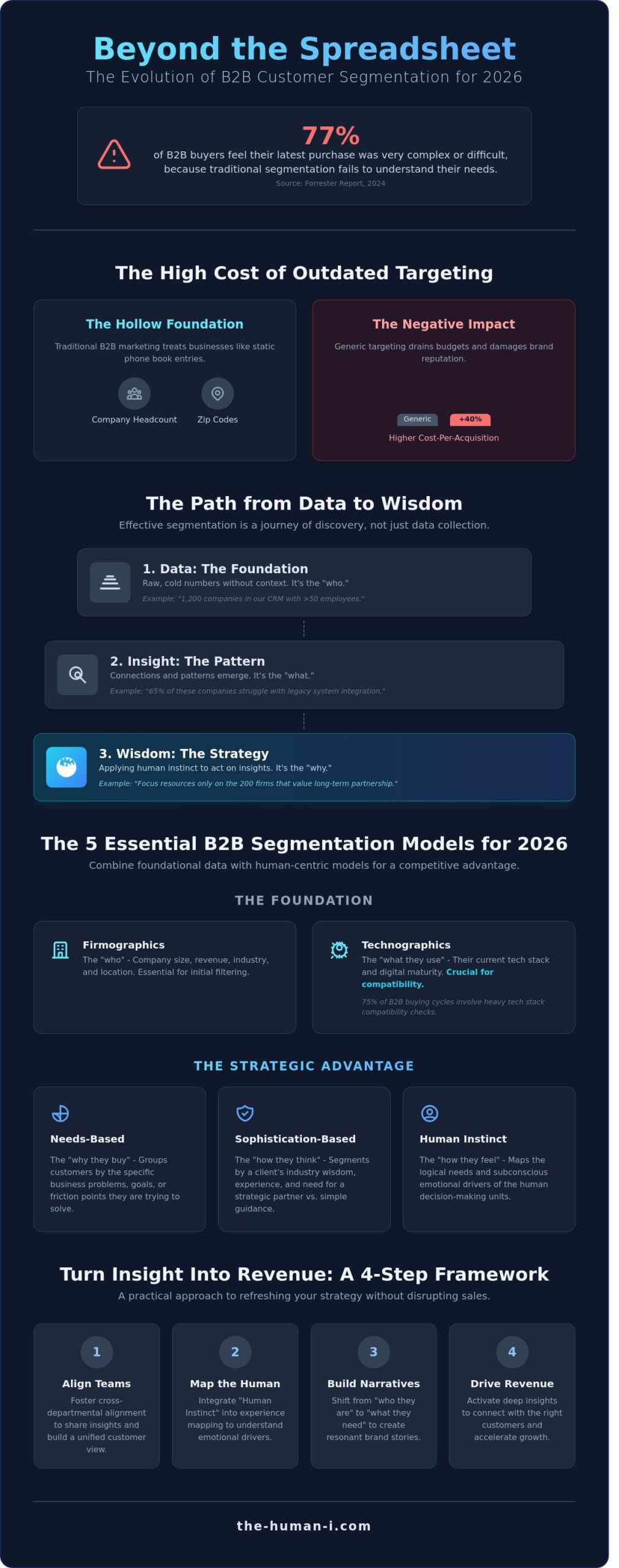
Most B2B marketing strategies are currently built on the hollow foundation of company headcount and zip codes, essentially treating a living business like a static entry in a phone book. A 2024 Forrester report found that 77% of B2B buyers feel their latest purchase was very complex or difficult. This friction often occurs because traditional customer segmentation models for b2b rely on cold data rather than human insight. You’ve likely felt the frustration of watching leads wither because your messaging feels like a form letter written for a skyscraper rather than a person.
It’s time to move beyond the surface. We’ll show you how to find the wisdom hidden within your spreadsheets to drive genuine brand growth. You’ll discover how to move beyond generic firmographics to human-centric models that prioritize instinct and strategic storytelling. We’ll provide a clear framework to align your marketing data with the psychological drivers of decision-making units, ensuring your brand stands out in 2026 through deeply personalized buyer journeys.
Key Takeaways
- Move beyond static spreadsheets to discover how a wisdom-led approach transforms raw data into a strategic journey of discovery.
- Uncover the five essential customer segmentation models for b2b that align your organizational expertise with the needs of a hyper-informed landscape.
- Master the shift from “who they are” to “what they need” by adopting needs-based lenses that build more resonant brand narratives.
- Integrate “Human Instinct” into your experience mapping to bridge the gap between logical B2B decision-making and subconscious emotional drivers.
- Learn the practical steps to refresh your strategy through cross-departmental alignment, turning deep insights into revenue without disrupting sales.
Beyond the Spreadsheet: Why B2B Customer Segmentation Needs Wisdom
B2B marketing isn’t about filling spreadsheets anymore. It’s a strategic journey of discovery. By 2026, the traditional approach of grouping companies by size or sector has become obsolete. Modern buyers are hyper-informed; they’ve already completed 70% of their research before they ever talk to a salesperson. If your message doesn’t resonate with their specific reality, you’re invisible. Effective customer segmentation models for b2b aren’t just data exercises. They’re about moving from simply looking for leads to actually finding the human motivations behind the purchase.
This shift requires a change in philosophy. Most teams get stuck in data collection, obsessed with firmographics and basic demographics. But true strategy is about insight. It’s the difference between knowing a company’s revenue and knowing why their procurement team fears a software migration. When you master what is customer segmentation, you stop shouting and start solving. This depth of understanding is what powers a successful brand strategy, ensuring your market positioning feels like a solution rather than a pitch.
The Cost of Generic Targeting
Shouting into the void with unsegmented lists is a guaranteed way to drain B2B budgets. Research from 2024 shows that companies using generic targeting see a 40% higher cost-per-acquisition compared to those with refined models. Beyond the financial loss, there’s a reputational risk. Stagnant audience definitions make a brand look out of touch, especially in fast-moving tech or service sectors. The segmentation-strategy gap is the primary barrier to B2B growth.
Insight, Data, and Wisdom: The Triad of Modern Segmentation
To build effective customer segmentation models for b2b, you must balance three distinct elements. Each serves a specific purpose in your growth engine:
- Data: These are the raw numbers. It’s the 1,200 companies in your CRM with more than 50 employees. It’s the foundation, but it’s cold and lacks context.
- Insight: This is where patterns emerge. You notice that 65% of those companies are struggling with legacy system integration. You’ve moved from “who” to “what.”
- Wisdom: This is the strategic decision to act. It’s choosing to ignore the 1,200 and focus only on the 200 firms that value long-term partnership over low-cost bidding. Wisdom is where you apply human instinct to data patterns.
When these three elements align, your marketing stops being a cost center and starts being a driver of value. It’s no longer about how many people you reach, but how deeply you understand the ones who matter. This is the hallmark of a brand that has moved beyond the spreadsheet and into the realm of true strategic wisdom.
The 5 Essential B2B Segmentation Models for 2026
One-size-fits-all strategy isn’t just lazy; it’s a liability. By 2026, the gap between companies using static lists and those using dynamic customer segmentation models for b2b will widen. We aren’t just sorting logos anymore. We’re mapping human intent within corporate structures. Real success depends on how you align these models with your internal expertise. Choosing the wrong model wastes resources; choosing the right combination creates a competitive moat.
Firmographics and Technographics: The Foundation
These are the table stakes. You must know company size, revenue, and location to filter the noise. However, in 2026, technographics carry more weight. A company’s digital maturity and current tech stack tell you if they’re ready for your solution. A 2023 Gartner study found that 75% of B2B buying cycles involve heavy tech stack compatibility checks. These metrics set the boundaries, but they don’t tell the story. They’re the starting point, never the destination.
Needs-Based and Sophistication Models
Real wisdom comes from understanding the “why.” Needs-based segmentation groups businesses by the specific friction points they’re trying to solve. To do this effectively, look at the B2B elements of value to identify which rational or emotional levers actually move your buyer. It’s about solving a business problem, not just selling a feature.
Sophistication-based segmentation is the next frontier. This model categorizes clients by their level of industry wisdom and experience. A sophisticated buyer wants a strategic partner who can challenge their thinking. A less experienced buyer needs education and hand-holding. Finally, profitability-based models ensure you prioritize segments driving long-term value. In 2024, industry data suggested that the top 20% of B2B customers often generate 150% of a company’s total profits, while the bottom 20% can actually cost money to serve.
Don’t settle for a single view. The most effective customer segmentation models for b2b are multi-layered. When you combine firmographic data with a deep understanding of customer sophistication, you stop guessing and start knowing. If you’re ready to uncover these deeper patterns, you might want to explore our solutions for strategic brand growth.
Firmographics vs. Needs-Based Models: Choosing Your Strategic Lens
Firmographics are the census data of the business world. They define the “who” using metrics like industry, revenue, and headcount. While these are essential for mapping your Total Addressable Market, they rarely explain why a purchase happens. When implementing customer segmentation models for b2b, the goal is to move from superficial stats to deep-seated motivations. Relying solely on static traits leads to stagnant brand positioning because it ignores the human instinct behind every corporate decision.
When to Prioritize Firmographics
Think of these metrics as a coarse filter for initial market expansion. If you’re mapping your reach, knowing that 12,400 companies in the UK fit your revenue criteria is a necessary starting point. However, a 2023 report from Forrester found that 56% of B2B buyers find generic, firmographic-based outreach irrelevant. In long-cycle sales, “who they are” is just the entry fee. Ailing brands often fail because they treat every $100M company the same, ignoring the internal friction that actually drives a sale. Use these models for initial prospecting, but don’t expect them to carry the weight of a complex narrative.
The Strategic Power of Needs-Based Segmentation
Needs-based customer segmentation models for b2b look past the office address to find the underlying “why.” This approach uncovers hidden narratives by focusing on desired outcomes rather than product features. When you align your strategy with a segment’s specific pain points, you’re no longer just selling software or services; you’re offering a path to relief. This requires empathy, a trait often missing in data-heavy environments. By understanding the emotional and professional stakes of your buyer, you can shape your expertise to meet real-world demands.
Critics often ask if this model is too complex to execute. It isn’t. It simply requires shifting from passive data collection to active discovery. A 2024 industry survey showed that companies using needs-based models saw a 15% increase in lead-to-opportunity conversion rates. This isn’t about more data; it’s about better wisdom. “Needs-based models transform a brand from a mere vendor into a strategic partner by proving you value their future as much as their current budget.” This shift is what separates market leaders from those just filling space in a crowded niche.
The Human Element: Mapping Segmentation to the Customer Journey
Data tells you what happened. Wisdom tells you why. While algorithms can categorize companies by revenue, they often fail to capture the “Human Instinct” driving the boardroom. In 2026, the most effective customer segmentation models for b2b shift focus from static accounts to dynamic buying groups. Gartner’s 2024 research highlights that the average B2B buying group now includes 6 to 10 stakeholders. Each person brings a unique psychological profile to the table.
We integrate these nuances into our solutions for experience mapping. It’s about recognizing that a business doesn’t buy software; a group of humans buys a solution to a specific pain. Mapping this journey requires a narrative that resonates at every touchpoint, from the initial discovery to the final signature.
Segment-Specific Journey Mapping
Your narrative must pivot based on the buyer’s maturity. A “Sophisticated” buyer, perhaps a veteran CTO, ignores high-level fluff. They want technical integration data and ROI projections. Conversely, a “Beginner” buyer needs education and risk mitigation. Storytelling isn’t a one-size-fits-all script. It’s a flexible framework. According to the 2024 Edelman-LinkedIn B2B Thought Leadership Impact Report, 73% of decision-makers state that an organization’s thought leadership is a more trustworthy basis for assessing capabilities than standard marketing materials. We use reputation measurement to track how these specific segments perceive your brand’s authority over time.
Data-Driven Personas with Soul
It’s time to retire “IT Manager Ian” and other cliché personas. These cardboard cutouts lack the behavioral drivers that actually trigger a purchase. Does your segment fear career stagnation, or are they motivated by being an internal disruptor? Qualitative research is the only way to validate these drivers. It moves you past the “what” and into the “why,” ensuring your personas reflect the actual market wisdom. When you understand the soul of the segment, your customer segmentation models for b2b become a roadmap for genuine connection rather than just a spreadsheet of targets.
Ready to move beyond data and find the wisdom in your market? Explore how we can help you refine your B2B strategy.
Refreshing Your B2B Strategy: How to Turn Insight into Revenue
Implementation is where most strategies fail. To shift your customer segmentation models for b2b from a spreadsheet into a revenue engine, you must bridge the gap between the boardroom and the front line. Sales teams often resist new models because they fear disruption to their established pipelines. You can mitigate this by treating the rollout as a series of controlled experiments rather than a sudden, jarring pivot.
Success requires total alignment between Marketing, Sales, and Product. If your product team builds features for one group while Sales targets another, your growth will stall. Move your KPIs beyond simple lead volume. Focus on metrics like Customer Acquisition Cost (CAC) payback periods and net revenue retention. A 2023 study by McKinsey showed that companies using advanced personalization and segmentation see a 10% to 15% lift in revenue. Aim for these substantial shifts rather than incremental gains that don’t move the needle.
The Implementation Roadmap
Start with a ruthless audit of your existing data to identify siloes. Once you have a clean slate, select from the most effective customer segmentation models for b2b that reflect your 2026 goals. Validate this model through qualitative research; talk to your customers to see if the data matches their reality. You must unlearn the assumption that your audience is a monolith. A 2024 report found that 73% of B2B buyers now expect a B2C-like personalized experience, making old audience assumptions obsolete.
- Audit: Identify where your data is stale or siloed across departments.
- Pilot: Test the new segment narrative with a small 15% cohort before a full-scale brand refresh.
- Execute: Build a narrative that speaks to the specific, profound pain points of the new segment.
Finding What Matters
The chef Ferran Adria famously noted that in creativity, what you find is more important than what you look for. This philosophy is the heart of strategic wisdom. Most firms look for patterns they already recognize. True insight happens when you uncover the unexpected friction or the hidden motivation that your competitors have missed. It’s the difference between having a database and having a direction.
We invite you to move past superficial analysis. Stop collecting data points and start building a foundation of wisdom that refreshes your brand and empowers your team. Contact us to start your journey of discovery and redefine how you see your market.
Activating Your Strategic Advantage for 2026
The transition from static spreadsheets to dynamic growth demands a fundamental shift in perspective. By 2026, the most successful firms will move beyond basic firmographics to embrace sophisticated customer segmentation models for b2b that prioritize human needs and behavioral insights. You’ve seen how integrating these five essential models and mapping the customer journey can bridge the gap between cold data and actionable wisdom. It’s about finding what truly matters to your audience rather than just looking at what’s available in a database.
Human Instinct brings a wealth of experience across Insight, Strategy, and Storytelling to help you uncover the profound truths others miss. With global expertise spanning Financial Services, Tech, and Automotive sectors, we provide the data-driven wisdom needed to revitalize stagnant brands. We focus on the discovery process to ensure your strategy is as intelligent as it is impactful. Discover how Human Instinct’s market segmentation services can refresh your brand.
Your data holds the map to your future success. It’s time to start the journey toward deeper understanding and renewed growth.
Frequently Asked Questions
What is the most effective customer segmentation model for B2B?
The most effective customer segmentation models for b2b combine firmographics with needs-based insights to create a hybrid framework. While firmographics tell you who a company is, needs-based data explains why they buy. A 2024 Harvard Business Review report suggests that companies using hybrid models see a 15% increase in sales productivity. This approach moves beyond surface-level data to find the wisdom in customer behavior and motivations.
How does B2B segmentation differ from B2C models?
B2B segmentation focuses on a complex decision-making unit rather than a single impulsive consumer. In B2B, you’re often selling to a group of 6 to 10 stakeholders, each with different motivations and technical requirements. B2C models usually target individual psychological triggers. B2B requires a deeper look at organizational goals and long-term value. It’s about navigating a collective mindset to find the path to a shared, rational solution.
How many segments should a B2B company have?
Most B2B companies find their sweet spot with 3 to 5 distinct segments. Having more than 5 segments often leads to diluted marketing efforts and operational confusion for the sales team. A 2025 study by Gartner indicates that firms focusing on 4 primary segments achieve 20% higher engagement rates. It’s better to deeply understand a few high-value groups than to have a superficial grasp of a dozen different categories.
Can you use firmographics and needs-based segmentation together?
You can and should use firmographics and needs-based segmentation together to form a multi-dimensional view of your market. Firmographics act as the filter to identify your total addressable market, while needs-based data drives the actual messaging and strategy. According to SiriusDecisions, this dual approach helps 68% of high-growth companies align their product development with real-world demand. It’s the difference between knowing a lead’s location and knowing their business pain.
What data do I need to start a B2B segmentation analysis?
You need a mix of quantitative CRM data and qualitative customer interviews to build a robust model. Start with at least 12 months of transaction history and firmographic details like annual revenue or headcount. Then, layer in insights from 15 to 20 deep dive customer interviews to understand the human motivations. This combination transforms raw numbers into a strategic narrative. Without the human element, your data is just a cold spreadsheet.
How often should a B2B company refresh its segmentation model?
A B2B company should refresh its segmentation model every 12 to 18 months to stay aligned with market shifts. Markets move fast, and a model from 2023 won’t account for the AI-driven changes of 2026. Regular audits ensure your segments still reflect the current economic environment. If your win rates drop by more than 10% in a single quarter, it’s a clear signal that your segments need a strategic rethink.
What is sophistication-based segmentation in B2B?
Sophistication-based segmentation categorizes clients by their operational maturity and technological readiness. Instead of looking at company size, you look at how they use your specific category of product. A Level 1 company might need basic education, while a Level 5 firm requires advanced API integrations and custom support. This model helps you tailor your service delivery. It ensures you aren’t selling a race car to someone who’s still learning to drive.
How does segmentation impact B2B brand strategy?
Segmentation acts as the blueprint for your B2B brand strategy by defining which problems your brand is uniquely qualified to solve. It allows you to move away from a one size fits all message that usually fits no one. By applying customer segmentation models for b2b, brands can achieve a 30% higher return on ad spend through hyper-relevant positioning. It turns a generic brand promise into a series of specific, high-value commitments to your clients.



