


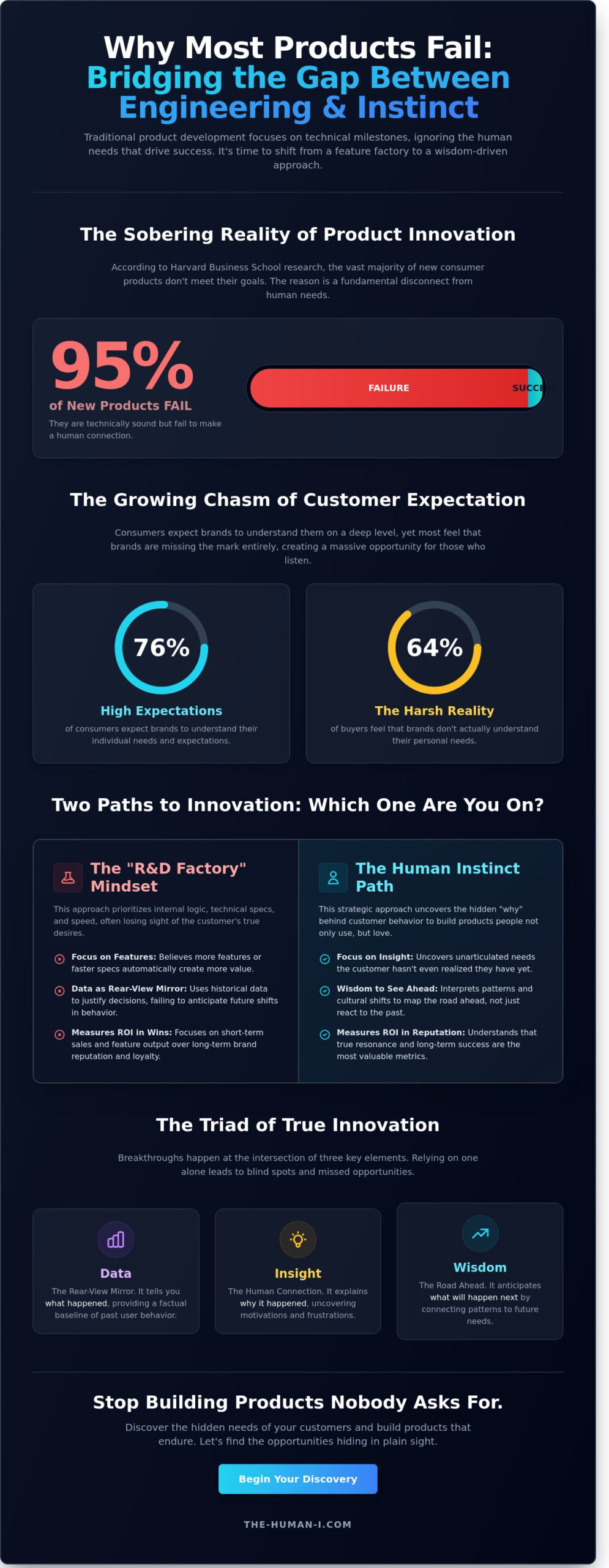
A staggering 95% of new consumer products fail every year, according to research by Harvard Business School professor Clayton Christensen. It’s a sobering reality for leaders who pour millions into R&D only to find their latest features met with a collective shrug from the market. This disconnect suggests that traditional innovation consulting for product development often prioritizes technical milestones over the messy, unpredictable nature of human instinct. You’ve likely felt this tension when a product looks perfect on a spreadsheet but fails to ignite any real spark in your customers.
You know that technical excellence isn’t enough to survive in a market where 76% of consumers expect brands to understand their needs and expectations, as reported in a 2022 Salesforce study. You’ve seen agile competitors with half your budget steal market share because they prioritize human insight over sheer processing power. This article will show you how to bridge the gap between engineering and empathy to build products that don’t just function, but endure. We’ll explore a strategic framework for achieving product-market fit and refreshing your brand narrative to drive measurable growth.
Key Takeaways
- Stop building features nobody asked for by uncovering the hidden friction between engineering logic and human instinct.
- See why data is just a rear-view mirror and how innovation consulting for product development uses wisdom to map the road ahead.
- Adopt a discovery framework designed to help you stop “searching” for the next big thing and start “finding” the opportunities hiding in plain sight.
- Shift your ROI lens from short-term wins to long-term reputation, using it as a vital metric for measuring the true resonance of your innovation.
- Identify the specific, depth-revealing questions that distinguish a high-volume “R&D factory” from a truly wisdom-driven strategic partner.
Why Product Innovation Stagnates: The Gap Between Engineering and Instinct
Innovation consulting for product development often gets mistaken for a simple R&D tune-up. Many leaders view it as a way to make the “factory” run faster or cheaper. In reality, true innovation happens where data meets human wisdom. Most companies fall into the trap of feature-first development. They build faster processors or add more buttons, then wonder why the market responds with a collective shrug. This disconnect creates a wide gap between engineering prowess and human instinct.
Success in the new product development process requires more than a checklist of technical milestones. It demands an obsession with insight over mere solutions. A solution fixes a known problem; an insight uncovers a need the customer hasn’t even articulated yet. When brands lose this spark, they become “ailing brands,” surviving on legacy rather than relevance. They’re still moving, but they’ve lost their direction.
The Trap of Technical Excellence
High-spec products fail when they lack a human connection. You’ve seen it before: the smartphone with ten cameras that nobody wants to hold, or the enterprise software with 500 features that feels like a chore to use. A study by Harvard Business School researchers indicates that 95 percent of the 30,000 new products launched every year fail to meet their targets. This happens because the focus remained on “what we can build” rather than “what they need to find.”
The cost of mismanaging product-market fit in established industries is astronomical. When a product is built in a vacuum, it ignores the emotional triggers that drive a purchase. To fix this, teams must pivot their perspective. We look for the following indicators of technical traps:
- Over-engineering for edge cases that 98 percent of users never encounter.
- Prioritizing internal manufacturing convenience over external user experience.
- Ignoring the psychological “why” behind a customer’s choice.
Refreshing Stagnant Product Narratives
Product lines lose their “why” when they stop telling a story. You can identify stagnation when your team talks more about margins than missions. According to 2023 consumer sentiment reports, 64 percent of buyers feel brands don’t actually understand their personal needs. This is where external perspectives become vital. They uncover hidden value that internal teams, often blinded by the “R&D factory” mindset, simply miss.
Refreshing a stagnant narrative isn’t about a new logo or a louder ad campaign. It’s about rediscovering the core purpose of the object itself. By leveraging professional brand strategy services, companies can bridge the gap between their engineering capabilities and the market’s desires. This type of innovation consulting for product development ensures that when you finally build the solution, it’s one the world was actually waiting to find. It transforms a functional tool into an essential part of a customer’s life.
The Triad of Innovation: Where Insight, Data, and Wisdom Meet
Most R&D labs function like high-speed factories. They churn out features, patents, and prototypes with mechanical precision. But a factory mindset often ignores the human element. At Human Instinct, we believe true breakthrough occurs where insight, data, and wisdom intersect. This triad is the heartbeat of effective innovation consulting for product development. It moves the process away from guesswork and toward a strategic certainty that resonates with the end user.
Data is often treated as a crystal ball, but it’s actually a rear-view mirror. It tells you exactly what happened in 2023, but it can’t tell you how a customer’s heart will change by 2025. Relying on big data alone is like trying to drive a car while looking only at the tail lights behind you. To see through the windshield, you need wisdom. This is the ability to interpret patterns, anticipate cultural shifts, and understand the “why” behind the “what.”
Storytelling is the glue that binds these elements. When an R&D team is buried in technical specifications, they often lose sight of the market reality. We use narrative to align engineers, designers, and stakeholders. According to the University of Phoenix, product innovation is fundamentally about creating value that didn’t exist before. Storytelling ensures that every member of the team understands exactly what that value looks like to a living, breathing person.
Data as the Foundation, Not the Ceiling
We use quantitative data to validate ideas, not just to generate them. While 95% of new products fail according to Harvard Business School research, many of those failures stem from a “cliché of analytics” where companies follow the same surface-level trends. We dig deeper. We incorporate reputation measurement into the development cycle to see how a brand’s standing affects product adoption. It’s about finding the hidden signals in the noise that others miss.
The Wisdom to Execute
Execution is where most brilliant ideas go to die. Seasoned experts don’t just hand over a report; they translate raw insights into actionable product roadmaps. This requires the discipline of brand planning. We ensure that every new feature fits the long-term identity of the company. By integrating our solutions into existing corporate structures, we help teams navigate internal politics and technical hurdles. It’s a journey of discovery that turns a stagnant brand into a market leader. If your current pipeline feels stuck, it might be time to rethink your approach with a more human-centric lens.
A Framework for Discovery: Mapping the Customer Journey
Innovation isn’t a scavenger hunt. It’s a discovery process. When we apply innovation consulting for product development, we shift the focus from “searching” for a random idea to “finding” the truth already present in the market. This distinction is vital. Searching implies you’re looking for something that might not exist, while finding is about seeing what others have overlooked. This framework moves beyond the walls of the R&D factory to ground every new feature in human reality.
To move beyond guesswork, we utilize a 4-step framework: deep segmentation, experience mapping, insight synthesis, and strategic ideation. By the time you reach the final stage, the product isn’t a gamble. It’s a calculated response to a documented reality. This methodical approach ensures that every dollar spent on development targets a specific, high-value outcome.
Step 1: Deep Market Segmentation
Demographics tell you who bought a product, but they rarely tell you why. Relying on age, gender, or zip codes is a legacy approach that misses the psychological drivers of modern consumption. We look for the “white space” in saturated markets by analyzing behavioral and psychological triggers. Market segmentation is a tool for discovery that partitions a broad market into distinct subsets based on shared human needs.
A 2023 analysis by Harvard Business School researchers suggested that 95 percent of new products fail, often because firms use ineffective segmentation. We avoid this trap by identifying niche audiences that are currently underserved by “one size fits all” solutions. These high-value groups often have specific pain points that, when solved, create intense brand loyalty. By focusing on these clusters, we find opportunities that competitors miss because they’re too busy looking at the averages.
Step 2: Customer Experience Mapping
Every friction point in a customer’s day is a hidden blueprint for a new product. Mapping the journey allows us to see the “unmet needs” that customers often can’t articulate. While digital tools provide the raw data, the human element provides the wisdom to interpret it correctly. We don’t just look at clicks; we look at the intent and the emotion behind them.
We focus on the emotional highs and lows of the user journey. If a user feels anxious or frustrated at a specific touchpoint, that’s exactly where the innovation belongs. This level of insight requires a specific perspective and a deep history of analyzing consumer patterns. It’s about understanding our team’s wealth of experience in decoding human behavior to turn data into strategy. When you combine hard data with this kind of strategic wisdom, the path for innovation consulting for product development becomes clear.
The final steps of our framework involve synthesizing these friction points into a cohesive strategy and moving into rapid ideation. This ensures that the final product doesn’t just exist in a vacuum. It solves a problem that people actually have, in a way that aligns with your brand’s unique strengths.
Measuring Reputation: The ROI of Innovation Consulting
The most common pushback against strategic advice is a simple, blunt question: How do we know it’s working? Traditional R&D departments often measure success by the number of patents filed or prototypes built. While these are tangible, they don’t account for market reception. Innovation consulting for product development demands a more sophisticated yardstick. We look at reputation as a leading indicator of financial performance rather than a byproduct of it.
A 2023 study by the Reputation Institute found that a 5-point increase in a company’s reputation score correlates with a 6.3% increase in consumer intent to purchase. We help clients move away from generic KPIs like “social mentions” or “site traffic” to meaningful metrics. These track how your brand’s wisdom is perceived by your core audience before a single unit even ships. It is the difference between launching into a vacuum and launching into a waiting crowd.
The Value of Brand Perception
Strong brand narratives do more than just sound good. They slash customer acquisition costs. When a company’s reputation precedes its product, the market does the heavy lifting. This halo effect ensures a well-positioned launch commands the market immediately. By aligning features with a clear brand promise, companies often see a 20% reduction in marketing spend. Explore our approach to brand strategy and growth to see how perception drives adoption.
Adoption rates are rarely about technical superiority alone. They are about the trust a user feels when they interact with a new solution. If the brand perception is one of stagnation, even a revolutionary product will struggle to gain traction. We measure this through pre-launch sentiment analysis and “willingness to pay” surveys that compare your new concept against established competitors.
Strategic Wisdom in Financial and Health Sectors
In regulated industries like health and finance, reputation acts as a shield. During the 2022 automotive shift to EVs, legacy brands with clear “future-ready” narratives maintained higher investor confidence than those without. Innovation consulting for product development helps these high-stakes players manage risk through strategic storytelling. It ensures that when you pivot, your customers don’t feel abandoned; they feel like they are part of a calculated evolution.
- Health Tech: Using data-backed insights to prove efficacy and build trust before clinical trials conclude.
- Fintech: Establishing incumbent-level security trust for disruptive digital tools that challenge traditional banking.
- Automotive: Positioning hardware updates as part of a larger, visionary mobility ecosystem.
Storytelling protects brand equity during radical disruption. It transforms a risky product launch into a logical next step for the company. This strategic alignment ensures that every dollar spent on innovation also buys you a more resilient brand. If you are ready to turn your product roadmap into a reputation powerhouse, get in touch with our team.
Finding Your Strategic Partner: The Human Instinct Path
Choosing a partner for innovation consulting for product development isn’t about finding the fastest assembly line. It’s about the distinction between a “factory” that processes inputs and a wisdom-driven partner that understands human nuances. Factories deliver reports; partners deliver clarity. While a factory might hand over a 100-page slide deck filled with generic market trends, a strategic partner identifies the specific emotional triggers that drive your customer’s next purchase.
To reveal if a firm possesses the depth you need, look past their client list and examine their thinking. Ask these three questions during your evaluation:
- How do you bridge the gap between raw data and actual human behavior?
- Can you share an example where your insight changed a product’s fundamental strategy, not just its visual design?
- What specific methods do you use to ensure our internal team can sustain this momentum after the engagement ends?
The core of successful development is what we call Human Instinct. It’s the intersection where data meets experience. We don’t just look at what people do; we uncover why they do it. This approach ensures that your product doesn’t just fill a gap in the market, but creates a meaningful connection with the user.
The Collaborative Journey
The first 90 days of an engagement define the trajectory of the project. During the initial 30 days, we move beyond surface-level briefings to immerse ourselves in your brand’s unique challenges. By day 60, we’ve transitioned from observation to identifying the “hidden truths” that your competitors have overlooked. By the 90-day mark, your team isn’t just receiving a final presentation. They’re equipped with a strategic framework and the storytelling tools needed to champion the project internally. We believe innovation consulting for product development should leave your organization smarter, more confident, and ready to lead.
Start Your Discovery
Real insight doesn’t happen in a rushed pitch meeting or a standardized discovery workshop. It starts with a thoughtful, unhurried conversation where we listen as much as we speak. We invite you to explore our specific sector expertise to see how we’ve applied our methodology across diverse industries. As Ferran Adria famously suggested, creativity is about what you find, not just what you look for. We’re here to help you find the extraordinary in the ordinary.
Reclaiming the Edge of Discovery
Engineering alone won’t save a stagnant brand. Real breakthroughs happen when you bridge the gap between technical data and human instinct. We’ve seen this transformation drive growth across the Financial Services, Automotive, and Tech sectors. It’s about moving past the R&D factory and embracing a triad where insight, data, and wisdom meet. By mapping the customer journey with precision, you turn abstract ideas into measurable reputation and long term ROI.
Effective innovation consulting for product development requires more than a checklist. It demands a strategic partner who understands the deep disciplines of Insight, Strategy, and Storytelling. Our team brings years of experience in refreshing brands that have lost their momentum. We don’t just look for answers; we find them by digging into the human motivations that data alone often misses. It’s time to stop guessing and start building with clarity. Your next breakthrough is waiting to be uncovered.
Uncover the insights your brand has been missing, contact Human Instinct today.
Frequently Asked Questions
What is innovation consulting for product development?
Innovation consulting for product development is a strategic partnership that bridges the gap between raw data and commercial wisdom. It isn’t just about building a better gadget; it’s about uncovering the human needs that drive purchase decisions. We help you move past the factory mindset to find products that actually resonate with your audience’s instincts.
How does innovation consulting differ from traditional R&D?
Traditional R&D lives in the lab, but innovation consulting lives in the market. While R&D teams focus on technical feasibility, consultants prioritize commercial viability and human desire. A 2023 report by Strategy& found that the top 10% of innovators spend less on R&D as a percentage of sales but focus more on aligning their strategy with customer insights.
Why do most new products fail to gain market traction?
Products fail because they solve problems that don’t exist. According to a 2021 CB Insights study, 35% of businesses fail because there’s no market need for what they’ve built. Most companies focus too much on the how of manufacturing and forget the why of the consumer’s daily life. We use data and wisdom to ensure your product has a reason to exist.
What industries can benefit from innovation consulting?
Every sector from healthcare to consumer electronics benefits from innovation consulting for product development to maintain a competitive edge. High stakes industries like automotive and fintech, which contributed to a $900 billion global consulting market in 2022, use these insights to navigate rapid disruption. If your industry is changing, you can’t rely on the same old playbook to keep your brand relevant.
How do you measure the success of an innovation strategy?
Success is measured by the Vitality Index and the speed of your feedback loops. Companies like 3M famously use this index to track the percentage of total revenue coming from products launched within the last 5 years. We also look at customer acquisition costs and market share growth to prove that your strategy is delivering more than just abstract ideas.
Can small businesses benefit from product development consulting?
Small businesses often gain the most from external expertise because it levels the playing field against corporate giants. A 2022 industry survey revealed that small firms using external strategic frameworks saw a 15% improvement in their speed to market. You don’t need a massive budget to apply the same intellectual rigor that drives the world’s most successful brands.
What role does brand strategy play in product innovation?
Brand strategy provides the narrative framework that gives a new product its meaning. It ensures that every innovation feels like a natural chapter in your company’s story rather than a random experiment. Interbrand’s 2023 Best Global Brands report highlights that companies with strong, consistent brand identities grow their value 2.5 times faster than those without a clear strategic focus.



