


Most customer journey maps are beautiful, insightful, and utterly useless.
You’ve seen them: intricate diagrams presented in a single meeting, only to be filed away and forgotten. It’s a legitimate fear, the sinking feeling that you’re paying for a deliverable, not a strategy. This confusion is amplified when quotes from freelancers land thousands of dollars apart from those of global firms, leaving you to wonder what you’re actually buying.
This guide cuts through that noise. We’re here to provide a transparent breakdown of the customer journey mapping consultant cost you can expect in 2026, moving beyond the price tag to uncover the value drivers that separate a static file from a strategic, revenue-generating asset.
Together, we’ll explore the distinct cost tiers, provide a framework for evaluating a consultant’s true expertise, and show you how to secure a journey map that delivers genuine business wisdom.
Key Takeaways
- Discover why the true value of a journey map lies in the strategic depth of the insight uncovered, not just the visual output it creates.
- Identify the right level of investment for your brand, whether you need a quick tactical map or a deep strategy that reveals new growth opportunities.
- Navigate the diverse landscape of the customer journey mapping consultant cost by understanding the distinct advantages of freelancers, agencies, and true strategic partners.
- Reframe your budget conversation by calculating the “Cost of Inaction” and learn how a strategic map directly reduces customer acquisition costs.
What Determines the Cost of Hiring a Customer Journey Mapping Consultant?
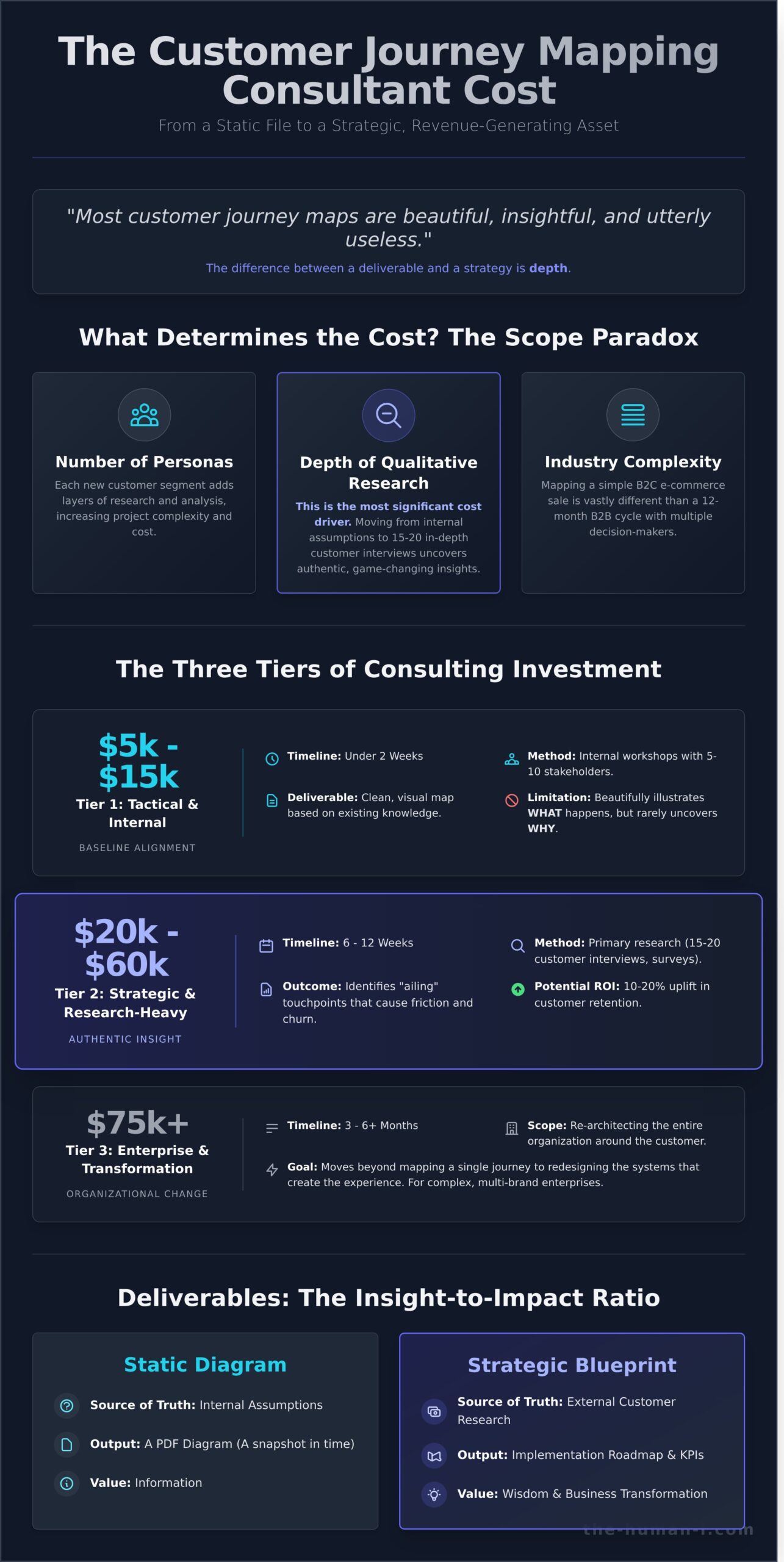
Understanding the customer journey mapping consultant cost begins with a critical shift in perspective. Don’t think of it as purchasing a document; see it as a strategic investment in brand intelligence. The practice of customer journey mapping is not about creating a colorful diagram. It’s about uncovering the hidden frictions and emotional drivers that shape customer loyalty and lifetime value. This distinction is the key to understanding the “Scope Paradox”: why a $5,000 map and a $50,000 strategic initiative can look similar at a glance but deliver profoundly different results.
The price is ultimately a function of depth. A consultant’s quote is shaped by three core variables that determine the project’s rigor and potential for impact:
- Number of Personas: A project focused on a single, primary customer segment will be less complex than one that needs to map distinct journeys for three or four different user personas. Each new persona adds a layer of research and analysis.
- Depth of Qualitative Research: This is the most significant cost driver. Relying solely on internal assumptions is fast and cheap. Engaging in 15-20 in-depth, one-on-one customer interviews is an investment that uncovers authentic, game-changing insights.
- Industry Complexity: Mapping a simple B2C e-commerce transaction is fundamentally different from charting a 12-month B2B sales cycle involving multiple decision-makers. Complex, high-consideration journeys require more extensive investigation.
Data collection is a commodity. The real value emerges from synthesis, where seasoned expertise moves beyond charts and graphs to uncover the unarticulated needs that truly drive customer behavior. It’s the difference between information and wisdom.
The Scope of Research: Data vs. Assumptions
The core difference in the customer journey mapping consultant cost lies in the source of truth. A low-cost project often relies on internal stakeholder workshops, which risk mapping what your business thinks the journey is. A high-value project is built on external customer interviews, ethnography, and data analysis. This uncovers the journey as it truly exists. Mapping five “moments of truth” for a B2C brand is far less intensive than analyzing twenty critical touchpoints in a complex B2B ecosystem.
Deliverables: Static Diagrams vs. Strategic Blueprints
A basic engagement might end with a PDF diagram-a snapshot in time. A strategic engagement delivers a comprehensive blueprint for action, including an implementation roadmap, prioritized opportunities, and key performance indicators. This “wisdom-led” approach demands more senior-level consulting hours because it focuses on translating findings into tangible business strategy. The Insight-to-Impact ratio defines the portion of your investment dedicated to creating transformative business actions versus merely producing a static diagram.
The Three Tiers of Customer Journey Consulting Investment
Understanding the customer journey mapping consultant cost requires looking beyond a simple price tag. The investment is a direct reflection of ambition. Are you looking for a quick visual aid to align your team, or are you seeking a fundamental shift in how your entire organization perceives the customer? The answer determines the depth of the engagement, which we see in three distinct tiers.
Tier 1: Tactical and Internal ($5,000 – $15,000)
This is the entry point. It’s a rapid, workshop-based exercise designed for startups or internal teams needing to establish a baseline understanding of their customer’s path. Typically completed in under two weeks, it relies on the existing knowledge of 5-10 key stakeholders. The deliverable is a clean, visual map. Its primary limitation? It beautifully illustrates what happens, but rarely uncovers why. It’s a photograph, not the full story.
Tier 2: Strategic and Research-Heavy ($20,000 – $60,000)
Here, we move from internal assumptions to external truths. This tier is built on a foundation of primary research, involving 15-20 in-depth customer interviews, competitor analysis, and often quantitative segmentation across 1,000+ survey respondents. The goal is to uncover the authentic customer narrative, identifying the “ailing” touchpoints that cause friction and churn. This level of insight is where the true Benefits of a Customer Journey Map, like a 10-20% uplift in customer retention, begin to materialize. Engagements are deep, typically lasting 6-12 weeks.
Tier 3: Enterprise and Transformation ($75,000+)
This isn’t just about mapping a journey; it’s about re-architecting the organization around it. Reserved for complex businesses in sectors like Financial Services or Automotive, this work integrates journey mapping into holistic brand strategy. It aligns disparate departments-from marketing and sales to product and compliance-around a single, powerful customer story. The insights gathered here don’t just fix problems; they fuel new product development, shape brand reputation, and create sustainable competitive advantages. It’s a catalyst for total brand transformation.
The critical difference between these tiers isn’t just the budget. It’s the gap between raw data and strategic wisdom. A Tier 2 project might tell you that 45% of customers abandon their cart, but it takes a deeper level of insight to understand the emotional trigger behind that click. This is where we focus our energy: translating numbers and transcripts into actionable human truth. Understanding which tier fits your ambition is the first step. Explore our approach to uncovering customer truths to see how deep the story can go.
Comparing Consultant Models: Freelance vs. Agency vs. Strategic Partner
The price you pay for customer journey mapping isn’t just a number. It’s a direct reflection of the expertise, depth, and strategic value you receive. The total customer journey mapping consultant cost is directly tied to the delivery model you choose, and each comes with distinct trade-offs.
Freelancers: Often the most budget-friendly option, with hourly rates typically between $100 and $250. A freelancer offers maximum flexibility and is perfect for tactical, well-defined tasks. Think mapping a single onboarding sequence or a specific digital checkout process. Their limitation is strategic depth; they deliver a map, but rarely the organizational change management required to implement its findings across complex business units.
Big-4 Consultancies: At the other end of the spectrum, you have the global giants. Engaging a firm like Deloitte or PwC for journey mapping often means a starting investment of over $250,000. You are buying brand prestige and immense scale. However, the work is frequently executed by junior teams using established, often rigid, frameworks. A 2023 report by Source Global Research found that while large firms are hired for their reach, clients often feel the final output lacks the bespoke insight needed for true transformation.
Boutique Strategic Partners: This model balances senior expertise with a customized approach. You work directly with seasoned partners, not a revolving door of associates. The investment is in the mid-to-high tier, but the return is in the quality of the thinking. It’s less about a templated deliverable and more about uncovering the nuanced, often unarticulated, human needs that drive customer decisions. This is where insight, data, and wisdom converge. It’s the philosophy behind our solutions; we focus on the human story within the data to shape strategy that sticks.
The “Who” Matters: Seniority vs. Scalability
Ask yourself a critical question: is your budget paying for a partner’s two decades of wisdom or a junior analyst’s 200 hours of billable time? A senior consultant’s real value is navigating the complex stakeholder politics that can derail any project. To spot a templated map before signing, ask to see anonymized past work. If they all follow an identical visual format and structure, you’re likely looking at a cookie-cutter process, not a bespoke investigation.
Hidden Costs and Engagement Models
Look beyond the initial proposal. For a discrete project like journey mapping, a fixed project-based fee provides cost certainty. A retainer model is better suited for ongoing advisory work. Be sure to clarify these potential add-ons:
- Workshops: Facilitating stakeholder workshops can add $5,000 – $15,000 per session to the bill.
- Travel & Expenses: Typically billed at cost and can quickly escalate for multi-location projects.
- Software Licensing: Access to platforms like Miro, Qualtrics, or UserTesting is rarely included and can represent an additional $2,000 – $10,000 annually.
Calculating ROI: When Does a Journey Map Pay for Itself?
Discussions about a customer journey mapping consultant cost often focus on the wrong variable. The critical question isn’t “What is the upfront investment?” but rather, “What is the Cost of Inaction (COI)?” Every day you operate without a clear, data-backed understanding of your customer’s experience, you are leaking revenue through friction, missed opportunities, and customer churn.
The COI is tangible. According to Forrester research from 2022, companies that lead in customer experience (CX) outperform laggards by nearly 80% in revenue growth. The investment in mapping isn’t an expense; it’s a direct play for market leadership. It shifts the entire financial equation from a cost-centric mindset to one focused on strategic, measurable returns.
By mapping the journey, you uncover the precise moments of truth that define your relationship with customers. This insight directly impacts your two most important growth metrics:
- Customer Acquisition Cost (CAC): Journey mapping provides the wisdom to stop wasting budget. Instead of broad campaigns, you can pinpoint the exact channels and messages that resonate with high-value segments. A 2023 analysis by HubSpot found that targeted segmentation can reduce CAC by as much as 50% by eliminating ineffective ad spend.
- Lifetime Value (LTV): A better experience reduces churn. Bain & Company data confirms that a mere 5% increase in customer retention can boost profitability by 25% to 95%. A journey map identifies the friction points causing customers to leave, giving you a clear roadmap to fix them and dramatically increase LTV.
The Efficiency Gain: Reducing Friction
Consider a key moment in your sales funnel where you see a 10% drop-off. A journey map uncovers the ‘why’ behind that number. By addressing the core issue, achieving even a 5% increase in conversion at that single touchpoint can translate into tens of thousands of pounds in new revenue. We saw this with a B2B SaaS client; refreshing their stagnant brand narrative around the ‘onboarding’ phase alone increased user engagement by 35% in the first 60 days.
Long-term Brand Value
A journey map is a powerful tool for de-risking innovation. It moves product development from guesswork to a strategic response to documented customer needs and frustrations. This is where data meets wisdom, allowing you to anticipate what your customers will need next. A customer journey map is an appreciating asset; its value grows as it is continually updated with new data, informing smarter strategic decisions over time.
The initial customer journey mapping consultant cost is dwarfed by the long-term value it creates. You’re not just buying a document; you’re investing in a new way of seeing your business through your customers’ eyes.
Ready to turn deep customer insight into a measurable financial return? Discover how we build strategies that pay for themselves.
Strategic Wisdom: The Human Instinct Approach to Experience Mapping
Many consultancies focus on what you ask them to look for. They build a journey map based on a known process, confirm a few assumptions, and deliver a tidy report. The problem is, genuine growth doesn’t come from confirming what you already suspect. It comes from what you find when you’re not explicitly looking.
This is the core of our philosophy. We believe the most powerful insights are uncovered in the unplanned detours and unexpected connections within a customer’s experience. Our work is a discipline of strategic discovery, designed to find the hidden truths that can refresh an ailing brand or unlock its next chapter of growth. It’s about moving beyond the flowchart to the fundamental human story underneath.
We achieve this by integrating three distinct layers of understanding: data, insight, and wisdom. Data tells us what is happening. Insight explains why it’s happening. But wisdom, born from decades of cross-sector experience, tells us what to do about it. This synthesis transforms a simple map into a strategic compass for your entire organization, making the conversation about customer journey mapping consultant cost one of long-term investment, not short-term expense.
Beyond the Data Points
Our senior-led model ensures you partner directly with seasoned strategists, not junior analysts. You get the distilled wisdom from our work across diverse sectors, from Health & Beauty to Financial Services and Technology. We deliver bespoke insights that resonate with your unique challenges, not a templated report. You can learn more about our philosophy of strategic discovery and the talent behind it.
Ready to Refresh Your Brand Narrative?
A successful engagement begins with a powerful question. Before our first discovery call, we encourage you to think beyond the immediate deliverable. Instead of “We need a journey map,” consider, “What is the critical business problem we need to solve?” To get the most from your investment, here’s how to prepare and what to expect:
- Prepare for the Call: Come with your most pressing business challenges and the assumptions you hold about your customers. Be ready to question everything.
- Your First 30 Days: Expect a period of deep immersion where our team interviews key stakeholders, reviews existing data, and begins to frame the core hypotheses that will guide our discovery process.
If you’re ready to find the human story in your data and build a more resonant brand, let’s begin the conversation. Contact Human Instinct to discuss your journey mapping needs.
From Cost to Clarity: Charting Your Course
As we look toward 2026, it’s clear the conversation has shifted. The true customer journey mapping consultant cost isn’t just a line item; it’s a direct investment in understanding. You’ve seen that the price reflects the depth of expertise, from freelance support to a dedicated strategic partner, and that the ultimate ROI is measured in the clarity that inspires decisive, profitable action.
Choosing a partner is about choosing a philosophy. At Human Instinct, our senior-led engagements prioritize wisdom over templates. We combine decades of experience across Insight, Strategy, and Storytelling to deliver proven success for leaders in Financial Services, Automotive, and Tech. We don’t just map the journey; we uncover the human story within it.
It’s time to move beyond the price tag and invest in perspective. Contact Human Instinct today to uncover the insights that will refresh your brand. The most valuable discoveries are waiting just beneath the surface.
Frequently Asked Questions
How much does a customer journey mapping consultant cost on average?
A customer journey mapping consultant costs between $15,000 and $50,000 for a comprehensive project. The final price tag depends on the scope, such as the number of customer segments analyzed and the depth of qualitative research required. A project with 10 stakeholder interviews and two core personas will fall on the lower end, while a multi-channel analysis with extensive ethnographic research can exceed $50,000.
Is journey mapping worth the investment for B2B companies?
Yes, journey mapping is a strategic investment for B2B companies. According to a 2021 study by the Aberdeen Group, businesses using journey mapping achieve a 54% greater return on marketing investment. For B2B firms with complex sales cycles, mapping uncovers critical friction points and opportunities. This insight can shorten sales cycles by up to 15% and significantly increase customer lifetime value.
What is the difference between a journey map and a service blueprint?
A customer journey map visualizes the customer’s front-stage experience, while a service blueprint details the back-stage operational processes that enable it. The journey map focuses on the customer’s actions, thoughts, and emotions at each touchpoint. In contrast, the service blueprint connects those customer actions to the corresponding employee actions, support systems, and internal processes required to deliver the experience.
How long does a typical journey mapping engagement take?
A typical journey mapping engagement takes between 6 to 12 weeks from kickoff to final delivery. This timeline usually breaks down into three phases. The initial 2-3 weeks are for discovery and stakeholder interviews. The next 3-5 weeks involve customer research and synthesis. The final 2-4 weeks are for validation workshops, analysis, and presenting a strategic roadmap based on the findings.
Can we use software instead of a consultant to save costs?
You can use software for visualization, but it can’t replace the strategic insight a consultant provides. Tools like Miro or Smaply are excellent for building the map artifact. However, a consultant’s true value is their objective research, expert facilitation, and ability to translate raw data into strategic opportunities. They uncover the “why” behind customer behavior, which software alone cannot do.
What data do I need to provide to a journey mapping consultant?
You’ll need to provide access to both qualitative and quantitative customer data. This includes quantitative sources like web analytics from Google Analytics, CRM data from a platform like HubSpot, and customer support ticket logs. For qualitative insight, a consultant will need access to customer interviews, survey responses, and frontline employees who can share firsthand accounts of customer interactions.
How often should a customer journey map be updated?
A customer journey map should be reviewed annually and undergo a significant update every 18 to 24 months. Customer expectations and technologies evolve, so an annual review ensures the map remains relevant. A major update is crucial after significant product launches, market shifts, or changes in your business model. Treating the map as a living document is key to its long-term value.
Does the cost include implementation of the findings?
No, the standard customer journey mapping consultant cost does not include implementation. The project’s primary deliverable is the map itself, along with a strategic report detailing key insights and prioritized recommendations. While the consultant provides a clear action plan, executing those changes is typically a separate, subsequent project. Always clarify this in the initial project scope to set clear expectations.



