


The cheapest data you buy in 2026 will likely be the most expensive mistake your brand ever makes. When 95% of new products fail according to Harvard Business School research, treating market research project pricing as a race to the bottom is a strategy for obsolescence. You’ve likely felt the frustration of receiving a 100 page deck full of interesting charts that offer zero direction on where to move your capital next. It’s the vital difference between just looking for information and actually finding wisdom.
It’s exhausting to deal with the opaque gatekeeping that makes budgeting feel like a guessing game. You deserve a clear framework for your upcoming investments that prioritizes strategic depth over raw data volume. We’ll break down the specific cost drivers of high impact research and show you how to identify partners who value human instinct. We’re moving past the spreadsheets to explore the true ROI of brand evaluation and how to build a budget that transforms stagnation into market leadership.
Key Takeaways
- Learn why sophisticated market research project pricing is a function of strategic depth rather than a simple tally of data points.
- Pinpoint the six core variables, from methodology to niche audience recruitment, that dictate the scale and success of your research investment.
- Avoid the “bad data trap” by understanding how cutting corners on professional insight can result in costly, long-term strategic errors.
- Implement a practical, phase-based framework to align your research budget with the specific business risks you need to mitigate.
- Discover how to move beyond raw data collection toward the storytelling and wisdom required to refresh a stagnant brand.
The Spectrum of Market Research Project Pricing
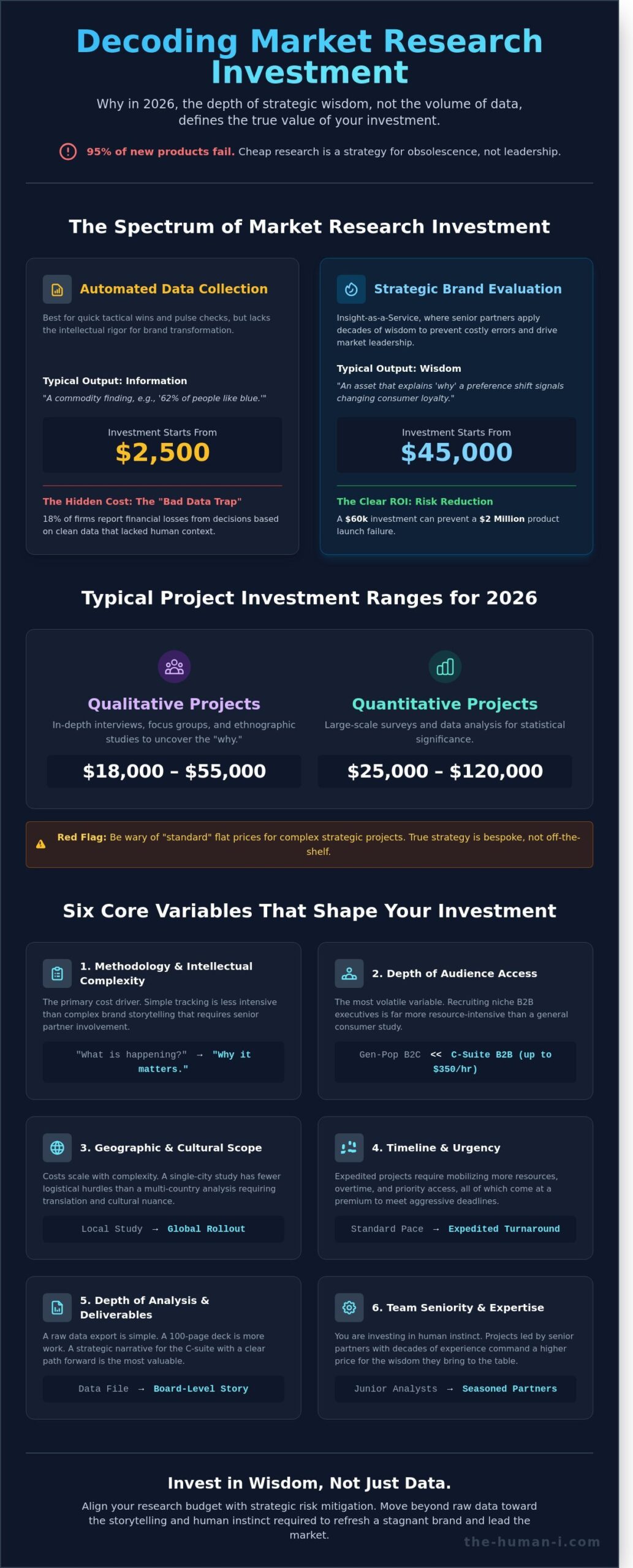
Market research project pricing is rarely about the volume of data points you collect; it is about the depth of the “why” you uncover. In 2026, the industry has moved away from selling spreadsheets. Instead, pricing reflects the value of the outcome. A survey that tells you 62 percent of people like blue is a commodity. A strategic analysis that explains why that preference signals a shift in consumer loyalty is an asset. Understanding What is Market Research? at its core helps clarify that you are buying a reduction in risk, not just a set of charts.
The gap between automated data collection and strategic consulting has widened. You can find automated platforms that offer “pulse checks” for as little as $2,500. These tools are excellent for quick, tactical wins. However, they lack the intellectual rigor required for brand transformation. High-level strategic consulting often starts at $45,000 because it involves senior partners who apply decades of wisdom to your specific business problem. This shift in 2026 reflects the rise of “insight-as-a-service,” where clients pay for the clarity of the narrative rather than the hours spent in the field.
Adopting a “wisdom-led” budgeting approach is essential for brands facing stagnant growth. This means allocating funds based on the potential impact of the discovery. If a $60,000 investment can prevent a $2 million product launch failure, the ROI is immediate. We view market research project pricing as an investment in the brand’s future story, ensuring every dollar spent translates into a clear, actionable path forward.
DIY Data vs. Strategic Brand Evaluation
Low entry costs on DIY survey platforms are tempting for teams with tight budgets. You can launch a study for the price of a mid-tier software subscription. The stakes change when you are planning a total brand refresh or entering a new global territory. Misinterpreting DIY data is a common pitfall; 18 percent of mid-market firms reported significant financial losses in 2025 due to decisions based on “clean” data that lacked human context. Human Instinct’s solutions focus on these high-stakes scenarios, providing the deep intellectual heavy lifting that automated tools simply cannot replicate. We uncover the nuances of human behavior that raw data often obscures.
Typical Investment Ranges for 2026
Budgeting requires concrete numbers to present to stakeholders. For qualitative projects involving in-depth interviews or ethnographic studies, expect to invest between $18,000 and $55,000 depending on the niche of the audience. Quantitative projects, which offer statistical significance across larger populations, typically range from $25,000 to $120,000. If a consultant offers a “standard” flat price for a complex strategic project, consider it a red flag. Strategy is not a product you pull off a shelf. It requires a unique lens for every client. A bespoke research project is a tailored journey of discovery designed to uncover the specific truths that will empower your brand to lead its category.
Six Core Variables That Shape Your Project Investment
Pricing isn’t a static number pulled from a spreadsheet; it’s a living calculation of risk and depth. When you evaluate market research project pricing, you’re essentially paying for the reduction of uncertainty. A 2023 industry report highlighted that 65% of research budgets are now shifting toward specialized strategic insight rather than raw data collection. This shift happens because data without wisdom is just noise. Your investment is dictated by six primary levers that determine the intensity of the work required and the value of the final output.
Methodology and Intellectual Complexity
The primary cost driver is the “how” behind the inquiry. A simple tracking study that monitors brand awareness might require less senior intervention than a complex customer experience mapping project. High-level brand planning and storytelling require more senior hours because they transform data points into a narrative that drives board-level decisions. You can explore how we integrate these disciplines on the Human Instinct expertise page. We don’t just look for answers; we find the underlying truth that refreshes stagnant brands. Intellectual complexity scales when you move from “what is happening” to “why it matters.”
The Depth of Audience Access
Recruiting participants is often the most volatile variable in any budget. A general B2C study targeting soda drinkers in London is relatively straightforward. However, a B2B segmentation analysis targeting Chief Sustainability Officers in the manufacturing sector involves a different level of investment. In early 2024, recruitment incentives for high-level executives often reached $350 per hour. This reflects the “Human” element of research. Authentic engagement requires respecting the participant’s time and expertise. Following a practical framework for market research helps businesses understand that these costs aren’t just fees; they are gatekeepers to high-quality, reliable data.
Beyond the audience and the method, four other factors influence the final quote:
- Geography: Cross-border projects often see a 20% to 30% increase in management fees to account for time zone coordination and cultural nuance.
- Talent Seniority: You aren’t just paying for a moderator; you’re paying for a strategist. Senior-led projects often yield 40% more actionable insights than those handled by junior staff.
- Sample Size: The “n” count matters. Moving from 200 to 1,000 respondents doesn’t just increase software costs; it increases the cleaning and weighting requirements for the data.
- Project Speed: Urgency is a premium. Shortening a standard six-week timeline to three weeks requires dedicated resources and overtime.
The seniority of the talent involved dictates the strategy fee because wisdom isn’t automated. When you hire for experience, you’re buying the ability to see patterns that others miss. This is where market research project pricing transforms from an expense into a strategic asset. If you’re ready to move beyond surface-level data, you might want to discover how our senior team approaches strategy through a more human lens. We focus on the find, not just the look.
Why Cheap Research Often Costs the Most
The most common hurdle in market research project pricing isn’t the budget itself, it’s the belief that a DIY approach is “good enough.” Internal teams often argue they can run a few surveys or host a couple of Zoom calls for free. This logic ignores the hidden tax of amateurism. When you do it in-house, you aren’t just saving money; you’re often buying a skewed mirror that reflects your own biases back at you. Professional researchers spend years learning how to strip away these biases to find the uncomfortable truths that actually move the needle.
Bad data acts like a faulty GPS. It doesn’t just leave you lost, it confidently drives you off a cliff. In 2021, a mid-market CPG brand reportedly lost $1.4 million in inventory because their in-house “pulse check” failed to account for a 15% shift in consumer sentiment regarding sustainable packaging. They saved $20,000 on professional fees but paid seventy times that in wasted production and logistics. Professional research provides the objectivity that internal teams, by their very nature, can’t maintain. You’re paying for the distance between the data and the person who has to present it to the board.
The Risk of Superficial Analysis
Ferran Adria, the legendary chef of elBulli, famously noted that with creativity, what you find is more important than what you look for. Cheap research only looks for what you tell it to find. It checks boxes and validates existing internal assumptions. It misses the “key moments” in a customer journey because it doesn’t know how to listen for the silence between the data points. Commodity research produces reports that sit in a drawer while your brand stagnates. A failed product launch is the most expensive way to realize you should have hired an expert.
Data vs. Wisdom: The ROI of Insight
Think of high-level research as a premium insurance policy for your brand reputation. While basic market research costs vary depending on methodology, the real value lies in bridging the “Wisdom Gap.” This is the space where raw data ends and strategic action begins. Most firms can give you a spreadsheet; few can give you a narrative that changes your trajectory. In a 2023 study of B2B marketing failures, 42% of unsuccessful pivots were attributed to “insight that lacked context,” proving that data without wisdom is just noise.
This distinction is central to the philosophy at Human Instinct, where the focus remains on wisdom over sheer volume. They understand that stagnant brands don’t need more numbers, they need a refresh that resonates with human behavior. For example, a 2022 brand refresh for a European fintech firm, rooted in deep qualitative wisdom rather than surface metrics, resulted in a 22% increase in customer lifetime value within six months. When market research project pricing is viewed as an investment in clarity, the upfront cost becomes secondary to the long-term ROI of getting it right the first time.
- In-house research often confirms bias rather than challenging it.
- Superficial data leads to brand stagnation and missed market shifts.
- The “Wisdom Gap” is where strategic growth actually happens.
- Professional insight acts as a financial safeguard against failed launches.
Budgeting for Impact: A Practical Framework
Understanding market research project pricing requires shifting your perspective from what a study costs to what the insight is worth. Most leaders view research as a procurement line item. That’s a mistake. It’s actually strategic capital. When you treat your budget as an investment in certainty, the numbers begin to make more sense. You aren’t just buying a PDF of charts; you’re buying the confidence to move forward with a multi-million dollar strategy.
Stop viewing research as an expense and start seeing it as an insurance policy. If you’re about to commit $10 million to a new product launch or a brand pivot, a $150,000 research budget represents just 1.5% of your total risk. This small fraction protects the other 98.5% of your capital from being wasted on a direction that doesn’t resonate with your audience. Wisdom, in this context, has a very clear ROI.
Aligning Budget with Business Stakes
High stakes demand deep wisdom. For major foundational decisions, a reliable rule of thumb is to invest 1% to 5% of the total project value into research. If the decision impacts $20 million in revenue, a budget of $200,000 to $400,000 is appropriate. Tactical testing, such as optimizing a single ad campaign or a website button, requires far less. You don’t need a sledgehammer to crack a nut, but you certainly need more than a toothpick to move a mountain.
Strategic capital should be allocated based on the complexity of the “why” rather than the volume of the “what.” Data tells you that 42% of your customers are churning; insight tells you they’re leaving because your brand voice no longer matches their values. The latter requires a more sophisticated approach to market research project pricing, as it involves deep psychological probing rather than simple head counting.
The Bespoke vs. Standardized Trade-off
Buying a pre-packaged report is like buying a suit off the rack. It might fit okay, but it won’t make you stand out. Standardized reports are useful for broad category trends, but they lack the nuance required for brand differentiation. A 2022 Gartner study found that 53% of marketing decisions are still made based on gut feel because the available research didn’t answer the specific “why” behind the data. Bespoke research solves this by tailoring the methodology to your unique challenges.
Tailored work requires a partnership, not just a purchase order. When you brief for value rather than the lowest bid, you allow researchers to act as consultants. They can uncover the “hidden” drivers of consumer behavior that a generic survey would miss. This collaborative approach ensures that the final output is a roadmap for growth, not just a stack of data that gathers dust on a digital shelf.
Smart leaders also use a phase-based approach to de-risk large investments. Instead of dropping $300,000 on a single massive study, break it into stages. Start with a $40,000 exploratory phase to identify the real problems. This prevents you from spending the bulk of your budget answering the wrong questions. It allows for agility, letting you pivot your focus as new truths emerge during the process.
Finally, leave room for the unexpected. Allocate roughly 15% of your total budget for “unplanned discovery.” In a 2023 analysis of consumer packaged goods, 22% of the most successful brand pivots came from insights discovered accidentally during secondary research phases. If your budget is too rigid, you’ll be forced to ignore these golden threads. Great research needs breathing room to follow the data where it leads, even if it’s somewhere you didn’t expect to go.
Ready to move beyond surface-level data and find the wisdom your brand needs? Partner with Human Instinct to uncover deeper insights.
Human Instinct: Precision-Built Research for Stagnant Brands
Brands often stall because they’re drowning in numbers but starving for direction. They have access to more consumer data than ever, yet they lack the clarity to move forward. Human Instinct acts as the necessary bridge between raw data and actionable wisdom. We don’t just hand over a deck of charts and leave you to decode them. Our senior talent pool brings an average of 19 years of experience across insight, strategy, and brand planning to every engagement. This level of seniority ensures your investment isn’t spent on junior analysts learning on your dime, but on experts who have seen these patterns before.
When evaluating market research project pricing, it’s easy to get distracted by the bottom line of a quote. However, the real cost of research is the price of being wrong. We justify our fees through the “Refreshed Brand” outcome. This isn’t a vague marketing promise. In a 2023 project for a legacy FMCG client, our insights led to a 14% increase in market share within six months by identifying a “lost” consumer segment that competitors had overlooked. We focus on the ROI of precision, transforming stagnant assets into market leaders.
Our Philosophy: Beyond the Spreadsheet
We operate at the intersection of Insight, Data, and Wisdom. Data tells you what happened; insight explains why it happened; wisdom tells you what to do next. We use storytelling to turn complex datasets into a business narrative that your stakeholders can actually get behind. This clarity is why 85% of our clients return for follow-up strategy work. If you’re ready to move beyond basic metrics, contact Human Instinct for a bespoke consultation that prioritizes your brand’s unique trajectory.
Starting Your Discovery Journey
We don’t believe in off-the-shelf price lists because your brand’s challenges aren’t generic. Your journey starts with a 45-minute scoping session where we dig into your specific stagnation points. We define the value of solving your business problem before we ever discuss market research project pricing. This ensures the scope matches the stakes of the decision you’re facing. We look for what’s actually there, not just what you’re looking for.
Precision isn’t just a goal; it’s a requirement for growth. Insight is a human instinct, and we give it the strategic rigor it needs to win in a crowded market. Let’s find what your brand has been missing.
Securing Your Brand’s Edge in 2026
Navigating market research project pricing in 2026 requires more than a spreadsheet; it demands a shift from buying raw data to investing in strategic wisdom. We’ve explored how the 6 core variables, from methodology to sample depth, dictate your ultimate ROI. Cutting corners today often leads to a 40 percent loss in strategic clarity by the time your product hits the shelf. At Human Instinct, we replace generic metrics with bespoke solutions built specifically for the Financial Services, Tech, and Health & Beauty sectors. Our senior-led team brings 20 years of brand planning experience to every engagement, ensuring your investment buys more than just numbers. It’s where insight, data and wisdom meet to solve the puzzles of stagnant growth. You don’t need a vendor; you need a partner who understands that the right narrative is your most valuable asset. The market moves fast, but the right insight moves faster. Let’s make sure your next project delivers the clarity your brand deserves.
Let’s find the narrative that refreshes your brand. Contact Human Instinct today.
Frequently Asked Questions
What is the average cost of a market research project in 2026?
Expect to invest between £20,000 and £65,000 for a standard market research project pricing model in 2026. This range reflects a 4.5% annual increase in participant recruitment costs and the premium placed on high-level data synthesis. While smaller pulse surveys might start at £8,000, deep-dive ethnographic studies that uncover profound human truths often exceed £85,000.
Why is qualitative research often more expensive than quantitative?
Qualitative research commands a higher price because it requires 40 to 60 hours of senior moderator time for interviewing and analysis. While a quantitative survey scales through automation, qualitative work relies on human wisdom to uncover the “why” behind the data. You aren’t just paying for a transcript; you’re paying for the 15 years of experience needed to spot a subtle behavioral shift that data alone misses.
How can a mid-sized brand afford high-level strategic research?
Mid-sized brands can access high-level strategy by adopting a modular research framework rather than an all-in-one overhaul. By focusing on a specific 90-day growth lever, such as customer churn or category entry, you can secure strategic insights for £12,000 to £18,000. This targeted approach ensures your budget fuels discovery where it actually moves the needle on your profit margins.
What are the hidden costs in a market research quote?
Hidden costs usually lurk in participant incentives and specialized recruitment, which can add 20% to your initial quote. Watch out for platform seat licenses or data cleaning fees that some agencies omit from the headline figure. Always ask if the price includes the final strategy workshop; otherwise, you might face an additional £2,500 day-rate charge to actually apply the findings.
Is it cheaper to conduct market research in-house using software?
Software reduces your out-of-pocket spend by 40%, but it often creates a wisdom gap that costs more in the long run. DIY tools excel at simple metrics, yet 72% of in-house teams struggle to turn raw data into a cohesive brand story. You save on the execution but risk spending your entire marketing budget on a strategy built on a fundamental misinterpretation of the consumer’s instinct.
How do I calculate the ROI of a brand evaluation project?
Calculate ROI by measuring the cost of a wrong decision against the project fee. If a £30,000 brand evaluation prevents a failed £500,000 product launch, your ROI is 1,566%. Track specific KPIs like a 5% lift in brand salience or a 10% reduction in customer acquisition costs over the 12 months following the research implementation to see the true value.
What is the difference between a research vendor and a strategic insight partner?
A research vendor provides a 50-page deck of charts, while a strategic partner delivers a roadmap for your next three years of growth. Partners integrate their talent into your business culture to uncover human instinct rather than just reporting numbers. They don’t just answer your questions; they tell you which questions you should have asked to refresh an ailing brand.
How much should we budget for a new product development insight phase?
Allocate 8% of your total development budget to the initial insight phase to ensure product-market fit. For a typical consumer goods launch, this equates to a market research project pricing range of £25,000 to £45,000. Investing this early prevents the 80% failure rate common in new products that skip the foundational stage of discovery and deep customer understanding.



