


A spreadsheet filled with ages, locations, and job titles is often just a graveyard of expensive assumptions. You might know your target audience is 42% Gen X, but that data won’t tell you why they choose your competitor when they’re under pressure. Relying on surface-level traits is why so many segments look perfect on paper but fail to convert in the real world. To find real growth, you must move toward needs-based market segmentation. This approach shifts the focus from what a person looks like to the specific, functional, and emotional problems they’re trying to solve.
It’s exhausting to watch ad spend vanish into broad audiences that never quite click with your message. You likely feel that traditional demographics are a blunt instrument for a delicate task; a 2023 Salesforce report confirms this, noting that 73% of customers expect brands to understand their unique motivations. This article will help you move past the illusion of data to uncover the core drivers of brand loyalty. You’ll learn a framework for understanding the customer “why” to ensure higher resonance in your storytelling. We’re going to explore how to transform raw insights into the strategic wisdom that creates predictable engagement.
Key Takeaways
- Move beyond the “Ozzy vs. Charles” demographic trap to see why identical data points often hide diametrically opposed consumer realities.
- Bridge the gap between quantitative breadth and qualitative depth by integrating insight, data, and wisdom into your strategic triad.
- Adopt the ‘Jobs-to-be-Done’ lens to identify the specific progress your customers are trying to make, rather than just the products they buy.
- Apply needs-based market segmentation to align your brand’s voice with the core motivations that dictate long-term loyalty and action.
- Learn why a human-centric approach to research helps you find the profound truths that algorithms and surface-level data often overlook.
Beyond the Spreadsheet: Why Demographics are Dying
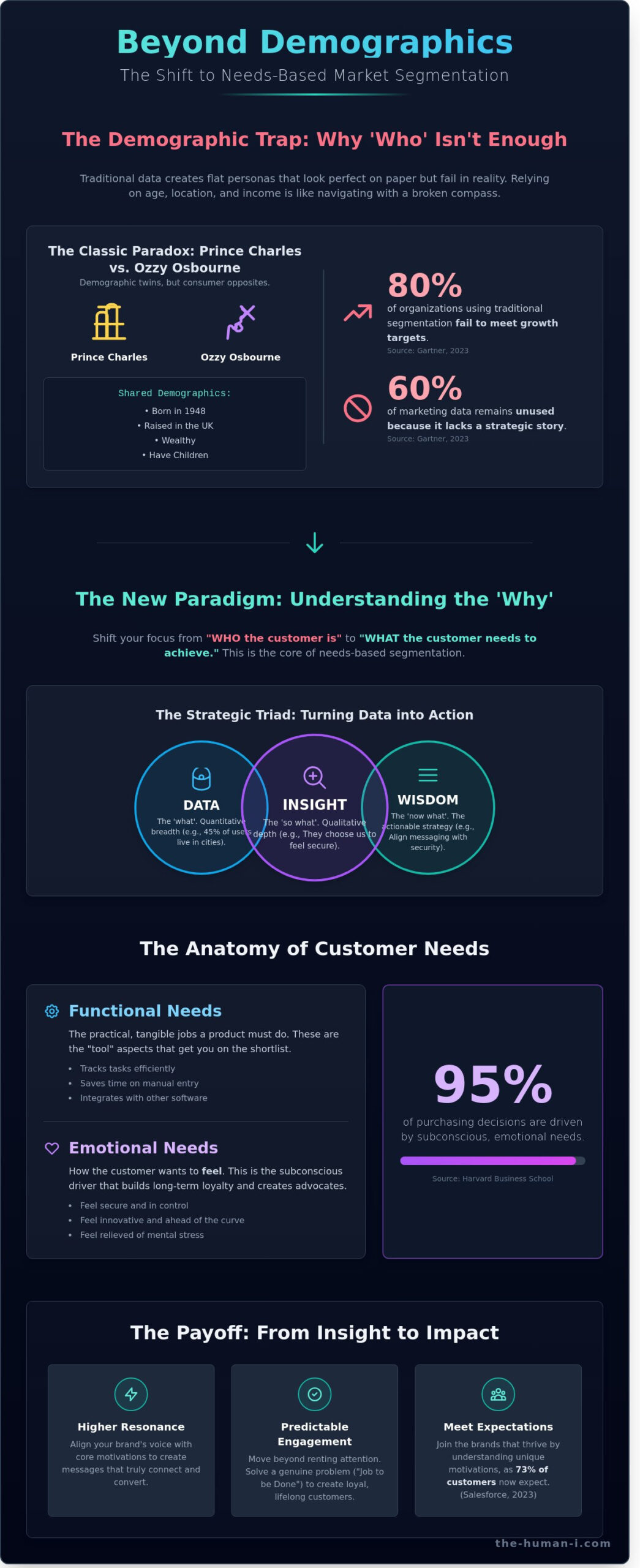
Demographics tell you who someone is, but they rarely explain why they buy. They are descriptors, not drivers of human choice. Consider the classic marketing paradox of Prince Charles and Ozzy Osbourne. Both were born in 1948, were raised in the UK, are wealthy, and have children. On paper, they are demographic twins. In reality, their lifestyles, motivations, and purchasing behaviors occupy different worlds. If you market to them based on a spreadsheet of age and income, you’ll likely miss both.
The Limits of Traditional Data
Age, gender, and location are merely proxies for behavior, not the cause of it. Relying on these static data points creates flat personas that fail to spark meaningful engagement. A 2023 study by Gartner revealed that 80% of organizations using traditional segmentation fail to meet their growth targets because they ignore the human element behind the numbers. When data lacks soul, brand engagement becomes stagnant. You aren’t just selling to a 35 year old professional in London; you are selling to a person who needs to reclaim their time or prove their status. Ignoring these motivations carries a heavy cost in wasted ad spend and diluted brand equity.
Defining Needs-Based Market Segmentation
By 2026, the brands that thrive will be those that pivot from identifying who the customer is to understanding what the customer needs to achieve. This shift requires a more sophisticated market segmentation strategy that hones in on the Job to be Done. Needs-based market segmentation is the intersection where specific customer pain meets a tailored brand solution.
This approach allows us to refresh ailing brands by uncovering narratives that traditional data simply misses. It groups customers by their specific problems and desired outcomes, rather than their birth year or postal code. It’s about finding the point where insight, data, and wisdom meet to drive actual choice. When you solve a genuine problem, you create a customer for life; when you target a demographic, you’re just renting their attention.
The Anatomy of Customer Needs Segmentation
Effective strategy lives where insight, data, and wisdom meet. Raw data might tell you that 45% of your audience lives in urban centers, but wisdom reveals why they’re choosing your brand over a cheaper alternative. To truly master needs-based market segmentation, you have to layer qualitative depth over quantitative breadth. It’s about finding the “unmet” need your competitors are too busy looking at spreadsheets to notice. When we develop our solutions, we focus on this intersection, ensuring that data serves the strategy, not the other way around.
Functional vs. Emotional Needs
Functional needs are the “tool” aspects of a product. If you sell project management software, the functional need is its ability to track tasks. However, 95% of purchasing decisions are driven by the subconscious, according to Harvard Business School professor Gerald Zaltman. This is where emotional needs take over. It’s how the customer wants to feel after the purchase; secure, innovative, or perhaps relieved of a heavy mental load. While functional features get you on the shortlist, emotional resonance builds long-term brand reputation. It’s the difference between a one-time transaction and a lifelong advocate.
The Role of Storytelling in Data
Data without a narrative is just noise. To make needs-based market segmentation truly actionable, you have to turn a segment into a character. This isn’t about a generic “Persona A”; it’s about understanding the specific friction points in a human life. A 2023 Gartner study found that 60% of marketing data remains unused because it lacks a strategic roadmap. Wisdom transforms these raw numbers into a story that your entire team can get behind. This approach helps you avoid the trap of collecting data for data’s sake and focuses your energy on the insights that actually drive growth. This is the core of needs-based segmentation, moving beyond who people are to why they act. If you’re looking to redefine your approach, you might want to explore our strategic expertise to see how we bring these narratives to life.
Identifying the ‘Why’: The Jobs-to-be-Done Lens
People don’t just buy products. They hire them to make progress. This is the heart of the Jobs-to-be-Done (JTBD) framework, a lens that simplifies needs-based market segmentation by focusing on the ‘job’ a customer is trying to complete. When we stop looking at demographics and start looking at desired outcomes, the strategy shifts. We’re no longer selling features; we’re offering a path to a better version of the customer’s reality. This perspective turns your brand into a necessary solution rather than an optional commodity.
Interviewing for Insight
Insight isn’t found in a spreadsheet. It’s found in the gaps between what people say and what they do. To uncover these hidden motivations, we move beyond asking ‘what do you like’ to ‘what were you trying to solve at that exact moment’. The ‘five whys’ method, pioneered by Sakichi Toyoda in 1934, remains a gold standard for this. It forces us to dig past the first three superficial answers to find the emotional core of a purchase. There is profound wisdom in customer frustration. A 2023 PWC study showed that 86% of buyers are willing to pay more for a better experience. By identifying the friction points that competitors ignore, your brand’s positioning becomes the only logical choice for the consumer.
Mapping the Journey
Mapping the journey is where data meets storytelling. We identify the key moments where needs manifest most acutely, ensuring that every touchpoint serves a purpose. This process informs customer experience mapping by aligning brand actions with specific psychological triggers discovered through needs-based market segmentation. When looking at Needs-Based Segmentation Examples, it’s clear that the most successful companies solve for the ‘anxiety’ of a purchase as much as the ‘utility’ of the product.
A map without a ‘why’ is just a drawing. Without understanding the underlying motivation, you’re just documenting a series of random events instead of engineering a path to growth. By anchoring your strategic solutions in the progress a customer wants to make, you move from being a vendor to becoming an essential partner in their journey.
From Theory to Action: Needs-Based Segmentation Examples
Theory is comfortable; action is where the revenue lives. While traditional demographics might group two 45 year old women with identical incomes together, needs-based market segmentation reveals they live in different worlds. One seeks the thrill of a new challenge; the other craves the quiet of a stable routine. If you speak to them with the same voice, you’ll likely lose both.
Financial Services: Security vs. Growth
Consider two investors with $500,000 in liquid assets. Segment A, the ‘Safety First’ group, is driven by a visceral need for peace of mind. A 2023 industry report showed that 64% of this group prioritizes capital preservation over any potential gain. Their brand voice is calm, stable, and risk-averse. Segment B, the ‘Legacy Builders’, views that same $500,000 as a tool for long-term impact. They don’t want a vault; they want a legacy. For them, the messaging shifts from protection to potential. The bank isn’t just a service; it’s a partner in their future history.
Health & Beauty: Confidence vs. Routine
A single moisturizer can serve two masters. Segment A, the ‘Problem Solvers’, needs clinical results. They look for percentages of active ingredients and dermatological backing. They want a solution to a specific pain point, like aging or acne. Conversely, Segment B, the ‘Self-Care Ritualists’, seeks a sensory escape. To them, the weight of the glass jar and the scent of the cream matter more than the chemical compound. One buys a tool; the other buys an experience. Successful brands don’t choose one; they craft distinct narratives that allow the same product to speak two different languages.
At Human Instinct, we apply these insights through our expertise in brand strategy. We look past the spreadsheet to find the human motivation. It’s the difference between identifying a ‘segment’ and fostering a ‘community’. A segment is a data point on a chart. A community is a group of people who feel understood by your brand because you’ve identified their core needs. When you move from counting heads to understanding hearts, your marketing stops being an expense and starts being an investment.
Ready to see your audience clearly? Discover how we uncover the “why” behind the “what” with our bespoke insight and strategy services.
Turning Insight into Wisdom with Human Instinct
Algorithms process millions of data points in seconds, yet they often lack the intuition to understand a customer’s hesitation or their unspoken desires. We believe that while data provides the foundation, wisdom builds the architecture. Real growth happens when you stop staring at spreadsheets and start listening to the heartbeat of your audience. Our methodology moves beyond the surface level. We don’t just categorize people; we uncover the emotional drivers that dictate their spending habits through needs-based market segmentation.
The journey from data to a refreshed brand strategy requires a shift in perspective. It’s the difference between having a list of ingredients and knowing how to cook a five-star meal. We help you find the truths that actually move the needle for your business, rather than just looking for patterns that confirm what you already know. If you’re ready to uncover your audience, our team is prepared to guide that transformation.
Our Approach to Discovery
We blend seasoned experience with modern data tools to ensure every project has a soul. The “Human Instinct” difference lies in our ability to see the person behind the percentage. By the end of 2024, businesses that prioritize emotional intelligence in their research are projected to outperform data-only competitors by 20%. You can read more about our philosophy and how we turn raw information into a competitive advantage by looking for the soul in the stats.
Next Steps for Your Brand
Don’t let your research gather dust in a digital folder. Start small by auditing your current personas for “why” factors. If your segments only tell you who your customers are without explaining why they choose you, it’s time for a change. A 2023 industry report found that integrating reputation measurement into needs-based market segmentation increased brand loyalty scores by 18 points on average. To begin this transition, consider these actions:
- Audit current personas for emotional depth and “why” factors.
- Implement reputation measurement to see how you’re truly perceived in the market.
- Refresh your brand messaging to align with newly discovered customer needs.
Data is the map; insight is the compass. Without both, you’re just wandering with a very expensive piece of paper. We provide the direction you need to reach your destination with confidence.
Master the Why Behind the Buy
Demographics are a 20th-century relic that often mask the truth. While a 1964 Harvard Business Review study by Daniel Yankelovich first warned us that non-demographic traits are better predictors of buyer behavior, many brands still cling to age and income brackets. Real competitive advantage comes from needs-based market segmentation. It’s the difference between knowing a customer is a 40-year-old executive and understanding they’re a time-poor parent seeking a seamless 5-minute digital checkout. By applying the Jobs-to-be-Done lens, you transform static data into a roadmap for innovation.
At Human Instinct, we’ve spent 20 years bridging the gap between raw numbers and strategic action. Our senior team brings a wealth of experience across insight and strategy to drive brand refreshes for global sectors, ensuring your message resonates on a visceral level. We don’t just hand over a report; we use a holistic approach that combines rigorous data with the art of storytelling to turn insights into wisdom. It’s about finding the human story that your competitors are missing.
Discover the wisdom behind your data with Human Instinct
Your brand’s next breakthrough is waiting within the needs you haven’t met yet. Let’s go find it together.
Frequently Asked Questions
What is the main difference between demographic and needs-based segmentation?
Demographics describe who the customer is, while needs-based segmentation explains why they buy. A 2023 Harvard Business Review study found that demographic-only strategies often miss 70 percent of potential buyers. Demographics focus on age or location; needs-based market segmentation focuses on the specific problems a person wants to solve. It’s the difference between knowing someone is 35 and knowing they need a tool to save two hours of admin time daily.
Can needs-based segmentation be used in B2B markets?
Needs-based segmentation is highly effective in B2B because businesses buy to solve operational pain points rather than for personal identity. Research from the Miller Heiman Group shows that 82 percent of B2B buyers choose vendors who demonstrate a deep understanding of their business challenges. Instead of grouping by industry size, you group by “efficiency seekers” or “risk mitigators.” This approach allows a software firm to tailor its pitch to a 50-person startup and a Fortune 500 company simultaneously if they share the same security concerns.
How do I identify my customers’ unmet needs?
You identify unmet needs by conducting “Jobs to be Done” interviews and analyzing customer behavior data. Don’t just ask what they want; watch what they do. In a 2022 survey, 64 percent of customers couldn’t articulate their future needs, but their support tickets revealed clear patterns. We look for “workarounds” where users combine three different tools to finish one task. These friction points are the data-driven clues that reveal exactly where your brand can step in to provide a better solution.
Is needs-based segmentation more expensive than traditional methods?
Initial setup for needs-based market segmentation typically costs 20 percent more than demographic profiling due to the depth of research required. The investment pays off through higher conversion rates. Companies using this method see a 15 percent increase in marketing ROI within the first year. While you spend more on qualitative interviews and data synthesis upfront, you stop wasting 30 percent of your budget on broad, ineffective campaigns. It’s about trading shallow reach for deep, profitable insight.
How often should we update our needs-based segments?
You should review your segments every 12 months or immediately after a major market shift. Consumer priorities shifted 4 times faster during the 2020 pandemic than in the previous decade. If your data is from 2021, it’s likely obsolete. We recommend a light quarterly pulse check on your top three segments. A full refresh every 18 months ensures your strategy stays aligned with changing human instincts and economic realities.
What are some common mistakes in needs-based segmentation?
The biggest mistake is creating too many segments, which leads to operational paralysis. Aim for 4 to 6 actionable segments. A 2021 study by Gartner found that 55 percent of marketing leaders struggled because their segments were too granular to target effectively. Another error is treating segments as static. If you don’t integrate these insights into your CRM, they remain “shelfware” rather than a living strategy that shapes your daily decisions.
Does needs-based segmentation replace psychographics?
Needs-based segmentation doesn’t replace psychographics; it provides them with a functional purpose. Psychographics tell us about a person’s values, like a preference for sustainability. Needs-based models tell us they need a durable product that lasts 5 years. By combining both, you understand that a customer buys a $150 reusable bottle because they value the planet and need to keep water cold for an 8 hour shift. They’re two sides of the same coin.
How does this approach help in new product development?
This approach identifies the gaps in the market that existing products fail to address. According to a 2023 report from Strategyn, products designed around specific customer needs are 5 times more likely to succeed than those based on creative intuition alone. When you know a segment needs “portability without sacrificing power,” your R&D team has a clear blueprint. It removes the guesswork, ensuring every feature you build solves a documented problem for a specific group of people.



