


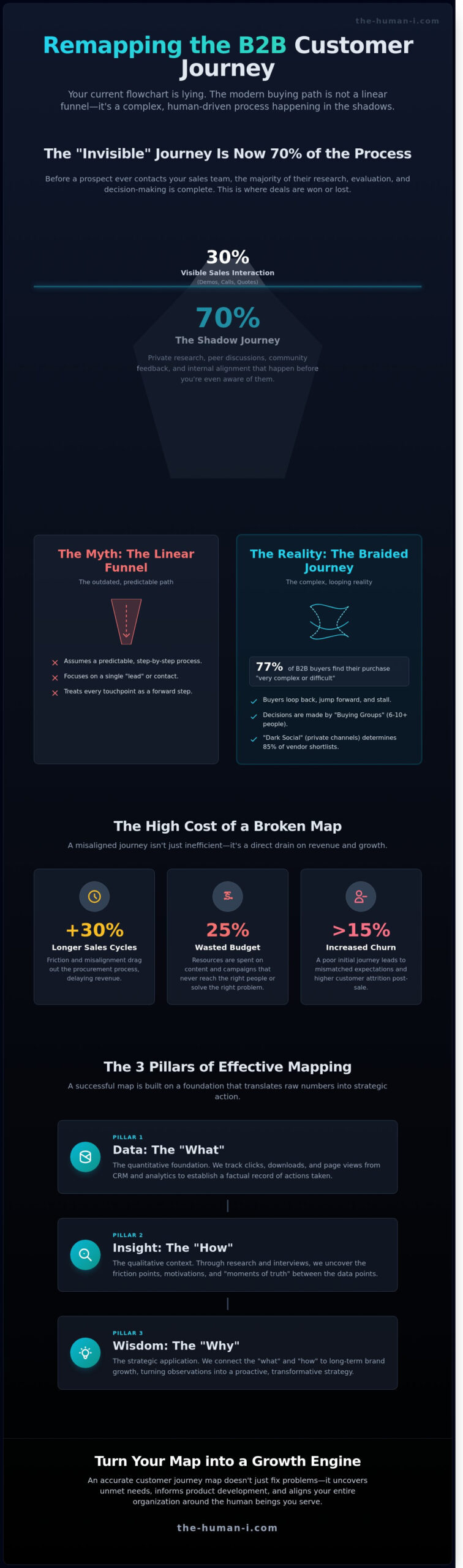
Your current flowchart is likely lying to you. While most diagrams suggest a neat, linear progression, 70% of the modern B2B buying path happens in the shadows before a prospect ever speaks to your sales team. Mapping the b2b customer journey effectively requires more than just connecting digital touchpoints; it demands a deep understanding of the quiet, human instincts that guide a professional through a typical 18 month procurement cycle. It’s exhausting to watch data fragment across departments while your brand narrative feels disconnected from the actual friction your customers face during their private research phase.
You’ve likely realized that a generic template won’t solve a complex attribution problem. We agree that the “invisible” part of the self-service journey is where most deals are truly won or lost. This article promises to help you move beyond surface-level data to turn raw information into strategic wisdom. You’ll learn how to build a journey map that identifies specific friction points and aligns your marketing and sales teams around deep buyer motivations. We’re going to break down a framework that prioritizes human insight over static flowcharts, ensuring your strategy finally matches the way people actually buy.
Key Takeaways
- Trade the linear funnel myth for a “braided” reality that captures how modern buying committees actually navigate their path to a decision.
- Master the art of mapping the b2b customer journey by blending hard data with the human wisdom that explains why buyers move forward or stall.
- Identify “Moments of Truth”-those critical interactions where your brand narrative either builds momentum or creates the friction that kills a deal.
- Use a strategic framework to audit every touchpoint, ensuring your message resonates with every stakeholder from the first ad to post-sale support.
- Turn your map into a growth engine by uncovering unmet needs that inform new product development and refresh your brand’s storytelling.
What is B2B Customer Journey Mapping in 2026?
Forget the clean, downward-sloping funnel. In 2026, mapping the b2b customer journey is less about a straight line and more about a strategic visualization of a “braided” reality. It’s a deep dive into the end-to-end relationship between your brand and a complex buying committee. We aren’t just tracking a single person’s clicks; we’re decoding how an entire group moves from collective ignorance to a confident purchase. This map serves as the vital link between raw data and the wisdom needed to influence high-stakes decisions.
The old linear model assumed buyers followed a predictable path. Data from late 2025 shows that 77% of B2B buyers describe their latest purchase as very complex or difficult. They loop back, jump forward, and stall. Modern mapping serves as the antidote to brand stagnation, preventing the disconnected marketing that happens when departments work in silos. By 2026, successful firms have stopped obsessing over individual “leads” and started focusing on “buying groups.” This shift recognizes that a single whitepaper download isn’t a signal; a cluster of interactions across five different stakeholders is the real heartbeat of a deal.
Effective mapping provides the clarity to refresh customer experience across every touchpoint. It transforms a static brand into a living entity that anticipates needs before they’re articulated. When you understand the friction points, you stop guessing and start solving. It’s about finding the truth in the data to empower your strategy and ensure your messaging resonates with the right people at the right time.
B2B vs. B2C: The Complexity Gap
B2B cycles are notoriously long, often stretching 9 to 12 months for enterprise solutions. You aren’t selling to a person; you’re selling to a committee of 6 to 10 stakeholders, each with different anxieties and goals. Despite this complexity, the “consumerization” of B2B is in full swing. 80% of buyers now expect a seamless, B2C-level digital experience, even when purchasing million-dollar software. Dark Social in 2026 represents the untraceable word-of-mouth influence occurring in private Slack channels and closed communities that determines 85% of the vendor shortlist before a sales rep is ever contacted.
The Cost of a Misaligned Journey
A broken map is expensive. Signs of failure include churn rates exceeding 15% and sales cycles that drag on 30% longer than the industry average. When marketing and sales aren’t aligned, the brand message becomes inconsistent and diluted. This lack of insight leads to “ailing brands” that fail to engage new audiences because they’re solving problems that no longer exist. Without a precise map, you’re effectively flying blind, wasting 25% of your budget on content that never reaches the right eyes. Mapping the b2b customer journey ensures every dollar spent is an investment in a verified path to revenue.
The Three Pillars of Effective Mapping: Insight, Data, and Wisdom
Success in mapping the b2b customer journey requires more than a spreadsheet of touchpoints. It demands a synthesis of three distinct layers: data, insight, and wisdom. Think of data as the “what,” providing a cold, hard record of actions taken. Insight is the “how,” revealing the friction and flow of the user experience. Wisdom is the “why,” the strategic layer that connects these observations to long term brand growth. Without all three, your map is just a drawing; with them, it becomes a compass. This holistic approach ensures that your strategy isn’t just a reaction to past behavior but a blueprint for future engagement.
Data grounds the map in reality. We pull from CRM systems, web analytics, and zero-party data to track the 2024 buyer’s footprint. This tells us that a lead visited the pricing page three times or downloaded a specific whitepaper. However, data is often silent on the motivation behind those actions. Insight steps in here. By conducting qualitative research, we discover those “moments that matter” that occur between the clicks. Finally, wisdom applies decades of experience to transform these findings into a transformative brand strategy. This is where competing on customer journeys becomes a reality, as brands move from reactive fixes to proactive market leadership. Wisdom allows us to see patterns where others see noise, helping a brand decide which touchpoints to amplify and which to discard.
Collecting Data Without Losing the Human Element
Quantitative metrics are essential, but they often produce a hollow map. If you only look at conversion rates, you miss the “pre-journey” perception that dictates whether a buyer even considers your brand. Research shows that 70% of B2B buyers have already defined their needs before they engage a vendor. Understanding this requires reputation measurement to see how you’re perceived in the wild. Balancing raw numbers with human-centric wisdom ensures the map drives genuine engagement rather than just vanity metrics. A map built solely on clicks ignores the emotional hesitation that stalls 40% of B2B deals. We must look past the screen to understand the person behind the keyboard.
Uncovering the ‘Hidden’ Stakeholders
A fatal mistake in mapping the b2b customer journey is focusing only on the person signing the contract. The modern B2B buying committee averages 6 to 10 stakeholders, according to 2023 industry benchmarks. You aren’t just selling to a manager; you are navigating the concerns of IT, Finance, and Legal. Each has unique triggers. While the “Champion” seeks efficiency and internal status, the “Economic Buyer” focuses on risk mitigation and ROI. Mapping these hidden influences allows you to craft content that speaks to the specific anxieties of a CFO versus the technical requirements of a CTO. If you’re ready to see the full picture of your buyer’s world, you can explore our approach to deep insight. Identifying these emotional triggers early prevents the late-stage friction that often kills complex deals during the final procurement phase.
Identifying Key Moments and Friction Points
Effective mapping the b2b customer journey requires more than just listing touchpoints. It demands an obsession with “Moments of Truth.” These are the high-stakes interactions where a prospect decides to commit or quietly exit. In a 2024 survey of B2B buyers, 73% of executives stated they chose vendors who demonstrated a deep understanding of their specific business challenges during these pivot points. If your data doesn’t highlight where these decisions happen, your map is just a drawing, not a strategy.
Friction points often hide in the gap between what a brand promises and what a user actually feels. If your marketing narrative promises “seamless integration” but your technical documentation is a 40-page PDF from 2019, you’ve created a friction point. These contradictions erode trust faster than any competitor can. Identifying these gaps requires a pragmatic framework for B2B customer journey management, specifically one that aligns external expectations with internal delivery capabilities as outlined in the February 2025 Journal of Business & Industrial Marketing.
To find these internal journey gaps, cross-departmental workshops are non-negotiable. When Sales, Support, and Product teams sit in the same room, you’ll discover that 60% of customer complaints often stem from “internal” silos where information fails to transfer. These workshops turn tribal knowledge into strategic insight, ensuring the brand voice remains consistent from the first ad to the final invoice.
The Emotional Arc of a B2B Purchase
We often pretend B2B buying is purely rational, yet the arc usually begins with “Anxiety.” A problem has been identified; a job might be on the line; a budget is at risk. Your job is to guide the buyer toward “Confidence.” Storytelling is the most potent tool for this transition because it humanizes the data. It moves the conversation from features to outcomes, proving you’ve solved this specific puzzle before. Brand strategy refreshes start with identifying these emotional gaps.
- Anxiety: Can we solve this? What if we fail?
- Discovery: Is there a credible partner out there?
- Validation: Does their logic hold up under scrutiny?
- Confidence: This is the right move for our organization.
Segmentation: Different Maps for Different Audiences
A one-size-fits-all map is a recipe for generic marketing that resonates with no one. A CTO in the fintech space has a vastly different emotional and logical journey than a COO in manufacturing. Mapping the b2b customer journey for specific industry verticals allows you to address unique regulatory hurdles and technical requirements that a general map would miss. According to recent 2024 industry benchmarks, companies using segmented journey maps see a 15% increase in lead-to-opportunity conversion rates.
We believe that wisdom comes from seeing what others miss. Our approach helps you uncover these nuances by applying data-driven insights to human behavior. You can explore how our solutions help businesses identify and segment new potential audiences to ensure every touchpoint feels personal and earned. By tailoring the journey to the specific pressures of each audience, you transform a standard sales process into a compelling brand experience.
How to Map the B2B Customer Journey: A Strategic Framework
Mapping the b2b customer journey is an exercise in empathy and data science. It requires a fusion of insight, data, and wisdom to see what others miss. We aren’t just looking for paths; we’re finding the friction points that stall a $50,000 deal. To do this effectively, you need a framework that moves beyond the linear funnel and embraces the complexity of modern procurement.
- Step 1: Define the Persona and Buying Committee. Gartner research shows that the average B2B buying group now consists of 6 to 10 stakeholders. You aren’t just selling to a single Marketing Manager; you’re convincing a CFO focused on ROI and an IT lead worried about security. Each person finds different value in your brand at different times.
- Step 2: Inventory Every Touchpoint. From the first LinkedIn ad click to the May 2024 update of your support documentation, every interaction counts. Research indicates that 27% of a buyer’s time is spent researching independently online. You must account for the dark social conversations happening in private Slack communities where your brand is discussed without your knowledge.
- Step 3: Layer in the Emotional Context. Ferran Adria famously said that it’s not what you look for that’s important, but what you find. At the consideration stage, is the buyer finding clarity or confusion? Use qualitative interviews to uncover if they feel empowered or overwhelmed by your technical specifications.
- Step 4: Identify the Gaps. This is where the data stops and the guesswork begins. A 2023 study found that 60% of B2B marketers struggle with multi-touch attribution. Pinpoint exactly where you lose visibility. If a prospect downloads a whitepaper but never receives a follow-up, that’s a structural failure, not a lack of interest.
- Step 5: Operationalize the Map. A map is useless if it sits in a PDF on a shared drive. It should dictate the cadence of your SDR outreach and the topics of your next three webinars. Turn the visual into a daily tactical guide that aligns sales and marketing.
Moving from Static to Living Maps
Markets shift every 90 days. A map created in January might be obsolete by April if a new competitor enters the space or economic conditions pivot. Use quarterly feedback loops from your sales team to keep the journey relevant. If buyers are suddenly asking about AI integration, your map needs to reflect that new detour immediately. By mapping the b2b customer journey with this level of agility, you stop guessing and start leading.
Visualizing the Journey for Maximum Impact
Create a map the C-suite can actually understand. Avoid the spaghetti chart trap where every line crosses another in a chaotic web. Use storytelling to show the journey. Focus on clarity; a CEO wants to see where the revenue leaks are, not every single automated email trigger. Use clean design and ample white space to allow the depth of your expertise to be the main focus.
Ready to transform your data into a strategic roadmap? Explore how our brand strategy services can help you uncover deeper customer insights.
From Insight to Impact: Leveraging Your Map for Growth
A journey map is more than a colorful visual for the boardroom. It’s a blueprint for innovation. When you’re mapping the b2b customer journey, you often stumble upon “black holes” where customers feel abandoned. In 2023, research from the Harvard Business Review indicated that companies prioritizing customer experience see revenue growth rates 1.7 times higher than laggards. These maps reveal unmet needs that your R&D team hasn’t considered yet. If 42% of your prospects drop off during technical integration, that’s not a sales problem; it’s a product opportunity. High-growth firms use these friction points to develop features that solve the specific frustrations their competitors ignore.
A brand isn’t a logo; it’s a collection of memories. When you’re mapping the b2b customer journey, you’re actually auditing your reputation in real time. In 2024, Edelman’s Trust Barometer highlighted that 67% of B2B buyers will stop purchasing if they lose trust in a company’s ability to deliver on its narrative. If your map shows customers are frustrated during the post-purchase “lull,” your brand story is breaking. Using these insights to refresh your narrative creates a resonance that generic marketing can’t touch. It turns a transaction into a partnership by showing you understand the buyer’s internal pressures.
Consistency builds authority. A well-mapped journey ensures that the “expert” persona you project during a webinar doesn’t vanish the moment the contract is signed. When every touchpoint is intentional, your reputation transitions from being a mere vendor to a trusted advisor. This transition is measurable. Organizations that align their journey with their brand promise report a 15% increase in customer lifetime value according to recent industry benchmarks. The journey isn’t just a path to a sale; it’s the foundation of your brand’s story. It’s how you prove your wisdom every single day.
Aligning Brand and Experience
Marketing often lives in a vacuum, making promises that operations can’t keep. When the “honeymoon phase” of the sales cycle ends, the drop-off can be jarring. Data from a 2024 Salesforce report shows that 80% of B2B buyers expect a consistent experience across all departments. Human Instinct specializes in identifying these points of friction. We provide the strategic insight needed to refresh stagnant brands by ensuring every touchpoint reflects your core values. This alignment transforms a disjointed process into a cohesive, high-performing engine.
Your Next Step Toward Wisdom
Information is cheap. Wisdom is rare. Most firms spend months “looking” for data without ever “finding” the truth of their customer’s experience. Stop collecting spreadsheets and start uncovering the human story behind the clicks. The goal isn’t just to complete a map; it’s to change how your business breathes. If you’re ready to move beyond surface-level metrics and gain a deeper understanding of your market, we’re ready to guide you. You can contact Human Instinct today for a strategic consultation that turns raw data into actionable wisdom.
Translate Your Data into Market Dominance
The road to 2026 demands more than a static spreadsheet. Winning brands turn raw interactions into a narrative that fuels growth. It starts with the three pillars: grounding your strategy in data, refining it through insight, and elevating it to wisdom. By identifying friction points before they stall a deal, you transform a complex process into a clear competitive advantage.
Effective mapping the b2b customer journey requires a blend of analytical rigor and human-centric storytelling. We’ve applied this framework across the Financial Services, Tech, and Automotive sectors to help leaders find what truly matters. Our team leverages over 20 years of experience in brand planning to ensure your data doesn’t just sit there; it speaks. You have the numbers. Now it’s time to find the story they’re trying to tell.
Ready to uncover the wisdom in your customer’s journey? Let’s talk.
Your next big breakthrough is hidden in the details of your customer’s path. We’re here to help you find it.
Frequently Asked Questions
What is the primary difference between B2B and B2C journey mapping?
The primary difference lies in the size of the decision-making unit and the length of the cycle. While B2C journeys often focus on a single person’s impulse, B2B mapping must account for 6 to 10 stakeholders. These professional journeys typically span 4 to 12 months. You’re balancing collective logic and ROI against individual brand perception; it’s a marathon of strategic consensus rather than a sprint of personal desire.
How many stakeholders should be included in a B2B journey map?
Include 6 to 11 stakeholders to capture a complete view of the complex buying committee. Research from Gartner confirms that the average B2B purchase involves this many individuals, each with distinct motivations and hurdles. Mapping the b2b customer journey effectively means identifying how the technical buyer, the financial gatekeeper, and the end-user interact. You need to understand the 17% of the journey they spend meeting with potential suppliers.
What are the most common mistakes in B2B customer journey mapping?
The most frequent error is adopting an inside-out perspective that prioritizes internal sales stages over the customer’s actual experience. 65% of companies fail to map the post-purchase phase, which is where long-term loyalty and renewals live. Don’t assume your internal CRM stages mirror the buyer’s mental state. Use actual customer data to uncover the 3 or 4 friction points your internal team has likely overlooked.
How does market segmentation affect the journey mapping process?
Market segmentation dictates the complexity of your map; a mid-market firm follows a different logic than a Fortune 500 enterprise. High-value segments often require 20% more touchpoints and deeper technical validation before a contract is signed. If you treat every segment the same, your strategy loses its edge. Precise segmentation ensures your insights align with the specific pain points unique to that 1 specific industry or company size.
Can journey mapping help with B2B brand reputation management?
Journey mapping protects your brand by highlighting the 2 or 3 critical moments where reputation is won or lost. Since 80% of B2B buyers choose a vendor based on previous experience, every touchpoint is a chance to build or break trust. By visualizing the journey, you can see where your brand promise fails to meet reality. It allows you to inject wisdom and consistency into interactions that might otherwise feel disjointed.
How often should a B2B business update its customer journey map?
Update your map every 6 months to stay aligned with shifting market dynamics and buyer behaviors. B2B landscapes change fast; 40% of tech buyers changed their procurement processes in 2023 alone. An annual check isn’t enough to capture these shifts. Regular updates ensure your mapping the b2b customer journey remains a living document that reflects current data rather than outdated assumptions from two years ago.
What tools are best for mapping a complex B2B journey?
Use collaborative platforms like Miro or Lucidchart for visual clarity, paired with CRM data from Salesforce or HubSpot. 55% of high-performing teams use these integrated stacks to sync qualitative insights with hard performance data. For deeper analysis, specialized tools like Smaply provide the framework needed to track multiple personas across a single timeline. The right tool turns abstract strategy into a practical roadmap for your entire organization.



