


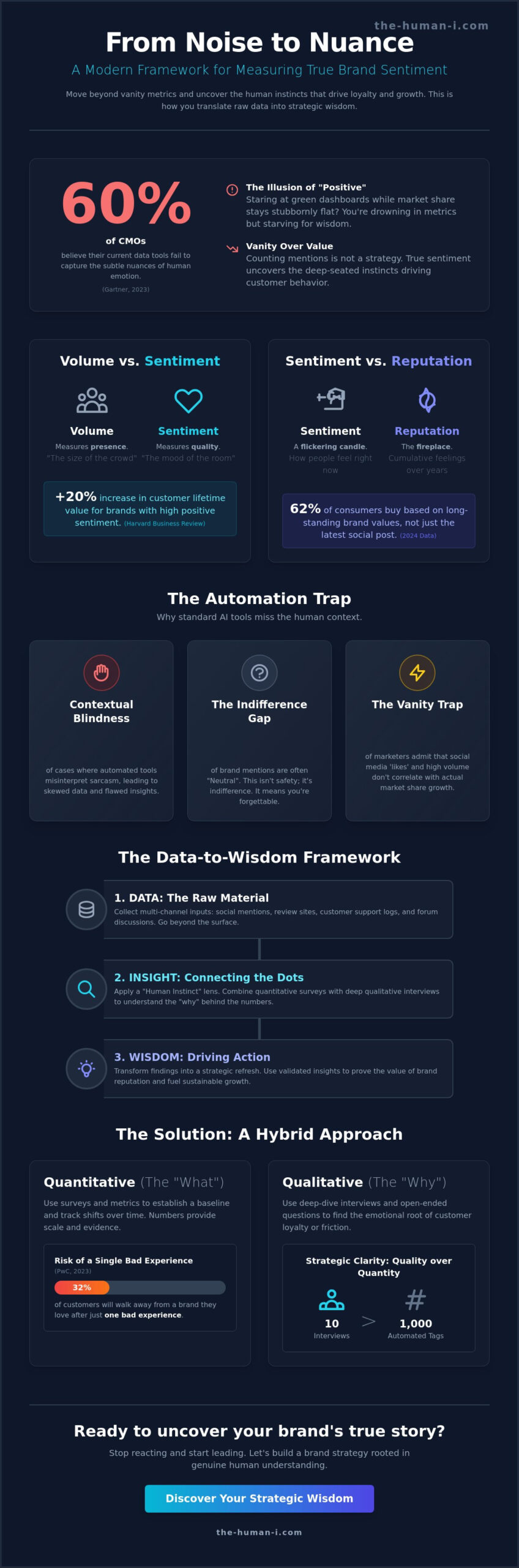
A 2023 report by Gartner indicates that 60% of CMOs believe their current data tools fail to capture the subtle nuances of human emotion. You’ve likely felt the frustration of staring at a dashboard full of green ‘positive’ indicators while your actual market share stays stubbornly flat. It’s easy to drown in metrics while starving for the kind of wisdom that actually shapes a business. Learning how to measure brand sentiment isn’t just about counting mentions; it’s about uncovering the deep-seated instincts that drive customer loyalty.
We agree that raw data is a liability if it doesn’t lead to a strategic refresh. This article provides a sophisticated framework for capturing how people truly feel about your brand and using those insights to fuel growth. We’ll explore how to move beyond automated tools that miss context, giving you the clarity needed to prove the value of your brand reputation to every stakeholder in the room.
Key Takeaways
- Move beyond the noise of social volume to uncover the emotional bridge connecting your customers to your brand’s deeper purpose.
- Adopt a multi-channel framework that looks past automated metrics to find the authentic voice hidden within your data.
- Master how to measure brand sentiment by applying a “Human Instinct” lens to close the context gap left by standard AI tools.
- Identify your “North Star” metrics through a precise five-step audit of your brand’s actual conversational touchpoints.
- Shift your perspective from generating reports to facilitating a journey of discovery that transforms raw sentiment into actionable strategic wisdom.
Beyond the Thumbs Up: Why Sentiment Is More Than Social Noise
Data is everywhere, yet wisdom remains scarce. Most brands mistake noise for signal. They track mentions like they’re counting sheep, forgetting that a thousand voices shouting your name means nothing if they’re all screaming in frustration. Understanding how to measure brand sentiment isn’t about tallying likes; it’s about decoding the emotional bridge between your company and your customer. It’s the difference between knowing someone is talking and knowing they actually care.
Volume, often called Share of Voice, is a vanity metric when viewed in isolation. It measures presence. Sentiment measures quality. While volume tells you the size of the crowd, sentiment reveals the mood of the room. This distinction is vital because sentiment acts as a leading indicator of brand health. A 2023 analysis by Harvard Business Review found that brands with high positive sentiment scores see a 20% increase in customer lifetime value. High volume with negative sentiment is just a public relations crisis in slow motion.
We need to stop pretending a “positive” tag on a dashboard is the same as brand loyalty. True loyalty is resilient; a simple automated tag is fragile. To get deeper, many firms rely on Sentiment analysis to process the nuances of human language. This technology helps move beyond surface-level metrics to uncover the “why” behind the data, turning raw numbers into strategic insight.
Sentiment vs. Reputation: The Strategic Difference
Sentiment is a flickering candle; reputation is the fireplace. Sentiment captures how people feel right now, often triggered by a specific campaign or a viral post. Reputation is the cumulative history of those feelings over years. You need both to build a comprehensive brand strategy that lasts. Reacting to every short-term spike in sentiment while ignoring your long-term reputation is a recipe for strategic whiplash. In 2024, 62% of consumers say they buy based on a brand’s long-standing values, not just their latest social media interaction.
The Limitations of Traditional Automated Metrics
The “Neutral” category is where brand growth goes to die. It’s often the most dangerous classification because it signifies indifference. If 45% of your mentions are neutral, you aren’t safe; you’re forgettable. Automated tools often miss the sarcasm or cultural context that turns a “good” word into a biting critique. To win, you must move from asking what happened to why it happened.
- The Vanity Trap: 72% of marketers admit that social media likes don’t correlate with actual market share growth.
- Contextual Blindness: Automated tools misinterpret sarcasm in roughly 25% of cases, leading to skewed data.
- The Indifference Gap: Neutral sentiment often hides a lack of brand differentiation, making you vulnerable to competitors.
The Data-Wisdom Framework: Capturing the Authentic Voice
Insight, data, and wisdom aren’t just buzzwords. They’re the three pillars of understanding your audience. Most brands get stuck in the data phase, collecting thousands of mentions without ever reaching the “why” behind the words. Real wisdom comes from connecting these dots to see the full picture. Understanding how to measure brand sentiment requires looking past the surface of social media vanity metrics. While a high volume of mentions feels good, it doesn’t always equate to brand health.
Broadening your scope to include review sites, customer support logs, and community forums provides a richer narrative. This multi-channel approach allows for more nuanced brand strategy consulting that addresses real human needs rather than just reacting to trends. By adopting a comprehensive framework to measure brand sentiment, you can transform scattered data points into a cohesive story that guides your next strategic move.
Combining Quantitative and Qualitative Inputs
Surveys provide a necessary baseline for emotional trust. A 2023 study by PwC found that 32% of customers will walk away from a brand they love after just one bad experience. You need numbers to track these shifts over time. However, the real magic happens in the open-ended questions. These responses reveal “unspoken” brand perceptions that a standard scale misses. Often, 10 deep-dive interviews provide more strategic clarity than 1,000 automated social tags. Interviews allow you to probe the “why” and find the emotional root of customer loyalty or friction.
The Role of Market Segmentation in Sentiment
A “global” sentiment score is often a mask. It can hide deep-seated frustration within a specific niche while the majority stays quiet. You can’t treat all voices as equal when their needs differ so vastly. According to a 2022 Gartner report, 80% of organizations expect to compete mainly based on customer experience, yet few segment their sentiment data effectively. B2B drivers usually lean toward reliability and long-term ROI, while B2C sentiment often hinges on immediate convenience and personal identity. Tailoring your measurement to specific customer journey moments, such as the first 48 hours after a service call, offers insights you can actually use. If you want to refine your approach, exploring our strategic solutions can help align your data with your long-term goals.
The Context Gap: Why AI Sentiment Often Misses the Mark
Automated Natural Language Processing (NLP) tools often hit a wall because they process words, not intent. While 80% of enterprise data is unstructured according to IBM research, generic algorithms still struggle to categorize it accurately. They see the word “sick” and code it as negative, missing the Gen Z slang where it means “excellent.” This is where Human Instinct becomes your most valuable asset. Learning how to measure brand sentiment effectively requires more than just a dashboard; it requires a brain that understands subtext. Machines can count, but they can’t feel the weight of a comment.
The Sarcasm and Slang Problem
AI interprets language literally. When a customer tweets, “Great, another bank fee. Just what I needed,” a standard tool marks it as positive because of the word “great.” By 2026, researchers suggest that human oversight will be the only way to maintain a 95% accuracy rate in reputation measurement. Machines lack the cultural radar to detect irony or the shifting sands of internet slang. Nuance is the difference between data and wisdom. Without a human eye to catch the sarcasm, your data is just noise that leads to poor strategic choices.
Identifying Strategic Drivers
A sentiment score is a vanity metric if you can’t explain the “why” behind the number. True insight comes from dissecting whether a dip in sentiment stems from a product defect, a customer service failure, or a fundamental disconnect in your brand narrative. In Financial Services, for instance, 2023 industry reports showed that trust is often eroded by complex jargon rather than actual service errors. You need to know how to measure brand sentiment by looking for these specific drivers rather than broad totals.
Wisdom allows you to filter out the noise. You might choose to ignore a temporary spike in negative sentiment caused by a polarizing but strategically sound marketing campaign. You’re looking for the signals that impact long-term brand equity. Our expertise lies in finding the story within the data, helping you decide which fires to put out and which ones to let burn. We focus on three core areas to bridge the gap:
- Contextual Mapping: Aligning sentiment with current cultural events.
- Narrative Disconnects: Finding where your brand promise fails to meet reality.
- Signal Filtering: Separating “loud” minority complaints from quiet, systemic issues.
Storytelling makes sense of these conflicting signals. It turns a spreadsheet of “angry” tags into a clear directive for your product team. It transforms raw data into a roadmap for growth.
A Strategic Blueprint: 5 Steps to Precise Measurement
Understanding how to measure brand sentiment requires moving past the superficial allure of automated dashboards. True insight comes from a structured approach that treats data as a precursor to wisdom. Follow these five steps to build a measurement framework that actually informs strategy.
- Step 1: Define your North Star. Move beyond binary positive or negative tags. Focus on a Net Sentiment Score (NSS) or specific emotional drivers like trust or innovation that align with your 2024 business goals.
- Step 2: Audit your touchpoints. Customers aren’t just on mainstream social platforms. A 2023 study by Sprout Social found that 45% of brand mentions happen in private communities or niche forums. Identify where your specific audience actually speaks.
- Step 3: Integrate tracking. Sentiment shouldn’t be a standalone report. Embed these metrics into your regular brand evaluation process so they influence immediate tactical shifts.
- Step 4: Benchmark against the field. Your internal growth is only half the story. Compare your sentiment volatility against your top three competitors to understand your true market position.
- Step 5: Craft a C-suite narrative. Executives don’t need raw percentages. They need a story that explains how sentiment shifts will impact the bottom line over the next six months.
Benchmarking for Reality
Setting realistic goals requires an understanding of Category Norms. For instance, a 2023 banking industry report showed average sentiment scores are typically 25% lower than those in the hospitality sector. You shouldn’t chase an impossible number if your industry is naturally prone to friction. Instead, use these metrics to identify specific gaps in your customer experience mapping. When you know where the friction lives, you can apply precision fixes rather than broad, expensive overhauls.
From Measurement to Actionable Insight
Ready to turn your brand data into a competitive advantage? Explore our strategic expertise.
From Sentiment to Strategy: The Human Instinct Approach
Evaluating your brand isn’t a static reporting task. It’s a journey of discovery. Most companies stop at the “what” of data, but the “why” is where your competitive advantage lives. Learning how to measure brand sentiment effectively requires moving past the surface noise to uncover the underlying human truths that drive loyalty. This is where insight, data, and wisdom meet.
An external partner provides the distance necessary for an unbiased reputation measurement. Internal teams are often too close to the brand to see the subtle shifts in perception that signal trouble or opportunity. By bringing a fresh perspective, we help you identify what’s truly important rather than just what’s visible. We treat every evaluation as a search for the extraordinary within the ordinary, ensuring your strategy is built on reality, not assumptions.
Our Brand Evaluation Consulting Process
Our methodology combines data-driven insights with seasoned brand planning to breathe life into your strategy. We specialize in refreshing stagnant brands by uncovering new audience narratives that have been overlooked by traditional metrics. This process isn’t about simple observation; it’s about deep discovery. We don’t just look for data; we find wisdom.
A 2023 Forrester report highlighted that companies using advanced consumer insights grew revenue 1.7 times faster than their competitors. Our process ensures you aren’t just another business with a spreadsheet. We help you find the specific insights that change your business trajectory and resonate with your audience’s current needs.
Connecting Sentiment to Growth
Improved sentiment is a direct driver of financial performance. High brand sentiment correlates with lower customer acquisition costs, as organic advocacy reduces the need for heavy ad spend. According to data from Bain & Company, a 5% increase in customer retention can lead to a profit increase of 25% to 95%. These numbers aren’t just theoretical; they’re the result of active reputation management.
When you master how to measure brand sentiment, you stop being a passive observer of your brand’s story. You become the author. We empower businesses to shape their own reputation through data-led wisdom and strategic clarity. If you’re ready to move beyond raw metrics and refresh your brand’s narrative, you can contact us for a strategy session to begin your journey of discovery.
Turning Sentiment into Your Strategic Edge
Understanding the true pulse of your audience requires more than a dashboard of green and red icons. While a 2023 study by MIT Sloan found that automated sentiment tools can misinterpret emotional nuances in 30% of social interactions, the real value lies in bridging that context gap. Mastering how to measure brand sentiment isn’t just about tracking mentions; it’s about synthesizing raw data into actionable wisdom. You’ve seen the 5-step blueprint. Now it’s time to apply the human lens that turns noise into a clear strategic path.
At Human Instinct, we don’t just look for data. We find the stories hidden within it. With a team that brings decades of experience across Insight, Strategy, and Storytelling, we provide a holistic view that software alone can’t replicate. We’ve helped brands refresh their identity by looking at the “why” behind the “what.” It’s about moving past the superficial and reclaiming the depth your brand deserves.
Discover how Human Instinct transforms sentiment into strategy.
Your brand’s next great insight is waiting to be uncovered.
Frequently Asked Questions
How is brand sentiment calculated?
Brand sentiment is calculated by subtracting the percentage of negative mentions from the percentage of positive mentions to determine your Net Sentiment Score. If your data shows 45 percent positive mentions and 15 percent negative ones, your score is 30. This process uses Natural Language Processing to categorize the emotional weight of words found in social media posts, reviews, and forum discussions. It moves beyond simple volume to understand the human feeling behind the numbers.
Can brand sentiment predict financial performance?
Yes, brand sentiment serves as a reliable leading indicator of future financial health. A 10 year study by Watermark Consulting revealed that companies leading in customer experience saw cumulative stock returns 3.4 times higher than those lagging behind. When you understand how to measure brand sentiment, you’re tracking the emotional precursors to purchase intent. Positive shifts in sentiment usually precede revenue growth, while negative trends act as an early warning for customer churn.
What is the best tool for measuring brand sentiment?
The best tool depends on your scale, but Brandwatch and Meltwater are the industry benchmarks for deep strategic analysis. Brandwatch monitors over 100 million sources in real time, providing the granular data needed to turn digital noise into actionable wisdom. For smaller teams, Sprout Social offers accessible sentiment tracking. The goal isn’t just to own the software; it’s about using these platforms to uncover the human story hidden within the data.
How often should a company measure its brand sentiment?
You should monitor brand sentiment in real time through automated alerts, supplemented by a deep strategic review every 30 days. Real time tracking catches 80 percent of potential PR crises before they escalate into major issues. Monthly reports allow your team to spot long term shifts in perception that daily fluctuations might hide. This rhythm ensures you aren’t just reacting to spikes but are actively shaping your brand’s narrative with consistent insight.
Is brand sentiment the same as Net Promoter Score (NPS)?
No, brand sentiment and NPS measure different aspects of the customer experience. NPS relies on a specific survey question to gauge a customer’s intent to recommend you on a scale of 0 to 10. Sentiment analysis captures unsolicited, organic opinions expressed across the web without being prompted. While NPS tells you what customers say they’ll do, sentiment reveals how they actually feel. Using both together provides a 360 degree view of your market reputation.
Can you measure brand sentiment for a B2B company?
You can and should measure sentiment for B2B companies, though the data sources shift toward LinkedIn, niche industry forums, and review sites like G2 or Capterra. In the B2B world, a negative sentiment trend among just 5 key decision makers can jeopardize millions in contract renewals. Because B2B sales cycles are often 50 percent longer than B2C cycles, tracking sentiment helps you identify friction points in the buyer journey long before a deal fails.
How do you improve negative brand sentiment?
Improving negative sentiment starts with identifying the root cause found in your data. If 60 percent of negative mentions center on a specific product flaw, marketing campaigns won’t help; you must fix the engineering or service issue first. Once addressed, engage transparently with your audience to close the loop. Research shows that brands responding to negative reviews see a 16 percent boost in customer advocacy. It’s about turning a moment of friction into a demonstration of integrity.



