


What if the most expensive mistake your business makes this year isn’t a failed product, but hiring a partner who only polishes the surface? A 2024 industry report found that 70% of marketing leaders struggle to prove the long-term value of their brand investments. You likely recognize the fear of wasting a significant budget on superficial changes that don’t actually move the needle. Knowing the right questions to ask a brand consulting firm is the only way to move past stagnant growth and finally identify those elusive new market segments.
We promise to equip you with the strategic inquiries that separate generic agencies from partners who offer genuine wisdom. You’ll discover how to demand data-driven insights that lead directly to new revenue streams rather than just aesthetic updates. This article provides a clear roadmap for your brand renewal by outlining 12 essential questions designed to uncover a consultant’s true depth before you sign any contracts.
Key Takeaways
- Shift your perspective from superficial graphic design to a deep-rooted strategic partnership that prioritizes long-term brand evolution over a simple facelift.
- Identify the critical questions to ask a brand consulting firm to determine if they possess the seasoned wisdom necessary to turn raw data into actionable strategy.
- Explore how refined market segmentation can uncover high-value audiences and reignite growth for brands that have hit a plateau.
- Discover how to transform “intangible” brand health into measurable results by making reputation a core deliverable of your consulting engagement.
- Learn why evaluating a firm’s senior talent and cultural chemistry is the most reliable way to ensure your vision is executed with precision and insight.
Beyond the Logo: Why Your Choice of Consultant Requires Strategic Inquiry
Brand consulting isn’t about choosing a hex code or a new font. It’s a strategic partnership designed to excavate the truth of your business. If you’re looking for a quick facelift, you’re looking for a graphic designer. If you’re looking for growth, you’re looking for a consultant. In 2026, the gap between these two paths determines whether a brand thrives or simply exists. You need a partner who values wisdom over whimsy and data over decoration.
Stagnant brands often suffer from surface-level syndrome. They change the wallpaper while the foundation cracks. A true refresh requires a rigorous evaluation of your current position. This isn’t just about aesthetics; it’s about understanding brand management as a driver of long-term equity and value. Identifying the right questions to ask a brand consulting firm is the first step in ensuring your investment yields more than just a pretty slide deck. Do they rely on fleeting trends, or do they utilize the Art of Brand Evaluation to set a baseline for every project?
The Difference Between Agency Output and Consulting Insight
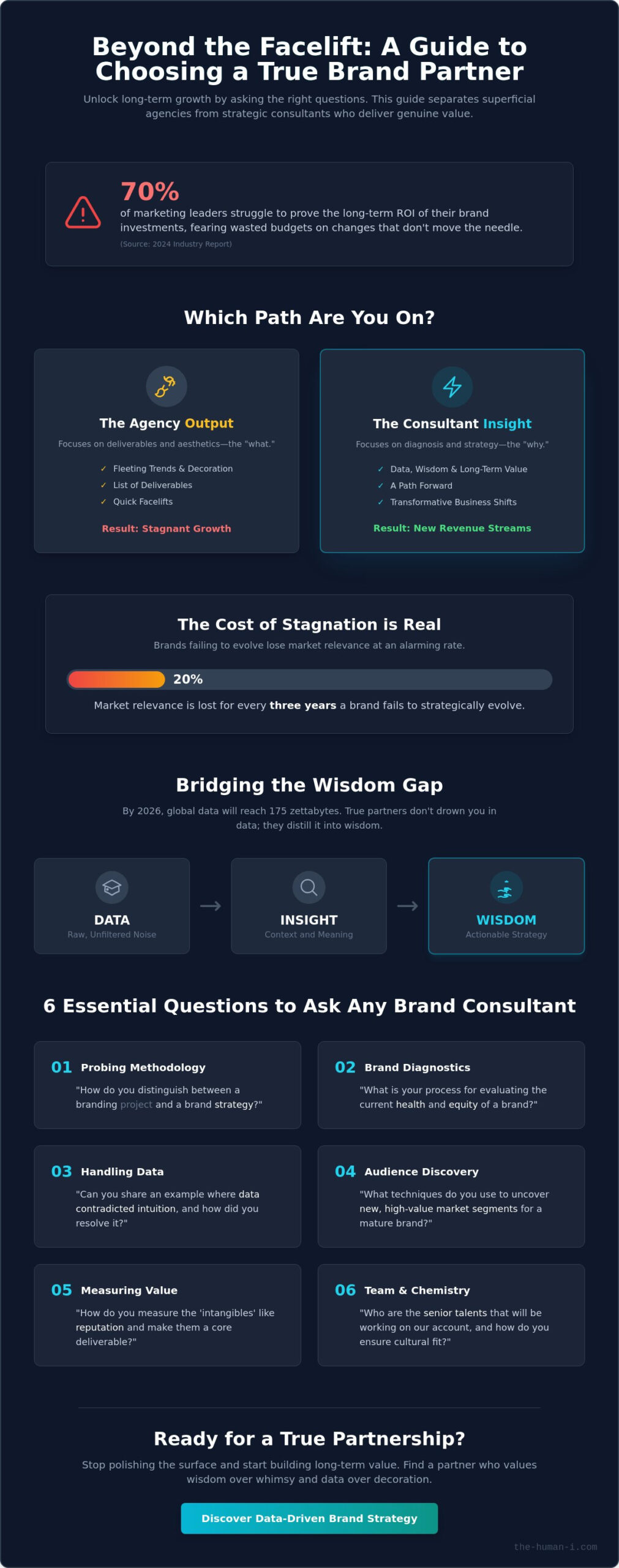
Output is what you see. Insight is what you know. Most agencies deliver a list of deliverables; consultants deliver a path forward. The most critical questions to ask a brand consulting firm center on discovery. Ask them: “How do you distinguish between a branding project and a brand strategy?” You want a partner who uncovers new narratives that create genuine engagement. It’s about finding what’s important, not just looking for it. This distinction separates a simple design update from a transformative business shift that can redefine your market position for the next five years.
Starting with Brand Evaluation
You can’t fix what you haven’t diagnosed. Every project should begin with a cold, hard look at the data. A 2024 analysis of market shifts suggests that brands failing to evolve every three years lose 20% of their market relevance. To avoid this, ask: “What is your process for evaluating the current health of an ailing brand?” If the answer doesn’t involve data-driven insights and a deep dive into customer psychology, walk away. A firm should be able to identify exactly where your brand is leaking equity. This level of precision is at the heart of Human Instinct’s solutions, where wisdom meets data to refresh brands that have lost their way. They don’t just guess; they find the truth.
Probing the Methodology: Insight, Data, and the Wisdom Gap
By 2026, the volume of global data is projected to reach 175 zettabytes. Most agencies will drown you in charts; few will tell you what they actually mean for your bottom line. Data without context is just noise. In a landscape where AI can generate a thousand personas in seconds, the differentiator is no longer the quantity of information you possess. It’s the depth of the insight you extract from it. We believe that true strategy requires a blend of three pillars: insight, data, and wisdom. Brand Wisdom is the intersection of data and human experience.
When narrowing down your list of questions to ask a brand consulting firm, start with their process for handling conflicting signals. You want a partner who doesn’t just mirror your existing assumptions but challenges them with a seasoned perspective. Consulting firms often rely on standardized questions to ask a potential partner, but the real value lies in how they interpret the answers to uncover what’s truly happening beneath the surface.
How Do You Move From Data Points to Strategic Wisdom?
The best firms value deep discovery over superficial analysis. They don’t just look at what people are doing; they seek to understand why they’re doing it. To find out if a firm possesses this level of depth, ask them: “Can you provide an example where data contradicted your intuition, and how did you resolve it?”
- Look for responses that prioritize human behavior over algorithm-driven trends.
- Evaluate if they use data to confirm a bias or to spark a new direction.
- Ensure they understand that What Is Brand Strategy? is about more than just numbers; it’s about finding the “why” behind the “what.”
The Role of Storytelling in Brand Planning
Strategy is the logic, but storytelling is the magic. Without a narrative, your strategy deck is just a collection of expensive slides that your team will likely ignore. Storytelling is the bridge between a dry strategy document and genuine customer engagement. It’s what makes your brand feel human in an increasingly automated world. These are the essential questions to ask a brand consulting firm if you want to move beyond surface-level aesthetics: “How do you translate market research into a compelling brand narrative?”
A firm that understands the human element will explain how they turn raw research into a story that resonates emotionally with your audience. They should be able to articulate how they shape the brand’s voice to empower and refresh stagnant identities. If you’re looking for a partner who prioritizes this level of intellectual rigor, explore our strategic expertise to see how we bridge the gap between data and wisdom.
Audience Exploration: How Will You Find Our Next Customer?
Stagnant brands aren’t always broken. Often, they’re just exhausted from chasing the wrong people. Growth in 2026 requires more than a wider net; it demands a sharper lens. When you’re evaluating partners, one of the most critical questions to ask a brand consulting firm is how they uncover the revenue hiding in plain sight. This isn’t about generalities. It’s about finding the friction points where your potential customers are currently walking away.
A brand that feels “stuck” usually lacks a deep understanding of its audience’s evolving behavior. According to Salesforce’s 2023 State of the Connected Customer report, 73% of customers expect companies to understand their unique needs. If your consultant is still relying on 2019 data, you’re already behind. You need to ask: “How do you identify key moments in the customer journey that we are currently missing?” The answer should involve a blend of data and human wisdom that goes beyond the surface.
Segmentation Beyond Demographics
Demographics are the “what,” but they rarely explain the “why.” In a B2B context, relying on industry codes or company size is a recipe for mediocrity. Ask your potential partner: “How do you perform B2B market segmentation that goes deeper than industry and company size?”
Look for firms that prioritize behavioral and psychographic insights. They should be able to tell you what keeps a CTO awake at 2:00 AM, not just how many employees they manage. This level of insight is vital for New Product Development. If you don’t know the specific frustrations of your segments, you can’t build the solutions they’ll pay a premium for. Effective segmentation identifies the psychological triggers that drive a purchase decision, allowing you to tailor your message with surgical precision.
Mapping the Experience Journey
A journey map shouldn’t be a static document that gathers dust in a drawer; it should be a living strategy. Ask: “What is your approach to customer experience mapping for diverse sectors like Financial Services or Tech?” These industries involve complex, multi-layered decision-making processes that simple retail maps can’t capture.
The best questions to ask a brand consulting firm focus on their ability to actively shape the journey. Documenting what happens today is only half the job. A strategic partner uses data to redesign the path, ensuring every touchpoint reinforces your brand’s value. They should demonstrate how they’ve helped companies in high-stakes sectors navigate regulatory hurdles while maintaining a seamless user experience. This requires a sophisticated understanding of both the human instinct and the technical landscape to ensure your brand doesn’t just exist, but thrives.
Measuring the Intangible: Reputation and Long-Term Brand Health
Critics often dismiss brand strategy as a soft science. They claim you can’t measure a feeling or a vibe. That’s a mistake. While a direct response ad gives you immediate clicks, brand strategy builds the foundation that makes those clicks cheaper over time. When you’re narrowing down your list of questions to ask a brand consulting firm, you must push for accountability beyond the launch day.
Reputation isn’t a static asset. It’s a living perception that requires constant calibration. A sophisticated firm doesn’t just deliver a deck and disappear. They provide the tools to monitor how your audience’s instinct about your company evolves. You need to ask: “How will we track the shift in brand perception six months after the project ends?” If they don’t have a framework for longitudinal tracking, they aren’t managing your reputation; they’re just decorating your business.
Defining Success Metrics for Brand Strategy
Short-term marketing metrics like CTR or conversion rates tell you what happened yesterday. Brand equity KPIs tell you what will happen next year. Ask your consultant what specific data points they use to quantify wisdom and market sentiment. Look for metrics like brand salience, net promoter scores, or price premium thresholds. A firm that takes accountability for business results will show you how a 15% increase in brand favorability correlates with a decrease in customer acquisition costs. This connection between perception and profit is where true strategy lives.
Protecting Brand Reputation During Change
Choosing Your Strategic Partner: Why Chemistry and Vision Matter
Selecting a partner is about finding a shared frequency. It’s the difference between a temporary fix and a permanent evolution. Human Instinct operates at the intersection of professional rigor and seasoned intuition. We don’t just provide a service; we offer a strategic anchor. The “Human Instinct” approach is built on the belief that data alone isn’t enough. You need the wisdom to interpret it and the insight to act on it. When you evaluate potential partners, you’re looking for a team that values discovery over superficial analysis.
Evaluating the Talent Behind the Strategy
A glossy portfolio tells you what a firm did for someone else, but it doesn’t tell you what they’ll do for you. One of the most critical questions to ask a brand consulting firm is: “Who will actually be doing the thinking on our account?” Too often, senior partners disappear after the pitch, leaving the heavy lifting to junior staff. A 2024 study by the Agency Management Institute found that 58% of clients felt “bait-and-switched” by agency talent assignments. You deserve better than that.
Look for a wealth of experience across disciplines like brand planning, deep-dive research, and storytelling. You want a “wise mentor” personality, not a “sales-first” representative. This person should be cerebral and analytical, yet capable of explaining complex strategies in clear terms. They should be more interested in finding the right answer than being right. When you review the “Our Talent” section of a firm’s website, look for evidence of long-term strategic thinking rather than just creative awards.
The Final Alignment Check
Before you sign a contract, you must ensure your visions are compatible. Ask: “Do you see our brand as it is, or as it could be?” This is the ultimate test of a firm’s strategic depth. A 2025 industry report indicated that 42% of brand initiatives fail because the external strategy didn’t align with the internal business goals. Your consultant should be able to articulate a future for your brand that feels both ambitious and authentic.
- Does their vision align with your 5-year growth targets?
- Do they challenge your assumptions with data-backed insights?
- Is the chemistry natural, or does it feel forced for the sake of the sale?
The right firm won’t just tell you what you want to hear. They’ll tell you what you need to know to stay competitive in 2026. This final alignment check is your safeguard against a generic strategy that looks good on paper but fails in the real world.
Refreshed brands start with Human Instinct. If you’re looking for a partner who brings insight, data, and wisdom to every conversation, it’s time to take the next step. We invite you to contact Human Instinct for an initial consultation to see how our seasoned team can empower your brand’s future.
Defining Your Brand’s Next Era
Finding the right partner isn’t about checking boxes. It’s about finding the bridge between your current reality and where the global market is moving in 2026. You’ve explored how to probe a firm’s methodology and why chemistry often outweighs a flashy portfolio. These specific questions to ask a brand consulting firm ensure you’re not just buying a temporary logo. You’re investing in a long term strategy rooted in human truth and measurable brand health.
Human Instinct operates at the precise point where insight, data, and wisdom meet. Our seasoned team draws from deep backgrounds in strategy and storytelling to support leaders across Financial Services, Tech, and Health and Beauty. We don’t just look for answers; we find the underlying narratives that drive genuine connection. It’s time to move past the surface and build a reputation that resonates for years to come.
Partner with Human Instinct to uncover your brand’s next narrative.
Your brand deserves more than a standard template. Let’s build something extraordinary together.
Frequently Asked Questions
What is the difference between a branding agency and a brand consulting firm?
A brand consulting firm focuses on high level strategy and business alignment, whereas a branding agency typically prioritizes creative execution and visual assets. Think of the consultant as the architect and the agency as the builder. In 2024, 72 percent of CMOs reported that strategic brand positioning was their top priority over tactical creative work. We provide the wisdom to ensure your brand’s foundation supports long term growth before a single pixel is moved.
How long does a typical brand strategy engagement take?
A typical brand strategy engagement lasts between 12 and 24 weeks. This timeline allows for deep discovery, audience research, and internal alignment. Shorter sprints of 4 weeks might address specific problems, but a full transformation requires time for data to settle into actionable wisdom. Most 2025 benchmarks suggest that rushing this process leads to a 40 percent higher chance of rebranding again within two years.
Should a brand consultant have experience in my specific industry?
Expertise in your specific sector is less critical than a consultant’s ability to uncover fresh insights and challenge your internal assumptions. Outside perspectives often identify blind spots that industry insiders miss. According to a 2023 Harvard Business Review study, cross industry innovation is a primary driver for market disruption. We use data and human instinct to find what others look past, regardless of the sector.
What deliverables should I expect from a brand strategy consultant?
You should expect a comprehensive brand strategy framework, audience personas, and a clear messaging architecture. These aren’t just PDF files; they’re the blueprints for your future growth. When you consider the questions to ask a brand consulting firm, ensure they mention a brand heart or similar internal alignment document. This ensures your team stays consistent across every touchpoint and customer interaction.
How much does it cost to hire a brand consulting firm?
Costs for brand consulting vary widely based on the scope of the project and the firm’s expertise level. Industry reports from organizations like the Association of National Advertisers show that mid sized firms often invest between 5 and 15 percent of their annual marketing budget into brand strategy. It’s an investment in the intellectual capital of your business rather than a simple line item expense.
Can a brand consultant help with internal company culture?
A brand consultant is essential for aligning internal company culture with your external promise. Your brand is only as strong as the people living it every day. Research by Gallup in 2023 found that companies with highly engaged employees see a 23 percent increase in profitability. We help you shape an internal narrative that empowers your team to become your most effective brand ambassadors.
What is the first step in a brand evaluation process?
The first step is always a deep discovery phase, often starting with a comprehensive brand audit. This involves looking at 360 degrees of your current performance, from customer sentiment to competitor positioning. It’s about finding the gap between where you are and where you want to be. This stage sets the trajectory for every strategic decision that follows, ensuring we build on truth rather than guesswork.
How do brand consultants use data to drive creativity?
Brand consultants use data to define the playing field, while creativity provides the winning play. Insight and data act as the compass, but wisdom determines the final destination. One of the most important questions to ask a brand consulting firm is how they balance these two. In 2026, the most successful brands will be those that use hard data to validate human centric storytelling.



