


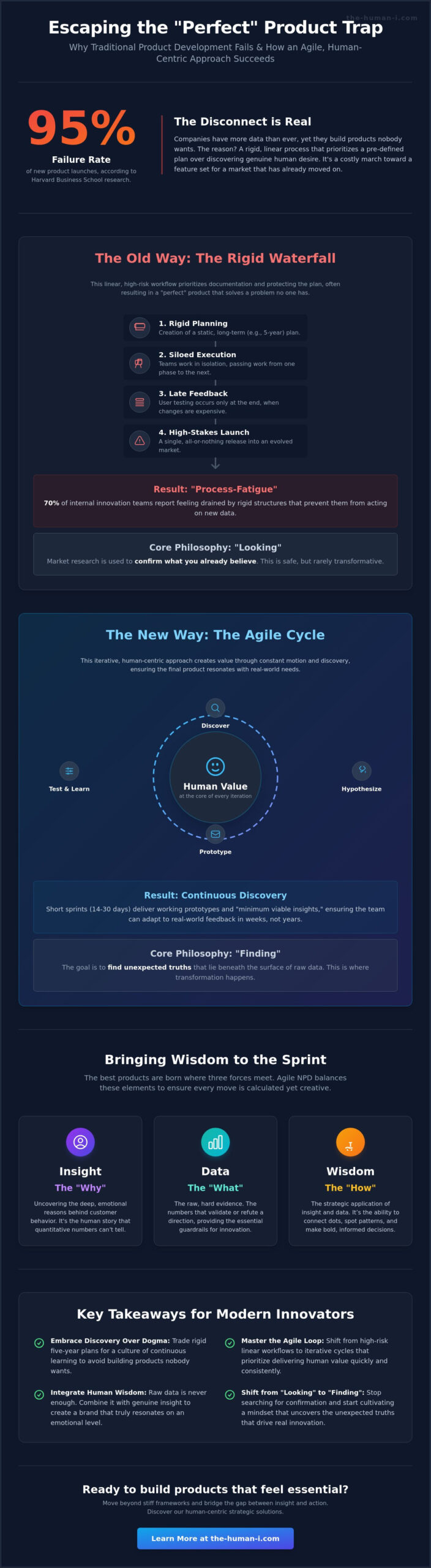
Why do 95% of new product launches fail every year, according to research from Harvard Business School, even when companies have access to more consumer data than ever before? It’s a sobering reality that suggests a massive disconnect between technical execution and genuine human desire. Most teams follow a rigid, linear sequence, yet they still end up with stagnant lines or expensive failures that miss the mark. To fix this, you need an agile new product development process that prioritizes discovery and fluidity over simple checklists.
You already know that cold metrics aren’t enough to guarantee a hit, and you’ve likely seen how internal silos can stifle even the most brilliant ideas. It’s frustrating to watch a project lose its soul as it moves from the research phase to the final execution. This article shows you how to move beyond stiff frameworks to build products that resonate with human instinct. You’ll discover a framework that balances data with strategic wisdom to ensure a faster time to market and a more human centric output. We’re going to explore how to bridge the gap between insight and action to create products that feel essential.
Key Takeaways
- Trade rigid five-year plans for a culture of discovery to ensure you aren’t building “perfect” products that nobody actually wants.
- Master the agile new product development process to shift from linear, high-risk workflows to iterative loops that prioritize human value.
- Identify the “moments of truth” in your customer journey through experience mapping to solve problems before they even arise.
- Learn why raw data is never enough and how to integrate human wisdom into your sprints to create a brand that truly resonates.
- Understand the critical difference between “looking” and “finding” to move beyond superficial analysis and into deep market insight.
The Death of the Five-Year Plan: Why Traditional NPD Fails
Traditional Waterfall methods often produce a “perfect” product that solves a problem no one actually has. It’s a common trap where teams spend 18 months polishing a feature set, only to launch into a market that evolved six months ago. This rigid approach prioritizes protecting the plan over uncovering the truth. When documentation becomes the primary goal, insight dies in a spreadsheet.
Stagnant brands often find themselves caught in these loops, valuing the comfort of a five-year roadmap over the reality of shifting human behavior. The agile new product development process offers a way out, replacing static milestones with continuous discovery. It’s the difference between following a map of a city that no longer exists and using a live GPS. Instead of a linear march toward a fixed point, it’s a journey of constant adjustment.
The Cost of Stagnation
Bureaucracy acts as a silent killer for innovation. By the year 2026, market shifts will occur at a pace that makes standard quarterly reviews feel like relics of a bygone era. If your development process feels like a hurdle rather than a highway, your brand is already at risk. Industry data suggests that 70% of internal innovation teams report feeling “process-fatigued” when rigid structures prevent them from acting on new data. This emotional toll is real; it drains the energy needed to create something truly extraordinary. You can explore how we address these hurdles through our strategic solutions.
Finding vs. Looking: A Philosophical Shift
Chef Ferran Adria once remarked that in the creative process, it’s not what you look for that’s important, but what you find. This distinction is the heartbeat of a modern R&D strategy. Traditional market research is about “looking” for confirmation of what you already believe. It’s safe, but it’s rarely transformative. A discovery-first mindset focuses on “finding” the unexpected truths that lie beneath the surface of raw data.
This approach draws heavily from the foundational principles of Agile software development, where the focus remains on iterative progress and human interaction. By adopting an agile new product development process, you move from surface-level market research to profound human insight. You stop trying to predict the future and start building a team capable of responding to it. This evolution ensures that the wisdom you gain today isn’t obsolete by tomorrow.
What is the Agile New Product Development Process?
The agile new product development process is a departure from the rigid, linear paths of the past. It’s a dynamic, iterative cycle designed to create value through constant motion. Instead of a single, high-stakes launch, we build in loops. This approach relies on three core pillars: deep collaboration, relentless customer-centricity, and rapid adaptation. When you stop trying to predict the next three years and start reacting to the next three weeks, everything changes.
This methodology isn’t just for software developers. In Financial Services, where 70% of digital transformations fail according to a 2021 BCG report, Agile provides the necessary guardrails. In Health and Beauty, it allows brands to pivot based on viral trends or ingredient breakthroughs. When Explaining Agile, the focus is often on the shift from managing bureaucracy to delivering outcomes. The ultimate goal is to move past theory to deliver working prototypes that gather real-world wisdom.
The Architecture of an Iteration
An iteration is a focused sprint, typically lasting 14 to 30 days. It begins with a hypothesis rather than a command. We ask: “Will this solve the customer’s friction?” To find out, we rely on “minimum viable insights.” These are the sharp, essential truths needed to move forward without getting bogged down in analysis paralysis. The result isn’t a thick report that sits on a shelf; it’s a working version of a product that we can put in front of a human being to see if it actually works.
The Strategic Triad: Insight, Data, and Wisdom
At Human Instinct, we believe the best products are born where three forces meet. Our approach to our solutions balances these elements to ensure every move is calculated yet creative:
- Insight: This is uncovering the “why.” If 35% of your audience ignores a new feature, insight tells us the emotional reason behind the rejection.
- Data: This is the raw evidence. It’s the hard numbers that validate or refute our direction, acting as the ultimate reality check.
- Wisdom: This is the human layer. It’s applying deep expertise to shape the final brand narrative, ensuring the product doesn’t just function, but feels right.
By integrating the agile new product development process into your strategy, you replace guesswork with evidence. It’s about moving from a place of “we think” to a place of “we know,” transforming raw data into the kind of wisdom that defines market leaders.
Agile vs. Waterfall: Choosing the Right Path for Innovation
Waterfall is the architectural blueprint of a previous era. It’s a linear sequence where one stage must end before the next begins. This structure feels secure because it offers a clear timeline, but that predictability is often a mirage. In the agile new product development process, we trade the comfort of a fixed plan for the power of iterative discovery.
Waterfall carries the highest risk of total failure because the “big reveal” happens after you’ve spent 100% of the budget. If you’ve built the wrong thing, there’s no money left to fix it. By contrast, Embracing Agile means you’re uncovering flaws when they still cost pennies to adjust. A 2020 report by the Standish Group noted that Agile projects are statistically twice as likely to succeed as Waterfall ones. It’s not just a workflow; it’s a risk-mitigation strategy for high-stakes environments where the cost of being wrong is existential.
Flexibility Over Rigidity
Agile isn’t about being indecisive. It’s about responding to data. When you map customer experiences early, you might find your original assumption was off by 45%. Pivoting isn’t changing your mind; it’s an act of strategic intelligence. It ensures your final product actually solves a human problem rather than just fulfilling a legacy requirement. You can explore how we facilitate these pivots through Our Solutions.
The Feedback Loop Advantage
Traditional models wait until the very end to see if the market bites. The agile new product development process uses continuous testing to build internal confidence. Frequent deliveries provide stakeholders with tangible evidence of progress, which is far more convincing than a static PowerPoint presentation. This method relies on three core pillars:
- Incremental Validation: Testing features in isolation reduces the psychological weight of the final launch.
- Stakeholder Buy-in: Confidence increases when partners see the product evolve in real-time based on evidence.
- Reputation Measurement: We track early perception to ensure the brand’s wisdom is landing as intended before the full rollout.
This approach replaces the anxiety of the big reveal with the steady accumulation of market proof. It recognizes that in a modern market, the fastest way to wisdom is through a series of small, calculated experiments.
Implementing Agile NPD: The Human-Centric Feedback Loop
Moving from raw data to actionable wisdom requires a structured yet flexible framework. The agile new product development process thrives on the friction between what we think users want and what they actually do. Success isn’t about avoiding mistakes; it’s about making them early and cheaply. According to Harvard Business Review, 85% of 30,000 new product launches fail because of poor market segmentation. We avoid this by grounding every sprint in human reality.
- Step 1: Market Segmentation. We identify the specific audience before the first line of code or design is drafted. This isn’t about broad demographics; it’s about psychographics and shared behaviors.
- Step 2: Experience Mapping. We find the “moments of truth” where a user decides to engage or abandon. These friction points define the product’s functional requirements.
- Step 4: Wisdom Integration. This is where we refine the product based on expert storytelling. We look beyond the “what” of user feedback to understand the “why,” turning observations into strategic direction.
Mapping the Customer Journey
An effective journey map does more than track clicks or steps. It uncovers the emotional highs and lows that dictate brand loyalty. By applying our deep expertise in human behavior, we identify the specific pain points that your new product must solve to be indispensable. We then translate this map directly into a product roadmap. This ensures every feature developed in the agile new product development process serves a documented human need rather than a technical whim.
The Role of Storytelling in Agile
Every iteration needs a clear narrative to keep the team aligned. Without a story, “agile” quickly turns into “aimless.” We refine the brand story alongside the product features so they grow in tandem. Features are just tools; the human impact is the reason they exist. A 2023 industry report found that 70% of product teams struggle with feedback loops. We solve this by moving beyond feature lists to focus on the narrative of the user’s life. If the story doesn’t make sense, the product won’t either.
Ready to turn your product data into market-leading wisdom? Connect with our strategists today to start your next iteration.
Bringing Wisdom to the Sprint: The Human Instinct Approach
Data is a compass, but it isn’t the destination. In a typical agile new product development process, teams often drown in metrics while starving for meaning. While 95% of new products fail according to Harvard Business School research, the cause is rarely a lack of data. It’s usually a lack of soul. Legendary brands aren’t built on spreadsheets alone; they’re built on the profound insights that emerge when human intuition meets rigorous analysis.
Our Human Instinct philosophy operates at this intersection. We believe that insight without wisdom is just noise. By integrating strategic storytelling and deep psychological understanding into your sprints, we help you uncover the “why” behind the “what.” This approach allows us to refresh stagnant brands by identifying new audiences and shifting the narrative from functional utility to emotional necessity. We don’t just help you move faster; we help you move toward a future that actually resonates with your customers.
Beyond the Framework
Think of the agile framework as a skeleton. It provides structure, but it needs muscle and spirit to move with purpose. This is where a seasoned mentor becomes vital. Having an outside perspective prevents the “echo chamber” effect that often stalls internal innovation. You can learn more about Human Instinct and our wealth of experience in strategy and brand planning to see how we provide that necessary external spark.
If you’re hesitant to overhaul your entire system, we suggest the pilot project approach. Start small. Apply the agile new product development process to a single, high-potential initiative rather than the whole portfolio. This allows your team to experience the power of wisdom-driven insights without the pressure of a total organizational shift. By focusing on discovery rather than just delivery, you’ll find that what you “find” is often more valuable than what you were originally “looking for.”
Ready to Refresh Your Brand?
Cultivating a discovery-led culture is the most effective way to future-proof your organization. When your team stops treating the development cycle as a checklist and starts treating it as a journey of understanding, the results are transformative. Industry data suggests that companies prioritizing customer-centric innovation see a 20% increase in brand equity over a three-year period. This isn’t just about making better things; it’s about making things that matter.
The long-term benefits of a wisdom-driven process include higher customer loyalty, clearer market positioning, and a team that feels empowered by their work. It’s time to move beyond the superficial and find the extraordinary truths hidden in your data. If you’re ready to transform your innovation pipeline into a strategic powerhouse, contact us to start your journey. Let’s uncover the insights that will define your brand’s next chapter.
Mastering the Art of the Market Pivot
The era of rigid, five-year roadmaps has ended. Modern innovation requires a shift from passive data collection to active, human-centric wisdom. By adopting an agile new product development process, your team can bridge the gap between technical output and emotional resonance. Success in high-stakes sectors like Financial Services, Automotive, and Tech depends on more than just speed. It requires a deep-seated ability to refresh a stagnant brand through strategic storytelling and sharp Insight. We’ve built a wealth of experience helping leaders move beyond the failure of traditional planning by implementing feedback loops that actually listen to the human instinct. When you combine raw data with seasoned strategy, you don’t just launch products; you create experiences that endure. Our work across the Financial Services, Automotive, and Tech sectors has proven that the right perspective can transform a cluttered sprint into a clear path forward. Discover how Human Instinct brings wisdom to your product development process. It’s time to stop guessing and start finding the profound truths that drive authentic growth.
Frequently Asked Questions
Is Agile NPD only suitable for software companies?
Agile isn’t just for tech labs. While it started in software, 27% of manufacturing firms and 18% of marketing agencies now use an agile new product development process to stay competitive. It works wherever customer needs shift quickly. We use it to turn raw market data into wisdom that shapes physical products and services alike.
How does Agile differ from the traditional Waterfall model in product development?
Waterfall follows a rigid, linear path that often leads to stagnation. Agile thrives on iterative loops. A 2020 Standish Group Chaos Study found Waterfall projects fail 9.6% more often than Agile ones. By breaking the process into two week sprints, you can pivot based on real time insight instead of waiting months for a final reveal that might miss the mark.
What are the main benefits of using an agile process for new products?
Speed and adaptability are the primary rewards. Organizations adopting these methods see a 64% improvement in delivery speed and a 47% increase in product quality, based on 2022 industry benchmarks. It’s about reducing the cost of being wrong. You learn what works in days, not years. This ensures your brand strategy rests on proven customer behavior rather than guesswork.
Can we still have a long-term brand strategy if we use Agile?
Strategy provides the North Star while Agile provides the path. Your long term vision remains the fixed destination. The agile new product development process simply ensures the steps you take are guided by fresh data. Think of it as a GPS. The destination is set, but the route adjusts to avoid traffic jams or roadblocks in the market.
How do we measure success in an agile product development environment?
Success moves beyond simple deadlines to focus on value delivery. We look at cycle time, which measures how long it takes to move an idea from the backlog to the customer. A 15% reduction in cycle time usually signals a healthy process. We also track Net Promoter Scores (NPS) after each release to ensure our insights are actually resonating with the target audience.
What is the role of market segmentation in an agile process?
Segmentation acts as a filter for your experiments. Instead of targeting everyone, you focus on the 20% of users who typically drive 80% of your product’s value. This precision allows you to test specific hypotheses within a controlled group. It’s about finding the deep wisdom within a niche before scaling your brand to the broader market.
How much time does an agile NPD cycle typically take?
A standard cycle, or sprint, lasts between 14 and 30 days. This timeframe forces teams to focus on the most impactful features first. By the end of this period, you should have a functional increment or a validated insight. It’s a rhythmic approach that prevents the project from becoming a bloated, multi year endeavor that loses its original purpose.



