


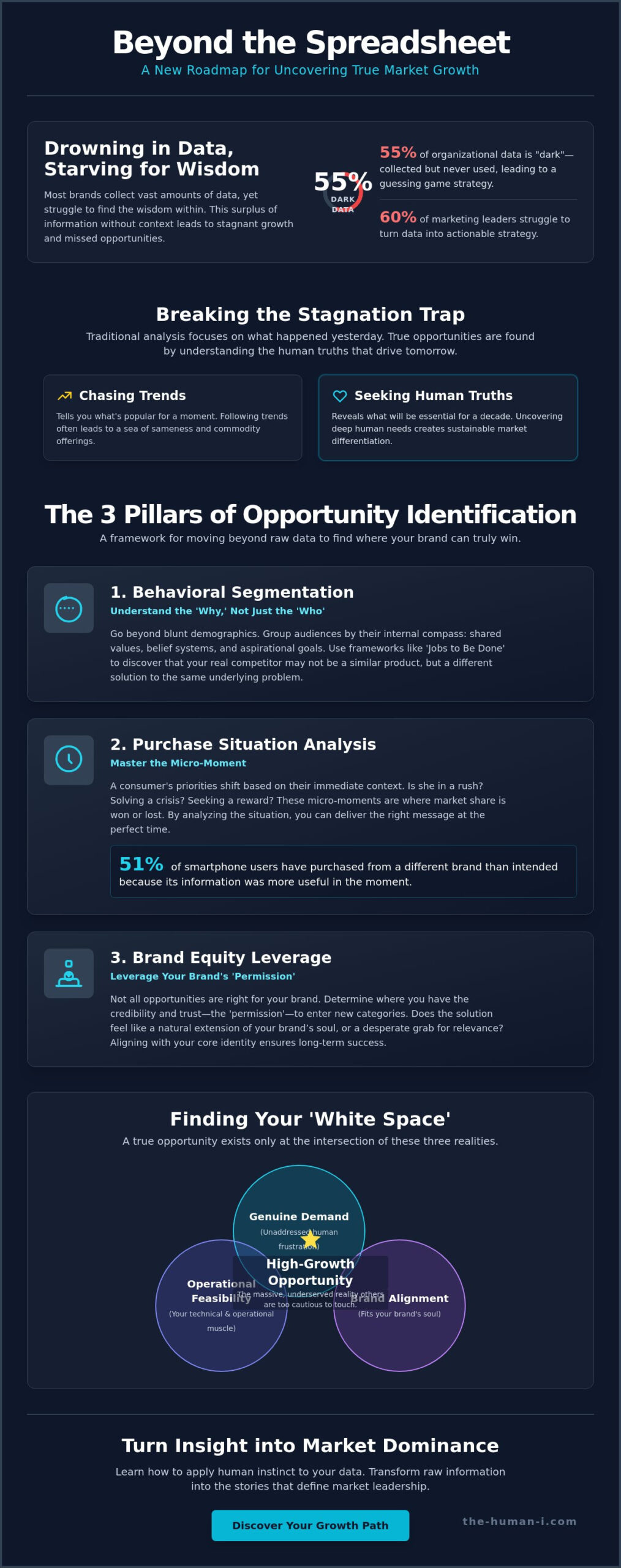
Most brands are currently drowning in data while starving for the wisdom to use it. A 2023 report from Splunk revealed that 55% of an organization’s data is “dark,” meaning it’s collected and stored but ultimately ignored. This surplus of information often makes identifying market opportunities for growth feel less like a strategy and more like a guessing game. You likely recognize the tension of having more metrics than ever, yet seeing brand engagement remain stubbornly stagnant while you worry about missing the next major shift in consumer behavior.
We believe that numbers only tell half the story. You’ll discover how to move beyond raw spreadsheets to uncover the human insights that drive sustainable, long-term brand growth. We’re providing a clear roadmap for identifying new audiences, validating your next product development ideas, and establishing the market differentiation you need to lead your category rather than just follow the trend.
Key Takeaways
- Break free from the stagnation trap by learning to look past “safe” data to find the human truths that drive real change.
- Master a three-pillared strategy for identifying market opportunities for growth that balances behavioral insight with strategic wisdom.
- Turn customer friction into your competitive edge by mapping the journey and uncovering exactly where your audience is underserved.
- Use the “Brand Permission” test to prioritize opportunities that align with your unique narrative and long-term brand identity.
- Learn how to apply human instinct to your data, transforming raw information into the stories that define market leadership.
The Stagnation Trap: Why Traditional Research Often Misses the Mark
Businesses often die by the spreadsheet. They chase “safe” numbers that promise incremental gains but ignore the tectonic shifts happening beneath the surface. Identifying market opportunities for growth requires more than a glance at a dashboard; it demands a rigorous interrogation of the status quo. Most companies fall into the trap of looking for trends when they should be looking for truths. A trend tells you what’s popular for a moment, but a human truth tells you what will be essential for a decade.
Standard market analysis frequently focuses on what competitors are doing right now, which inevitably leads to a sea of sameness. If 80% of your sector is pivoting toward the same “innovation,” it’s no longer an opportunity; it’s a commodity. A true market opportunity only exists at the intersection of three specific pillars:
- Demand: Is there a genuine human ache or frustration that remains unaddressed?
- Feasibility: Does your organization possess the technical and operational muscle to solve it?
- Brand Alignment: Does the solution feel like a natural extension of your brand’s soul, or is it a desperate grab for relevance?
The Illusion of Certainty in Big Data
Data is a rearview mirror. It’s a historical record of what happened, not a crystal ball for what’s next. A 2023 Gartner survey revealed that 60% of marketing leaders struggle to turn their vast data lakes into actionable strategy. This disconnect happens because standard segmentation often suffers from confirmation bias, looking for patterns that justify existing budgets rather than challenging them. We need to move past the “what” of a transaction. Knowing a customer bought a product at 2:00 PM on a Tuesday is useless unless you understand the “why” behind the purchase. Data provides the skeleton, but human wisdom provides the pulse.
Identifying the ‘White Space’ in Your Sector
White space isn’t just an empty category on a graph; it’s an unmet human need. Spotting these gaps requires a keen eye for market volatility. When customer frustration with legacy services hits a breaking point, or when a “standard” industry practice starts to feel like a burden, a gap opens. We use reputation measurement to identify where brands are failing their own promises. This isn’t about finding a tiny niche to hide in. It’s about finding a massive, underserved reality that others are too cautious to touch. Our strategic solutions focus on these high-growth gaps where deep insight outperforms raw, uncontextualized numbers.
The Three Pillars of High-Growth Opportunity Identification
True growth isn’t found in a spreadsheet alone. It’s discovered at the intersection where raw data meets deep human insight and strategic wisdom. When identifying market opportunities for growth, businesses often get stuck looking at the surface. They see what happened yesterday, but they miss the underlying ‘why’ that drives future behavior. To move beyond the obvious, we look at three specific pillars that redefine how a brand expands its footprint.
- Behavioral segmentation: We group people by their internal compass, their values and lifestyles, rather than just their birth year or location.
- Purchase situation analysis: We examine the context of the buy. Is the consumer in a rush, seeking a reward, or solving a sudden household crisis?
- Brand equity leverage: We determine where your brand has the ‘permission’ to enter new categories without losing its core identity.
Advanced Market Segmentation Strategies
Demographics are a blunt instrument. A 40-year-old in London might have more in common with a 25-year-old in New York than with their own next-door neighbor. Shifting toward psychographic drivers allows brands to capture the emotional triggers that actually spark a purchase. Using Human Instinct’s expertise, companies map audiences based on shared belief systems and aspirational goals. We also employ the ‘Jobs to Be Done’ framework. This methodology reveals that your real competitor might not be a similar product, but a completely different category that solves the same underlying friction for the customer.
Analyzing Purchase Situations and Context
A consumer’s priorities shift in real-time based on their environment. A 2023 study by Google highlighted that 51 percent of smartphone users have purchased from a different brand than intended because the information provided was more useful at that specific moment. These micro-moments are where the battle for market share is won. By identifying areas of company growth through situational data, brands can predict needs before they even arise. This isn’t just about identifying market opportunities for growth; it’s about being present when the context demands a solution. Data tells you the ‘what,’ but wisdom tells you the ‘when.’ If you want to see how these insights translate into a concrete strategy, you might explore our solutions for brand transformation.
Mapping the Customer Journey to Uncover Hidden Friction
Friction is the most reliable indicator of a new market opportunity. While raw data tells you what is happening, the “why” often hides in the moments where customers feel stuck. Identifying market opportunities for growth requires looking beyond the conversion rate to find the points of resistance that competitors are ignoring. When you find a point of friction, you’ve found a gap in the market.
- Step 1: Map the current state. Analyze where customers are dropping off. A 2023 study by Baymard Institute found that 70.19% of online shopping carts are abandoned, often due to avoidable friction in the checkout process. These drop-offs are your first clues.
- Step 2: Identify emotional highs and lows. Data shows a completed transaction, but it won’t show the frustration of a confusing interface. Wisdom lies in recognizing the “peak-end rule” popularized by Daniel Kahneman, where the emotional climax and the conclusion of the journey define the brand’s reputation.
- Step 3: Look for workarounds. When customers “hack” your product or use third-party tools like Excel to bridge a gap, they’re handing you a blueprint for innovation. These makeshift solutions are neon signs pointing toward unmet needs.
- Step 4: Quantify the cost. Friction isn’t just annoying; it’s expensive. Calculate the lost lifetime value (LTV) or the support hours spent fixing the same recurring issue to prioritize your moves.
The Power of Customer Experience Mapping
Visualizing the journey reveals the gaps that spreadsheets hide. It’s about finding the “moments of truth” that define brand loyalty. Often, there’s a disconnect between the brand promise and the customer reality. Bridging this gap is essential for identifying market opportunities for growth that are sustainable. By seeing the journey through the customer’s eyes, you move from selling a product to providing a solution that feels intuitive and human. It’s about empathy as a business strategy.
From Pain Points to Product Development
Transforming complaints into a roadmap turns your loudest critics into your best consultants. Instead of relying on slow focus groups that often yield filtered results, use rapid insight testing to validate ideas in real-time. This agile approach ensures you aren’t just guessing. It creates a narrative for growth that resonates with your audience because it’s built on their actual behavior. When you solve a documented pain point, you don’t just improve a product; you capture a market that was previously underserved.
Prioritizing Growth Opportunities: The Strategic Filter
Data provides the map, but wisdom provides the compass. When identifying market opportunities for growth, many businesses fall into the trap of chasing volume over value. A gap in the market doesn’t always represent a profitable opening for your specific brand. You must apply a strategic filter to ensure that expansion doesn’t lead to brand dilution or wasted capital.
The “Brand Permission” test is your first hurdle. It asks a simple question: does your audience trust you to solve this specific problem? If a heritage brand pivots too sharply into a new, unrelated sector, they often face a 20% to 30% decline in brand equity among their core demographic. Every move must fit your core narrative or you risk losing the ground you’ve already won.
Resource allocation is where strategy meets reality. Balancing quick wins with long-term shifts is essential. We often advise a structured approach to investment that protects the business from market volatility:
- Core optimization (70%): Strengthening your existing foundation and current customer base.
- Adjacent expansion (20%): Testing the waters in related sectors or new demographics.
- Breakthrough innovation (10%): High-risk bets on future trends and transformative ideas.
This distribution acts as a shock absorber. With central bank interest rates remaining volatile throughout 2023 and 2024, a diversified growth plan ensures that a single market dip doesn’t derail your entire trajectory.
Evaluating Market Size vs. Strategic Fit
A smaller, high-affinity niche often beats a large, generic market. In 2023, specialized firms focusing on high-intent audiences saw 18% higher profit margins than generalist competitors. You must assess your “moat.” How easily can others follow you? True growth aligns with your long-term brand strategy, ensuring you build a fortress rather than a temporary camp.
The Role of Reputation in Market Expansion
Your current reputation either enables or limits your next move. Measuring brand sentiment is vital to ensure you don’t alienate your base while identifying market opportunities for growth. Growth can be a powerful tool to refresh a stagnant brand identity, provided the new direction feels like a natural evolution. A 2024 survey showed that 64% of consumers prefer brands that expand into areas that solve genuine, related needs. Use insight to ensure your reputation carries you forward.
Discover how we help you uncover the right path for your business. Explore our strategic expertise.
Turning Insight into Market Dominance with Human Instinct
Data acts as the map, but wisdom provides the direction. Most organizations find themselves buried under piles of metrics while remaining starved for actual meaning. Identifying market opportunities for growth isn’t a mechanical process of checking boxes or running automated scripts. It’s an exercise in human instinct. We look at the same data sets as the competition, but we find the narratives that others simply miss. This shift from cold analysis to resonant storytelling is what separates a market follower from a market leader.
Strategic partners shouldn’t just hand you a report and walk away. They should offer a compass. When you move beyond the “what” and start understanding the “who,” your execution becomes sharper and more intentional. You stop shouting into the void. Instead, you start speaking directly to specific human needs that your competitors haven’t even noticed yet. It’s about the courage to follow an insight to its logical, and often profitable, conclusion.
Our Solutions for Stagnant Brands
Brands don’t usually die; they just stop listening to the world around them. We provide comprehensive solutions designed to bridge the gap between stagnant metrics and vibrant, sustainable growth. By integrating data-driven insights with seasoned strategic planning, we refresh ailing brands through deep market re-segmentation. A 2022 report by the CMO Council found that 63% of marketers struggle to deliver personalized experiences because of poor data integration. We solve this by finding the human truth hidden in the numbers, ensuring your brand resonates with new audiences while staying true to its core identity.
Start Your Discovery Journey
The window for identifying market opportunities for growth is always moving. Waiting for the “perfect” moment or a 100% complete data set is a recipe for being left behind by more agile competitors. We believe in the power of finding what’s important, a philosophy echoed by creative pioneer Ferran Adria. Your brand’s next chapter depends entirely on the story you choose to tell today. It’s time to move from looking to finding. Reach out to Human Instinct today to begin your evaluation and transform your brand’s trajectory through the powerful intersection of data and wisdom.
Turning Strategic Insight Into Market Dominance
Growth doesn’t happen by accident; it’s the result of looking where others won’t. While traditional research often hits a wall, the most successful brands move past the stagnation trap by integrating deep customer journey mapping with a rigorous strategic filter. Our work across the Financial Services, Automotive, and Tech sectors shows that data tells you what happened, but human wisdom tells you what’s next. By identifying market opportunities for growth through this dual lens, you transform friction into a competitive edge.
Our seasoned team brings a wealth of strategic experience to every partnership. We don’t just hand over a report; we provide the insight that refreshes stagnant brands and empowers new ones. With a track record of uncovering extraordinary opportunities in complex global markets, we ensure your next move is backed by both hard evidence and intuitive brilliance. This approach is why leaders in the Automotive and Tech industries rely on us to shape their future trajectory. It’s where data-driven insights meet deep human wisdom.
Ready to uncover your next growth opportunity? Let’s talk.
Your next breakthrough is waiting to be found.
Frequently Asked Questions
How do I identify a market opportunity for a new product?
You identify a viable opportunity by pinpointing a specific friction point where current solutions fail the consumer. Start by analyzing search data to find high-intent queries that have low competition. For example, if 30% of users in a category search for a feature that doesn’t exist, you’ve found a gap. It’s about looking past the numbers to find the human story.
What is the difference between a market trend and a market opportunity?
A trend is a broad market shift, while an opportunity is a concrete space your business can profitably occupy. Think of the 12% rise in remote work as a trend. The opportunity is the specific need for ergonomic furniture designed for small apartments. Trends tell you where the crowd is going; opportunities tell you exactly where to build the shop.
How can I find new audiences for an existing brand?
Find new audiences by analyzing the psychographics of your most loyal 10% of customers. Look for adjacent segments who share the same values but haven’t been targeted yet. If your data shows high engagement from 25 to 34 year olds in London, test that same creative on similar demographics in Manchester or Birmingham to see if the wisdom scales.
What role does market segmentation play in business growth?
Segmentation provides the roadmap for identifying market opportunities for growth by breaking a broad market into manageable, high-value clusters. It’s the difference between shouting in a stadium and having a quiet, persuasive conversation. Data from the Harvard Business Review suggests that businesses mastering segmentation achieve 76% higher customer engagement than those that don’t use targeted strategies.
How do I know if a market opportunity is worth the investment?
Use a matrix that weighs market size against your internal capability to execute. If the addressable market is worth less than 1 million or the competition holds more than 70% share, the investment is likely too risky. You need a clear path to a 3 to 1 return on investment within the first 24 months to justify the capital spend.
Can I identify growth opportunities using only internal data?
Internal data is a rearview mirror; you need external insight to see the road ahead. While your CRM shows what 100% of your current customers do, it tells you nothing about the 95% of the market who don’t buy from you yet. A 2022 Gartner report highlighted that 85% of leaders who integrate external data points see faster revenue growth.
How often should a business perform a market opportunity analysis?
Schedule a comprehensive review every 6 months to ensure your strategy hasn’t grown stale. In fast-paced industries like fintech or retail, a quarterly pulse check is safer. Consumer sentiment can shift by 15% or more in a single season. Regular audits prevent you from chasing ghost opportunities that have already vanished while your back was turned.
What are the common mistakes when identifying growth opportunities?
The biggest pitfall is falling in love with an idea and ignoring the data that contradicts it. Confirmation bias leads companies to waste 20% of their R&D budgets on products nobody actually wants. Success in identifying market opportunities for growth requires a balance of cold statistics and human intuition. Don’t ignore the why behind the what when looking at your spreadsheets.



