


Launching a new product into the B2B market can feel like a high-stakes gamble. Internal conviction is essential, but it isn’t enough to guarantee success. Without objective validation, you risk investing significant resources into a solution that fails to gain traction because it doesn’t solve a real-world business problem.
The alternative is to replace assumptions with evidence. A structured approach to B2B market research provides the critical insights needed to validate your product, refine its features, and build a go-to-market strategy with confidence. This framework turns uncertainty into a data-backed plan for a successful launch.
Understanding the B2B Market’s Unique Challenges
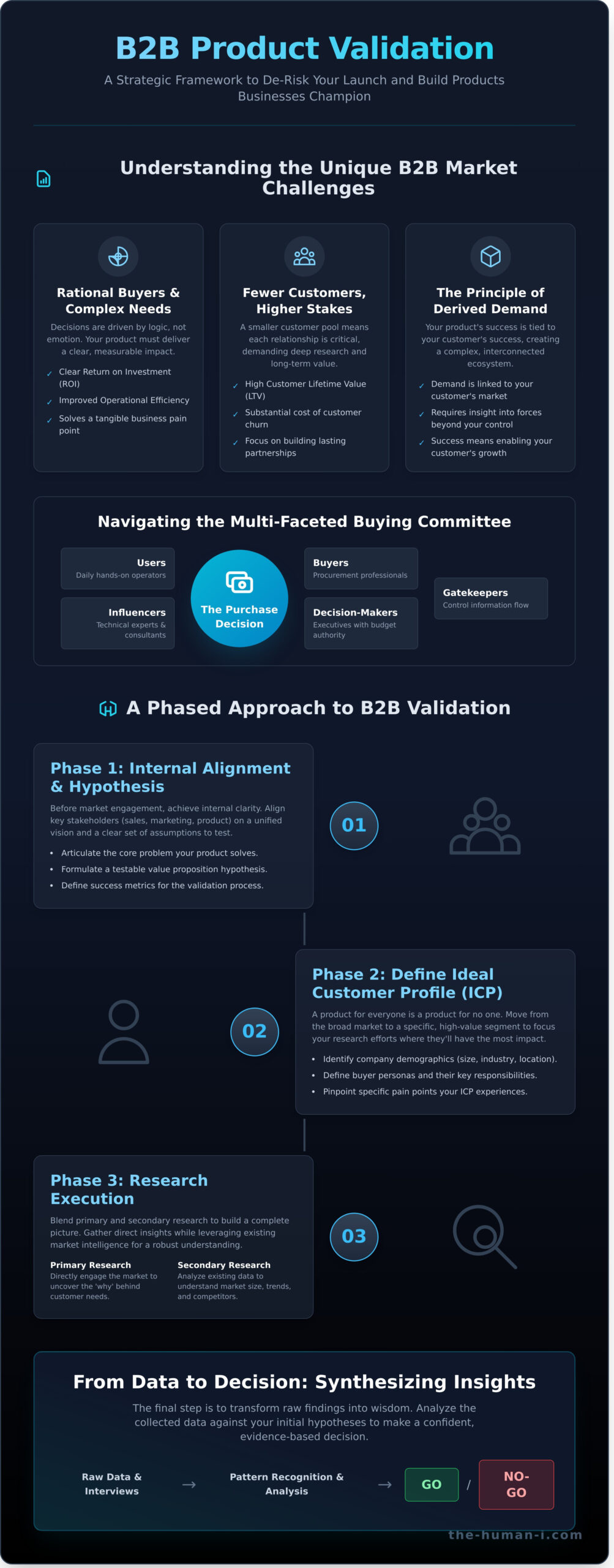
Validating a B2B product requires a different mindset than in consumer markets. The B2B market is not driven by impulse but by a complex interplay of logic, value, and process. Three factors, in particular, shape the research approach:
- Rational Buyers and Complex Needs: B2B purchases are strategic investments. Buyers analyze ROI, efficiency gains, and integration with existing workflows. Your product must solve a specific business pain or create a clear, measurable opportunity.
- The Multi-faceted Buying Committee: Decisions are rarely made by one person. A typical buying committee includes users, technical influencers, financial buyers, and executive decision-makers. Each member has unique priorities and pain points that your research must uncover and address.
- Fewer Customers, Higher Stakes: Most B2B markets have a smaller pool of potential customers, making each relationship incredibly valuable. The research process must be deep enough to understand their business intimately, as the impact of winning—or losing—a single major client is significant.
A Strategic Framework for Product Validation Research
A disciplined, phased approach de-risks your investment and ensures your efforts are focused on answering the most important questions. This framework provides clarity and actionable steps, moving your idea from a hypothesis to a validated business case.
Phase 1: Internal Alignment and Hypothesis Definition
Before looking outward, look inward. The first step is to achieve internal clarity on the problem your product solves. Work with key stakeholders across product, sales, and marketing to formulate clear, testable hypotheses about your target market, their primary pain points, and the value your solution delivers.
Phase 2: Defining Your Ideal Customer Profile (ICP)
Move from a broad market definition to a specific, targetable segment. Your Ideal Customer Profile (ICP) is a precise description of the company that will gain the most value from your product. Define it using firmographic data (industry, company size, revenue) and enrich it with behavioral criteria (technology adoption, operational maturity).
Phase 3: Choosing Your Research Methodologies
A complete picture requires a mixed-method approach. The goal is to combine broad quantitative data with deep qualitative insight.
- Secondary Research: Start by analyzing existing data to understand the landscape.
- Primary Research: Gather firsthand information directly from your target B2B market to validate your specific hypotheses.
Primary Research: Gathering Direct Insight
This is where you uncover the "why" behind market needs by engaging directly with potential customers.
- In-Depth Stakeholder Interviews: The cornerstone of B2B research is the one-on-one conversation. Identify and recruit participants who fit your ICP and represent different roles on the buying committee. Use open-ended questions to explore their daily workflows, challenges, and buying processes. The goal isn’t to pitch your product but to listen and learn.
- Quantitative Surveys: Once you have qualitative insights, use surveys to validate them at scale. Surveys are effective for testing feature importance, price sensitivity, and purchase intent across a larger sample of the B2B market. Keep them concise and offer a relevant incentive to encourage completion.
- Proof of Concepts (POCs): The ultimate test of your value proposition is to offer a pre-release version of your product to a small group of ideal customers. A pilot program provides invaluable data on real-world usage, helps identify critical issues, and generates early testimonials.
Our experts can help you uncover the insights that drive growth. Contact Human Instinct.
Secondary Research: Finding Existing Data
Leveraging existing information saves time and provides essential context for your primary findings.
- Competitor Analysis: Map out direct and indirect competitors. Analyze their product features, pricing, and marketing messages to identify positioning gaps. Customer reviews on platforms like G2 and Capterra offer unfiltered feedback on their strengths and weaknesses.
- Industry Reports: Access market analyses from firms like Gartner and Forrester, as well as industry-specific publications. This data helps you understand market size, trends, and growth projections.
- Online Communities: Monitor discussions in industry forums and LinkedIn Groups. These conversations often reveal common questions, frustrations, and unmet needs related to your product category.
From Data to Decision: Synthesizing Your Findings
Data collection is only half the process. The real value comes from synthesizing the insights to make a clear, strategic decision.
- Develop Personas and Journey Maps: Consolidate your interview findings into detailed buyer personas. Map their journey from awareness to purchase, identifying their pain points and decision criteria at each stage.
- Build a Data-Driven Go-to-Market (GTM) Plan: Use the research to sharpen your product’s positioning and messaging. Let the data inform your pricing strategy based on perceived value and select the marketing channels where your ICP is most active.
- Make the Go/No-Go Call: Finally, evaluate the evidence against your initial hypotheses. Use a scorecard to assess the market opportunity, product-market fit, and potential risks. This allows you to make a final, evidence-based decision: launch with confidence, pivot based on feedback, or stop before making a costly mistake.
By grounding your product strategy in rigorous B2B market research, you transform a launch from an act of hope into a calculated business decision.
Frequently Asked Questions
What is the difference between B2B market research and market validation?
Market research is the broad process of gathering information about a market. Market validation is a specific type of research focused on testing a new product idea with that market to determine if there is a real, paying need for it before launch.
How much should a company budget for new product validation research?
Budgets vary widely based on scope, methodology, and industry. The key is to view it not as a cost but as an investment in de-risking a much larger product development and marketing expenditure.
How long does a typical B2B market research project take?
A focused product validation project can take anywhere from 4 to 12 weeks, depending on the complexity of the market and the difficulty of recruiting participants for primary research.
What are the best online tools for conducting B2B surveys?
Platforms like SurveyMonkey, Typeform, and Qualtrics are excellent for general surveys. For reaching specific B2B professionals, consider using a panel provider or leveraging targeted ads on platforms like LinkedIn.
How do you find the right people to interview in a large corporation?
Start with a clear definition of the roles you need (e.g., IT Director, Head of Operations). Use LinkedIn Sales Navigator to identify individuals, leverage your existing professional network for introductions, or work with a specialized B2B research recruitment firm.
What is the most common mistake companies make in B2B product validation?
The most common mistake is asking leading questions or "selling" the product during research interviews. This generates biased feedback and confirms existing assumptions rather than uncovering genuine market insights. The goal is to listen and learn, not to persuade.



