


Launching a new product often feels like a high-stakes gamble, especially when your success hinges on navigating the intricate web of business needs. The fear of investing immense resources into a solution that no company will actually purchase is a formidable hurdle for any innovator. Unlike consumer trends, the dynamics of the b2b market are driven by complex buying committees, long sales cycles, and deeply entrenched operational challenges, making the entire process feel opaque and fraught with risk. This is where strategic insight isn’t just an advantage; it’s essential for survival.
This guide is designed to replace that uncertainty with a clear, actionable framework. We will walk you through the essential steps of conducting market research that goes beyond surface-level data to uncover genuine business needs. You will learn how to confidently define your target market, validate your product concept with the right stakeholders, and develop a go-to-market strategy founded on solid evidence. Prepare to master the complexities and launch a product the market not only wants but is ready to invest in.
Key Takeaways
- Shift your focus from a single buyer to the entire buying committee, understanding that B2B decisions are driven by collective, rational needs.
- Learn to replace risky product assumptions with concrete data by implementing a structured, two-pronged research approach.
- Pinpoint your most profitable niche by using firmographics to accurately size and segment the complex b2b market.
- Discover why validating the customer’s problem, before you even discuss your solution, is the most effective way to de-risk your product launch.
What Defines the B2B Market? Key Differences for Product Innovators
To successfully validate a new product, innovators must look beyond the simple “business-to-business” acronym and uncover the distinct ecosystem it represents. The b2b market operates on a fundamentally different wavelength than its consumer-facing counterpart. Here, purchasing decisions are not driven by fleeting emotion or impulse but are calculated, strategic choices rooted in logic, efficiency, and return on investment. This landscape is characterized by a smaller, more concentrated pool of high-value customers and a commercial rhythm that prioritizes long-term, symbiotic relationships over single, fleeting transactions.
Understanding this distinction is the first critical step. The complexity of the buying process, involving multiple stakeholders and extended timelines, requires a more nuanced approach to market validation.
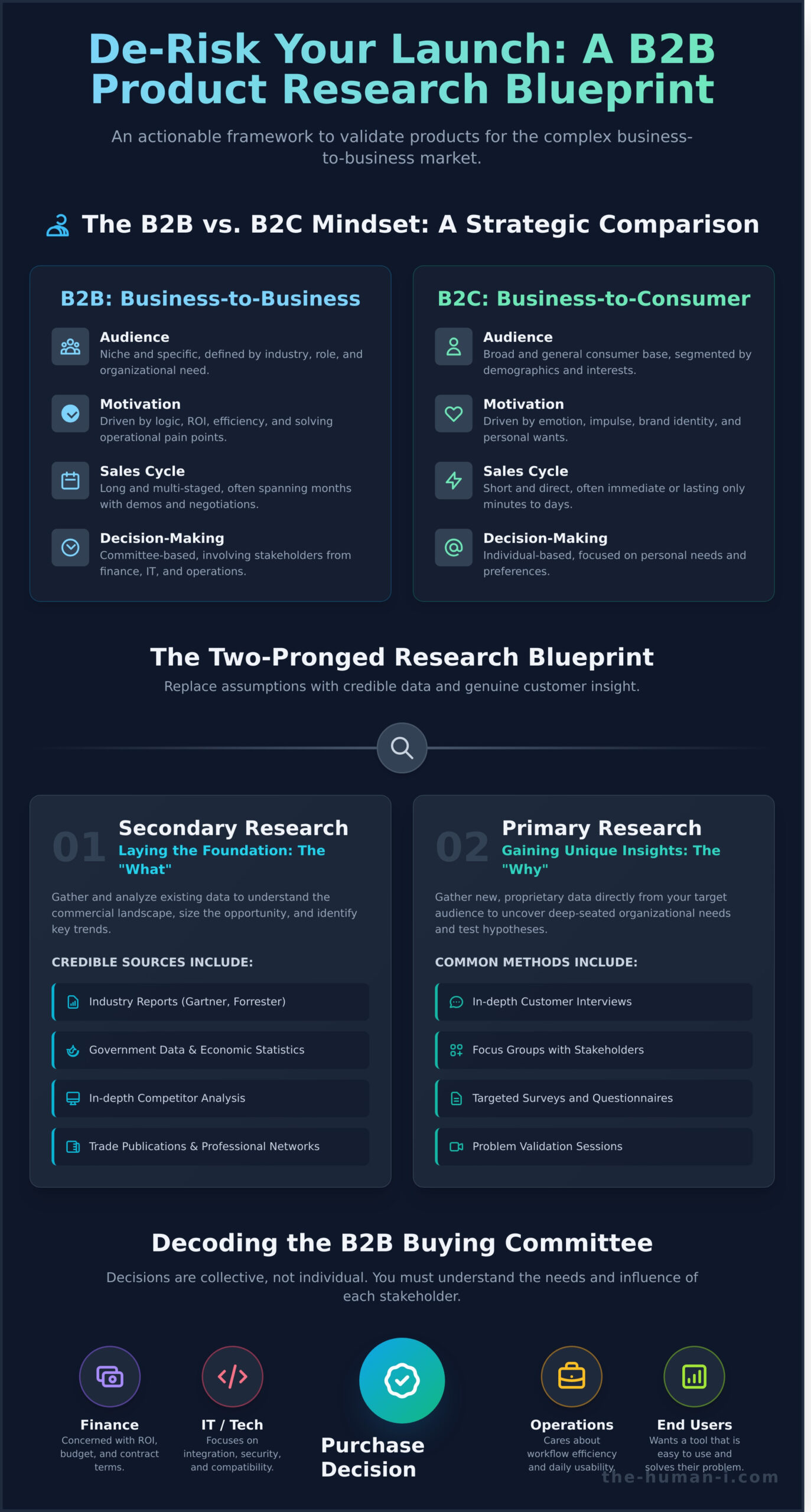
The B2B vs. B2C Mindset: A Strategic Comparison
The motivations and processes that define business and consumer purchasing are worlds apart. This strategic insight shapes every facet of product development and marketing.
- Audience: B2B targets a niche, highly specific audience defined by industry, role, and organizational need, whereas B2C addresses a broad, general consumer base.
- Motivation: B2B buyers are driven by logic, seeking solutions that improve ROI, boost efficiency, or solve a specific operational pain point.
- Sales Cycle: The B2B sales process is typically long and multi-staged, often spanning months and involving demos, proposals, and negotiations.
- Decision-Making: Purchases are rarely made by an individual; they are committee-based decisions involving stakeholders from finance, IT, and operations.
Key Characteristics of B2B Transactions
These foundational mindset differences manifest in the very nature of B2B commercial exchanges. Effective B2B market research is a discipline of its own, focused on uncovering deep-seated organizational needs because the transactions themselves are more complex and consequential.
- Higher Contract Values: Order sizes are significantly larger, representing a substantial investment for the buying organization.
- Emphasis on Partnership: The goal is often a long-term partnership, with a strong focus on post-sale support, service, and mutual growth.
- Customization and Integration: Products and services frequently require customization or deep integration with a client’s existing technology stack and workflows.
- The Critical Role of Trust: In the b2b market, reputation, proven expertise, and unwavering reliability are the most valuable currencies. Trust is the bedrock of every successful transaction.
The Blueprint for B2B Market Research: A Two-Pronged Approach
Validating a new product concept requires moving beyond internal assumptions and embracing a structured process of discovery. The goal is to replace conjecture with credible data and genuine customer insight. A robust research strategy for any b2b market stands on two essential pillars: secondary and primary research. Secondary research provides the broad context-the map of the existing terrain-while primary research delivers the proprietary, specific insights needed to navigate it successfully. Using them in tandem creates a comprehensive intelligence framework that empowers strategic decision-making.
Laying the Foundation with Secondary Research
This initial phase involves gathering and analysing existing data to understand the commercial landscape. It’s about building a foundational knowledge base before engaging directly with potential customers. Your objective is to size the opportunity and identify key trends. Credible sources include:
- Industry and market research reports (e.g., from Gartner, Forrester).
- Government data and economic statistics.
- In-depth competitor analysis of their positioning, features, and pricing.
- Trade publications and professional networks like LinkedIn for emerging trends.
This data helps you grasp the overall market size and begin the strategic process of Segmenting B2B markets based on criteria like industry or company size. From this, you can formulate initial hypotheses about customer pain points to test in the next phase.
Gaining Unique Insights Through Primary Research
Where secondary research tells you what is happening, primary research uncovers why. This is where you gather new, proprietary data directly from your target audience through methods like surveys, focus groups, and in-depth interviews. For complex B2B sales cycles, one-on-one interviews with decision-makers are invaluable. The key is recruiting the right participants-individuals who match your ideal customer profile-and focusing your questions on uncovering their deepest challenges and unmet needs, not just pitching your solution.
Qualitative vs. Quantitative: Finding the Right Balance
Effective primary research blends two distinct approaches. Qualitative research (the ‘why’) from interviews uncovers motivations, context, and nuanced pain points. It provides the depth. Quantitative research (the ‘how many’) from surveys validates these findings at scale, providing statistical confidence. The most powerful strategy often starts with qualitative discovery to inform the creation of a targeted, insightful quantitative survey, ensuring you’re not just collecting data, but generating true wisdom.
Sizing and Segmenting Your B2B Market Opportunity
A product designed for everyone often resonates with no one. To successfully validate and launch a new product, you must move from a broad concept to a focused, strategic target. This requires a deep and disciplined understanding of your potential customer landscape. The goal is not just to identify who could use your product, but to uncover who is most likely to buy it, champion it, and derive maximum value from it.
Defining Your Ideal Customer Profile (ICP)
Your ICP is a precise definition of the company that is a perfect fit for your solution. This goes far beyond a simple industry vertical. True insight comes from layering firmographic data to build a multi-dimensional picture. Consider factors such as:
- Company Vitals: Annual revenue, employee count, and geographic location.
- Technological Maturity: What is their existing software stack? Are they early adopters or laggards?
- Business Pains: Identify the specific operational or strategic challenges your product directly solves for this profile.
Calculating Your Addressable Market
Once your ICP is defined, you can quantify the opportunity using a trusted framework. This methodical approach grounds your strategy in data, not assumptions. The key is to understand the different layers of your potential b2b market.
- Total Addressable Market (TAM): The total global demand for a solution like yours.
- Serviceable Addressable Market (SAM): The segment of the TAM your business can realistically target based on your product, geography, and specialization.
- Serviceable Obtainable Market (SOM): The portion of your SAM you can realistically capture within the first few years, considering your resources and competition.
Conducting a Competitive Landscape Analysis
Understanding your market requires a clear view of the alternatives your customers have. Look beyond direct competitors to identify indirect (solving the same problem differently) and substitute (manual processes or workarounds) solutions. Analyze their positioning, messaging, and pricing to uncover strategic gaps and opportunities where your product can offer unique, defensible value.
This rigorous process of segmentation and sizing transforms a promising idea into a viable commercial strategy. It provides the wisdom needed to focus your resources, shape your messaging, and build a product that truly matters to a specific audience. Need help defining your market? Discover how our insights can guide you.
Decoding the B2B Buying Committee: Who Holds the Power?
In consumer sales, you often appeal to a single individual. In the complex b2b market, however, you are rarely selling to just one person. Instead, you must convince a buying committee-a group of stakeholders, each with distinct responsibilities, priorities, and pain points. A failure to understand this internal dynamic is a primary reason why promising products fail to gain traction. Your market research must go beyond identifying the target company; it must map the influential individuals within it.
Mapping the Key Roles in the Buying Process
While the exact structure varies, most buying committees include several core archetypes. Your strategy must account for each one, as they all play a part in the final decision.
- The Initiator: The individual who first identifies a problem or need that your product could solve. This is often a manager or team lead feeling the operational pain most acutely.
- The User: The end-user who will interact with your product daily. Their primary concern is functionality, ease of use, and how it will impact their workflow.
- The Influencer: Often a technical expert (like an IT specialist) who evaluates your solution against specific criteria like security, integration capabilities, and compliance.
- The Gatekeeper: An individual who controls the flow of information to the decision-makers. This could be an executive assistant, a procurement officer, or an IT department that must approve all new software.
The Decider vs. The Buyer: Understanding the Difference
It is critical to distinguish between the person who signs the cheque and the person who says “yes.” The Buyer (often in procurement or finance) handles the logistical and financial transaction, focusing on price and contract terms. However, the Decider (typically a VP or C-level executive) holds the ultimate authority. Their decision is based on strategic value, ROI, and alignment with high-level business objectives. While you must satisfy the Buyer, influencing the Decider is the primary goal.
Identifying the Pains and Priorities for Each Stakeholder
A generic message will resonate with no one. To be effective, your value proposition must be tailored to address the unique concerns of each stakeholder. For example:
- The User wants to know: “Will this make my job easier and more efficient?”
- The Influencer (e.g., Head of IT) wants to know: “Is this solution secure, reliable, and easy to integrate with our existing systems?”
- The Decider wants to know: “How will this deliver a measurable return on investment and give us a strategic advantage?”
Uncovering these nuanced perspectives is where deep, strategic insight becomes invaluable. To truly validate your product, you must empower your message with the data and wisdom needed to navigate these complex internal relationships. We help brands uncover the insights that shape compelling, stakeholder-specific narratives.
From Insight to Validation: Testing Your Product in the Real World
Market research provides the strategic map; real-world testing validates the destination. This final, critical phase transforms assumptions into evidence by rigorously testing your concept before committing to a full build. The objective is not to sell but to learn-first by confirming the problem is significant and urgent, and only then by testing if your proposed solution truly resonates.
Running Effective B2B Customer Interviews
The foundation of validation lies in strategic conversation. Instead of pitching your product, ask open-ended questions about your prospect’s current processes, daily frustrations, and operational bottlenecks. Listen for the language they use to describe their challenges. The goal is to uncover pain points so acute that they have a budget allocated to solve them-a crucial signal in the complex b2b market.
Concept Testing and Minimum Viable Product (MVP) Strategy
Translate your solution into a tangible concept using mockups, wireframes, or a simple prototype. This allows you to present your idea without a major investment. Define your Minimum Viable Product (MVP)-the smallest set of features that solves the core problem for an early adopter. Your aim is to gather focused feedback on:
- Core value and problem-solving effectiveness
- Usability and integration with existing workflows
- Initial reactions and willingness to engage further
Analyzing Pricing, Value Perception, and Willingness to Pay
A solution is only viable if the customer is willing to pay for it. Move beyond cost-plus pricing and explore how your target customers perceive its value. Ask direct questions about their current spending on this problem, how they measure ROI, and who controls the budget. Test different pricing structures-such as per-seat, usage-based, or tiered-to uncover the model that best aligns with the value you deliver.
This iterative process of interviewing, testing, and analyzing is where raw data becomes strategic wisdom. Each piece of feedback helps you refine your value proposition, prioritise your feature roadmap, and de-risk your investment in a competitive b2b market. By validating each core assumption, you ensure the product you ultimately build is not just innovative, but essential. Navigating this final stage requires a blend of insight and strategic questioning. At Human Instinct, we empower businesses to translate customer feedback into validated, market-ready solutions.
From Insight to Impact: Mastering B2B Product Innovation
Successfully launching a new product requires more than a great idea; it demands a profound understanding of the complex b2b market. As we’ve explored, this means decoding the intricate web of the buying committee and applying a rigorous research approach to validate every assumption. Transforming raw data into strategic wisdom is where true innovation begins.
At Human Instinct, we specialize in providing the data-driven new product development insights that empower confident decision-making. With deep expertise in B2B market segmentation and extensive experience across sectors like Technology and Financial Services, we help you uncover the critical signals within the noise. Ready to shape your next success story? Uncover the insights that drive growth. Partner with Human Instinct.
Your path from a promising concept to a market-leading solution is within reach.
Frequently Asked Questions
What is the main difference between B2B market research and B2B market segmentation?
B2B market research is the broad process of gathering data to understand customer needs, competitive landscapes, and industry trends. It’s about discovery-uncovering the “what” and “why” behind business challenges. Segmentation, on the other hand, is the strategic application of that research. It involves organizing the total addressable market into distinct groups based on shared characteristics like industry, company size, or buying behavior, allowing you to target your product and messaging with precision.
How much should a company typically budget for B2B market research before a product launch?
Budgets vary significantly based on scope and methodology. A smaller-scale project using online surveys and a few in-depth interviews might cost between $15,000 and $30,000. A more comprehensive study involving multiple qualitative and quantitative phases with a specialized agency can easily exceed $50,000. The key factors influencing cost are the complexity of the research, the difficulty of recruiting participants, and the depth of analysis required to generate actionable insights.
What are the most common mistakes companies make when validating a new B2B product?
The most frequent error is confirmation bias-only seeking data that supports a pre-existing belief about the product’s value. Another common mistake is focusing solely on the economic buyer while ignoring the needs and workflows of the end-user, which can cripple adoption post-sale. Finally, many companies in the complex b2b market rely too heavily on quantitative surveys, missing the crucial qualitative insights that explain the “why” behind user behavior and purchasing decisions.
How long does a B2B market research project usually take from start to finish?
The timeline depends on the project’s complexity. A focused study, such as a round of in-depth interviews with a specific customer segment, can typically be completed in 4 to 6 weeks. A larger, multi-stage project that combines exploratory qualitative research with a quantitative survey will more likely take 8 to 12 weeks. This includes time for strategic planning, participant recruitment, data collection, rigorous analysis, and final reporting of strategic recommendations.
Can you do effective B2B market research for an industry you have no experience in?
Yes, and an external perspective can be a powerful advantage. A skilled research partner is an expert in the process of inquiry, analysis, and strategy, not necessarily the industry itself. This “outsider” view helps challenge ingrained industry assumptions and uncover blind spots that insiders may overlook. Thorough foundational research, including consultations with subject matter experts, quickly builds the necessary context, allowing for fresh and unbiased insights to emerge and shape strategy.
What’s more important in B2B research: understanding the company’s needs or the end-user’s needs?
Both are critically important, but they solve for different parts of the equation. Understanding the company’s needs-such as ROI, security, and integration-is essential for making the sale and getting past the procurement gatekeepers. However, understanding the end-user’s daily pain points and workflow is vital for ensuring product adoption, retention, and long-term success. A product that is purchased but not used is ultimately a failure for both the vendor and the customer.



