


Discover the essential brand evaluation frameworks and learn a step-by-step process to measure your brand’s health, identify growth opportunities, and drive strategic decisions.
Why a Brand Evaluation Framework is Non-Negotiable for Strategic Growth
In a competitive market, relying on subjective opinion to guide your brand is a significant risk. A structured brand evaluation framework moves your team beyond guesswork, replacing assumptions with objective data that connects brand health directly to business outcomes like revenue, loyalty, and market share.
By establishing a clear baseline, you can identify strengths to leverage and weaknesses to address before they become critical. This data-driven approach empowers you to justify marketing spend, make confident strategic decisions, and accurately track the ROI of your brand-building initiatives over time.
The True Cost of an Unmeasured Brand
Without a formal evaluation process, brands risk stagnation. They lose relevance as markets evolve, leading to wasted marketing budgets on ineffective messaging and an inability to command a price premium. More importantly, an unmeasured brand operates in the dark, missing crucial opportunities for market expansion and innovation that competitors, armed with better insight, will quickly seize.
Linking Brand Equity to Financial Performance
Brand equity is not an abstract concept; it’s a measurable asset with a direct impact on your bottom line. Strong brand equity, built on trust and positive perception, leads to higher customer lifetime value (CLV) and greater market share. A robust brand evaluation framework de-risks investment in brand building by clearly demonstrating the correlation between brand preference and financial performance, turning brand strategy into a predictable driver of growth.
The Core Components of a Comprehensive Brand Evaluation
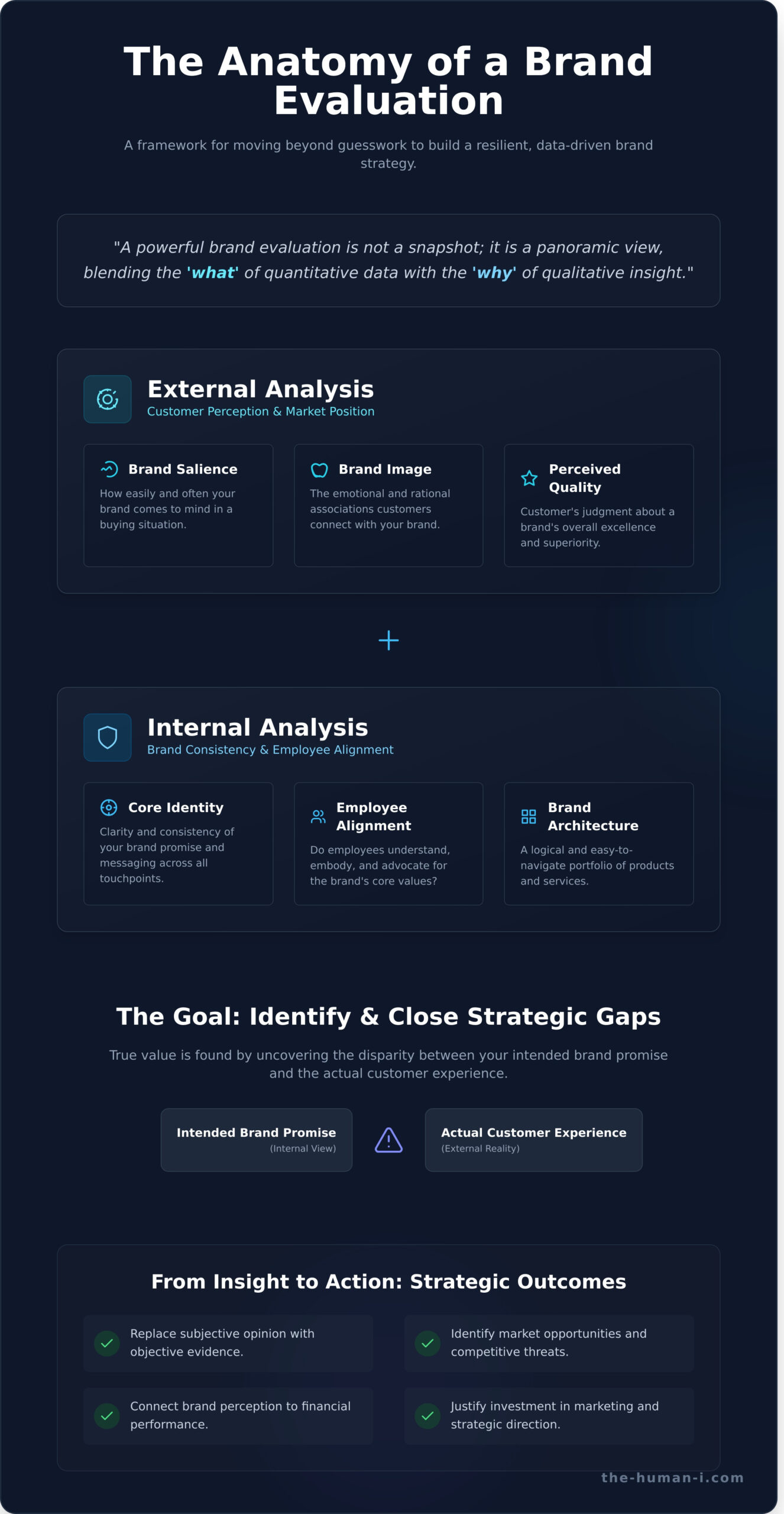
A truly effective evaluation provides a holistic view of your brand, combining internal realities with external perceptions. It blends qualitative insights (the "why") with quantitative data (the "what") to create a complete and actionable picture. This process isn’t just about self-assessment; it’s about understanding how your brand performs relative to your competitors at every stage of the customer journey.
External Analysis: Customer Perception and Market Position
This outward-looking analysis focuses on how your brand lives in the minds of your customers and the marketplace. Key areas of investigation include:
- Brand Awareness & Salience: How easily and often do customers think of your brand in a purchasing situation?
- Brand Associations & Image: What specific thoughts, feelings, and beliefs does your brand evoke? Are they positive, negative, strong, and unique?
- Perceived Quality & Loyalty: Do customers trust in the quality of your offerings? Are they willing to repeatedly choose you over alternatives?
- Competitive Benchmarking: How does your brand’s awareness, perception, and loyalty stack up against your key rivals?
Internal Analysis: Brand Consistency and Employee Alignment
This inward-looking analysis ensures the brand you intend to project is the one you are actually delivering. It examines whether your internal operations are aligned with your external promise.
- Brand Identity & Messaging: Is your visual identity, tone of voice, and core messaging consistent and clear across all touchpoints?
- Employee Understanding & Advocacy: Do your teams understand the brand’s values and promise? Are they equipped and motivated to deliver on it?
- Brand Architecture: If you have multiple products or services, is the portfolio structured in a logical way that prevents customer confusion and maximizes cross-selling opportunities?
Key Brand Evaluation Frameworks Explained: From Keller to Aaker
While the components of an evaluation are universal, several established frameworks provide a strategic lens to structure your analysis. These models translate academic rigour into practical business tools, each designed to answer different strategic questions.
Keller’s Customer-Based Brand Equity (CBBE) Pyramid
- Focus: Building a strong brand from the bottom up, through the eyes of the customer.
- The Four Levels: The model progresses through four sequential levels: Identity (who are you?), Meaning (what are you?), Response (what about you?), and Relationships (what about you and me?). The goal is to build deep, resonant relationships at the pyramid’s peak.
- Ideal Use Case: Excellent for B2C brands or any organisation focused on cultivating deep customer loyalty and emotional connection.
- Practical Question It Answers: Are we systematically building the right experiences to foster deep, lasting customer relationships?
Aaker’s Brand Equity Model
- Focus: Identifying and measuring the five core assets that comprise a brand’s total value.
- The Five Assets: This model views brand equity as a combination of Brand Loyalty, Brand Awareness, Perceived Quality, Brand Associations, and Other Proprietary Assets (e.g., patents, trademarks).
- Ideal Use Case: Best for a comprehensive, asset-based audit of your brand’s value, helping to identify which assets contribute most to its strength.
- Practical Question It Answers: What are our most valuable brand assets, and where should we invest to protect or grow them?
The Brand Asset Valuator (BAV) Model
- Focus: Diagnosing a brand’s health, momentum, and future growth potential through four key pillars.
- The Four Pillars: The BAV model measures brands across Differentiation (what makes you unique?), Relevance (how appropriate is your brand to consumers?), Esteem (how well-regarded is your brand?), and Knowledge (how well do consumers understand your brand?). The interplay between these pillars reveals a brand’s trajectory.
- Ideal Use Case: Powerful for understanding your brand’s competitive positioning and diagnosing whether it’s a rising star, a fading leader, or a niche player.
- Practical Question It Answers: Does our brand have the momentum to grow, or is it at risk of becoming a commodity?
A Practical 5-Step Process for Implementing Your Brand Evaluation
A successful brand evaluation is a disciplined process that can be adapted to fit your organisation’s scale and budget. The key is to move methodically from clear objectives to actionable strategy.
Step 1 & 2: Set Objectives and Select Your Framework
First, define precisely what you need to achieve. Are you preparing for a rebrand, measuring the impact of a recent campaign, or diagnosing a drop in market share? Your objective will determine the scope of the evaluation. Based on this goal, choose the framework—Keller, Aaker, BAV, or a hybrid model—that best aligns with the questions you need to answer. This choice will guide which key metrics you need to track.
Step 3 & 4: Gather Data and Analyze the Findings
Next, collect the necessary data using a mix of methodologies. This can include quantitative methods like customer surveys and sales data analysis, as well as qualitative methods like focus groups, stakeholder interviews, and social listening. The goal is to combine the "what" (quantitative) with the "why" (qualitative). Once gathered, analyze the findings against your initial objectives and competitive benchmarks to identify significant patterns, strengths, and weaknesses.
Step 5: Report Insights and Formulate a Strategy
The final step is to transform raw data into a compelling story that drives action. Synthesize your findings into a clear report for stakeholders, using data visualisation to make complex insights easy to grasp. Most importantly, translate these findings into specific, strategic recommendations that will guide your business forward.
Need help turning data into a winning strategy? See how we can help.
From Insight to Action: Translating Evaluation Data into Brand Strategy
A brand evaluation is only valuable if it leads to intelligent action. The true power of a framework is its ability to connect data points to strategic initiatives, providing a clear rationale for change and investment.
In today’s data-rich environment, many leading companies work with a Palantir Forward Deployed Engineering partner to ensure their brand strategy is built on a foundation of powerful, integrated analytics.
Strengthening Your Market Position
If your evaluation reveals a gap between your intended positioning and actual customer perception, the data provides a roadmap for refining your messaging. For example, if Aaker’s model shows high Brand Awareness but low Perceived Quality, your strategy should focus on product improvements and quality-centric marketing. Insights from competitive benchmarking can also uncover gaps in the market your brand is uniquely positioned to fill.
Improving the Customer Experience
Data from your evaluation can pinpoint specific weaknesses in the customer journey. If Keller’s pyramid shows a drop-off at the "Response" level, it suggests customers understand your brand but don’t have positive feelings or judgments about it. The strategic action is to investigate and improve the touchpoints—from your website to customer service—that are failing to create a positive experience.
For a practical guide on how to improve your digital touchpoints to dominate a local market, check out Insight Multimedia.
Guiding Internal Brand Building
Finally, the findings should be used to align your internal teams. If the internal analysis reveals that employees cannot articulate the brand’s core values, it signals a need for internal training and communication programs. An evaluation provides the necessary insight to ensure your company culture, operations, and employee behaviour all reflect and reinforce your desired brand image.
Transform insight into impact. Contact us to discuss your brand evaluation needs.
- Expertise in data-driven brand strategy
- Experience across diverse B2B and B2C sectors
- A proven approach that blends insight, data, and wisdom
Frequently Asked Questions
What is the difference between a brand evaluation and a brand audit?
A brand audit is typically a broader, more comprehensive review of all brand assets and marketing activities. A brand evaluation is often more focused, using a specific framework to measure brand equity and health against key objectives.
How often should you conduct a brand evaluation?
A deep evaluation is recommended every 3-5 years or in response to a major market shift, merger, or performance decline. Lighter "brand health tracking" should be conducted annually to monitor key metrics.
Can you use these frameworks to evaluate a B2B brand?
Absolutely. While the specific metrics may differ (e.g., focusing on trust, reliability, and partnership over emotional connection), the core principles of Keller’s, Aaker’s, and BAV’s models are highly applicable to B2B contexts.
What are the most common mistakes to avoid in a brand evaluation?
Common mistakes include having unclear objectives, relying on only one type of data (e.g., only quantitative surveys), failing to include competitive benchmarking, and gathering data without a clear plan for how to translate it into action.
How much does a professional brand evaluation typically cost?
Costs vary widely based on the scope of the project, the methodologies used, and the target audience. A simple evaluation using existing data may be modest, while a global study involving primary research will be a significant investment.
Which metrics are the most important for measuring brand equity?
Key metrics often include brand recall and recognition (Awareness), Net Promoter Score (NPS) and repeat purchase rate (Loyalty), price premium tolerance (Perceived Quality), and specific attribute ratings (Associations). The most important metrics depend on your chosen framework and business goals.



