


In a crowded marketplace, a generic brand message is more than a missed opportunity-it’s a critical vulnerability. When internal teams lack a unified vision of who you are and what you stand for, the brand’s potential erodes, ceding ground to more focused competitors. The challenge often isn’t a lack of effort, but the absence of a guiding structure. Many leaders search for a brand positioning strategy template hoping for a quick fix, only to find that fill-in-the-blanks exercises rarely produce the profound insight needed for true differentiation.
This article moves beyond the superficial. We provide a strategic framework designed not for simple documentation, but for deep, critical thinking. We will guide you through the process of uncovering the unique truths of your business, articulating a position that is both authentic and defensible. The outcome is a clear, actionable strategy that unifies your teams, captivates your ideal customer, and builds an unshakeable foundation for market leadership.
Key Takeaways
- Define brand positioning not as a marketing tagline, but as the central strategic principle that guides your entire business for cohesive decision-making.
- Move beyond simple fill-in-the-blanks exercises with our brand positioning strategy template, designed as a framework to facilitate critical strategic discussions.
- Discover the essential steps for activating your positioning, transforming a strategic document into a tangible and valuable business asset across all departments.
- Identify the most common strategic pitfalls that can derail even well-intentioned positioning efforts and learn precisely how to avoid them.
Beyond Buzzwords: What Is Brand Positioning (And Why a Template Isn’t a Silver Bullet)?
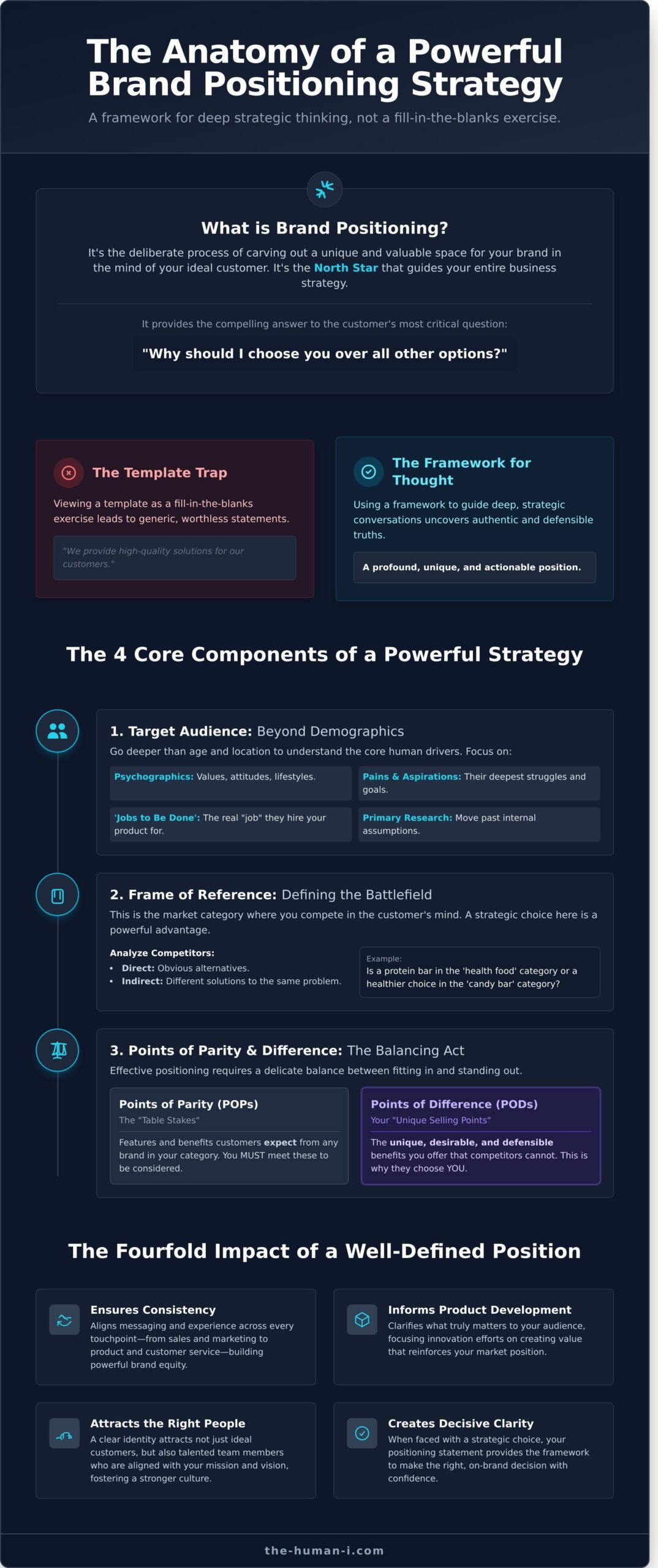
At its core, brand positioning is the deliberate process of carving out a unique and valuable space for your company in the mind of your ideal customer. It’s not merely a marketing slogan or a logo; it is the North Star that guides your entire business strategy. The foundational concepts of What Is Brand Positioning revolve around this idea of owning a specific, meaningful perception. Think of it as the clear, compelling answer to the most critical question a customer asks: “Why should I choose you over all other options?”
The Critical Role of Positioning in Sustainable Growth
A well-defined position is the bedrock of a resilient brand. It moves beyond superficial marketing to influence the very fabric of your organization, acting as a strategic filter for every decision. Its impact is fourfold:
- It Ensures Consistency: It aligns messaging and experience across every touchpoint-from sales and marketing to product and customer service-building powerful brand equity over time.
- It Informs Product Development: By clarifying what truly matters to your audience, it focuses your innovation efforts on creating value that reinforces your market position.
- It Attracts the Right People: A clear identity doesn’t just attract ideal customers; it also draws in talent who are aligned with your mission and vision, fostering a stronger culture.
- It Creates Decisive Clarity: When faced with a strategic choice, your positioning statement provides the framework to make the right, on-brand decision with confidence.
The Template Trap: A Tool for Thought, Not a Substitute for It
Your search for a brand positioning strategy template is an intelligent first step-it shows a commitment to structuring this critical work. However, the greatest risk is viewing it as a fill-in-the-blanks exercise. A template that yields generic statements like “We provide high-quality solutions for our customers” is a failure. The document itself holds no intrinsic value.
Instead, our framework is designed as a tool for rigorous thought. Its purpose is to prompt the difficult questions and guide the deep, strategic conversations necessary to uncover authentic answers. The value isn’t found in the template; it’s forged in the process of completing it.
The Anatomy of a Powerful Positioning Strategy: Core Components
Before you populate a single field in a brand positioning strategy template, it is critical to understand the foundational pillars that give it meaning. These components are the non-negotiable elements of any effective strategy, with each piece building on the last to create a cohesive and defensible market position. Truly developing a brand positioning strategy is less about filling in blanks and more about a rigorous journey of discovery. Let’s uncover the what and why of each essential component.
Target Audience: Beyond Basic Demographics
A deep understanding of your customer is the bedrock of your strategy. Move past simple demographics to uncover psychographics-their values, attitudes, pains, and aspirations. The ‘Jobs to Be Done’ framework helps reveal their true motivations for “hiring” a product like yours. This level of insight can only be achieved through primary research, as internal assumptions are often misleading. Understanding this is central to our expertise in market segmentation.
Frame of Reference: Defining Your Competitive Battlefield
Your frame of reference is the market category in which your brand competes in the customer’s mind. It’s crucial to analyze both direct competitors (obvious alternatives) and indirect ones (different solutions to the same problem). The frame you choose can create a powerful advantage. For instance, is a new protein bar competing in the crowded ‘health food’ aisle, or is it a healthier, more strategic alternative in the ‘candy bar’ category? The choice shapes every subsequent decision.
Points of Difference (PODs) & Points of Parity (POPs)
Effective positioning requires a delicate balance between fitting in and standing out.
- Points of Parity (POPs): These are the ‘table stakes’-the features and benefits customers expect from any brand in your category. You must meet these expectations to even be considered.
- Points of Difference (PODs): These are the unique, desirable, and defensible benefits you offer that competitors cannot. Your PODs must be authentic and sustainable over the long term.
Reason to Believe (RTB): The Proof Behind Your Promise
A brand promise without proof is just an empty slogan. Your Reason to Believe provides the tangible evidence that makes your claims credible. RTBs can be specific product features, compelling customer testimonials, proprietary data, a rich company heritage, or a unique patent. Quantifiable, data-driven proof points are especially powerful in building trust. This is where brand credibility is ultimately won or lost, transforming your positioning from a statement into a believable truth.
The Strategic Framework: Your Brand Positioning Template in Action
A strategy is only as powerful as the questions it answers. This section transforms our free brand positioning strategy template from a document into a dynamic framework for strategic discovery. We have structured the core components into a series of critical questions designed to guide your team’s discussion. Approach each one with intellectual honesty and, wherever possible, hard data. The goal is to uncover the foundational truths that will define your brand’s place in the market.
Download the Worksheet: To facilitate your session, we’ve created a simple, one-page PDF of this framework. Download your free Brand Positioning Worksheet now.
1. Audience & Market Context
Clarity begins with the customer. Before you can define your brand, you must first understand the world your audience inhabits. This requires moving beyond broad demographics to uncover specific motivations and perceptions.
- Who is your single most important customer segment to win? Be specific. “Millennial homeowners in urban areas” is better than “homeowners.”
- What is their core problem, need, or desire that you solve? Articulate their pain or ambition in their own words.
- What is the competitive landscape they currently perceive? List the 2-3 direct and indirect competitors they would consider instead of you.
2. Your Brand’s Unique Identity
With the market context established, the focus turns inward. This is where you codify what makes your brand distinct, memorable, and trustworthy. Your answers here must be both aspirational and authentic.
- What is your unique and compelling brand promise? This is the singular value you guarantee to your target audience.
- What are the 3-5 personality traits that define your brand’s voice? (e.g., Wise, Innovative, Empathetic, Bold).
- What are your most credible Reasons to Believe (RTBs)? List specific features, awards, customer testimonials, or data points that prove your promise.
3. Synthesizing Your Positioning Statement
The final step is to synthesize this strategic work into a clear, concise internal statement. This is not a public-facing tagline but an internal North Star that aligns all marketing, sales, and product efforts. The classic formula is a powerful starting point. This framework, used by top strategists, can help you craft the perfect brand positioning statement with precision.
The Formula: For [Target Audience], [Your Brand] is the [Frame of Reference] that provides [Point of Difference] because [Reason to Believe].
- Weak Example: “For people who need a car, ZoomCar is a vehicle that is reliable.” (Vague and generic).
- Strong Example: “For busy urban professionals, Zipcar is the car-sharing service that provides on-demand freedom because it offers convenient, self-service access to vehicles by the hour or day.” (Specific, differentiated, and credible).
From Template to Reality: Activating Your Positioning Strategy
A completed brand positioning strategy template is an intellectual achievement, but its true value is only unlocked through action. A strategy document gathering dust on a server is useless; activation is how your positioning evolves from a concept into a tangible, revenue-generating business asset. This is the critical phase where you translate the ‘who we are’ defined in your framework into the ‘what we do’ across every facet of your business. Consistent activation across all touchpoints is the key to truly owning your market position.
Aligning Marketing & External Communications
Your brand positioning becomes the strategic filter for every external message. It dictates not just what you say, but how and where you say it. The work done on your brand positioning strategy template should serve as the definitive brief for all creative work, ensuring every campaign and piece of content is a direct expression of your brand’s core promise. This alignment covers:
- Key Messaging: Shaping your value propositions, taglines, and content pillars.
- Visual Identity: Ensuring your logo, color palette, and imagery evoke the desired perception.
- Channel Strategy: Selecting platforms and media where your target audience and brand values intersect.
Embedding Positioning in the Customer Experience
A powerful brand promise can quickly unravel at the point of customer interaction. This is why many great strategies fail. Your positioning must be deeply embedded in every touchpoint, from the user experience on your website to the product packaging and the demeanor of your staff. It requires diligent training so that sales and customer service teams don’t just understand the brand promise-they can articulate and deliver it authentically in every conversation. Explore our full range of brand and customer experience solutions to see how we bridge this gap.
Driving Internal Culture and Alignment
The most resilient brands are built from the inside out. Your employees must understand, believe in, and live the positioning for it to be credible externally. It should become an internal mantra that guides behavior and priorities. Use your positioning as a strategic tool for hiring talent that fits your culture, for onboarding new team members, and for making critical business decisions. When your team is aligned, your brand’s integrity is unmistakable. Learn more about our team and philosophy on achieving deep internal alignment.
Common Pitfalls in Brand Positioning (And How to Avoid Them)
Even the most robust brand positioning strategy template is a tool, not a substitute for rigorous strategic thinking. The process is filled with potential missteps that can dilute your message and render your efforts ineffective. Identifying these common traps is the first step toward building a strategy that endures.
These pitfalls highlight a critical need for objectivity and an honest assessment of both the market and your own capabilities. They reveal the moments where internal bias can cloud judgment and derail an otherwise solid plan.
The ‘Me Too’ Trap: A Lack of True Differentiation
This occurs when brands default to generic benefits like ‘high quality’ or ‘excellent service’. While important, these are table stakes, not true differentiators. The root cause is often a fear of being niche, leading to a vague message that tries to please everyone but excites no one. Memorable brands make brave, specific choices. The goal is to be meaningfully different, not just marginally better.
The Credibility Gap: A Promise Your Brand Can’t Keep
Your positioning is a promise. A credibility gap opens when you make aspirational claims your product or operations cannot consistently deliver, which is the fastest way to erode customer trust. Your positioning must be rooted in an authentic, deliverable truth. It is always a more powerful strategy to under-promise and over-deliver, building a reputation on reliability rather than hype.
The ‘Inside-Out’ Perspective: Forgetting the Customer
This classic error happens when a strategy is built around features the company thinks are important, rather than benefits the customer truly values. It stems from developing a plan in an internal echo chamber, without robust external research. The only cure for this bias is objective, data-driven insight. Always begin with the customer’s world-their problems, needs, and language-not your own.
Avoiding these traps demands an unwavering commitment to strategic honesty. It’s often at this stage that the wisdom of an external perspective becomes invaluable, providing the objective insight needed to challenge internal assumptions and build a brand position that is not only unique but also credible and customer-centric.
Beyond the Template: Uncovering Your True Market Position
Mastering your market position is a journey, not a destination reached by simply filling in the blanks. As we’ve explored, a powerful brand identity is built on a deep understanding of your unique value, your customer’s world, and the competitive landscape. A brand positioning strategy template provides the essential framework, but the transformative power lies in the wisdom and data you pour into it. It’s the critical thinking that turns a structured document into a dynamic roadmap for growth.
A template can frame the questions, but true insight provides the answers. If you’re ready to move beyond the framework and uncover transformative growth opportunities, our seasoned strategists are here to help. We leverage data-driven insights from a proven framework and deep expertise across diverse B2B and B2C sectors to shape compelling brand narratives. Contact us to discuss your brand strategy challenges.
Your journey toward market dominance starts with a single, strategic conversation.
Frequently Asked Questions
What’s the difference between brand positioning and a mission statement?
Brand positioning is an external-facing strategy focused on how you want your target audience to perceive you relative to competitors. It’s about occupying a distinct space in the customer’s mind. A mission statement, conversely, is internal-facing. It defines the company’s core purpose, ethics, and goals, guiding internal decisions and company culture. For example, a car brand’s positioning might be “the safest family vehicle,” while its mission is “to create sustainable and innovative transport solutions for all.”
How often should a company revisit its brand positioning strategy?
Brand positioning is not a static exercise; it requires periodic review to remain relevant and effective. We recommend a formal review every one to two years. More urgent reassessments are necessary following significant market shifts, such as the emergence of a disruptive competitor, a fundamental change in consumer behavior, or a major pivot in your own business objectives. The goal is to ensure your positioning continues to provide a competitive advantage and resonate deeply with your target audience.
Can a single company have multiple positioning strategies?
Yes, it is both possible and often strategically necessary, particularly for companies with a diverse portfolio of products or sub-brands. This approach, known as a “house of brands,” allows a parent company to target distinct market segments without diluting the identity of any single brand. For instance, a global hotel group will have a unique positioning strategy for its luxury resorts, another for its business-focused hotels, and a third for its budget-friendly accommodations, each tailored to a specific audience.
What is a perceptual map and how does it help with brand positioning?
A perceptual map, or positioning map, is a visual tool that illustrates the perceived landscape of a market. It plots how target customers view competing brands based on key attributes, such as price versus quality or innovation versus tradition. This visualization provides critical insight, helping you identify unoccupied market gaps, understand your current position relative to competitors, and make data-driven decisions on where to strategically place your brand to achieve a unique and defensible advantage.
How do you test if your brand positioning is effective with your target audience?
Testing your brand positioning requires a blend of qualitative and quantitative research. Qualitative methods like focus groups and in-depth interviews can uncover the emotional resonance and clarity of your message. Quantitative tools, such as brand perception surveys and message recall tests, provide measurable data on awareness and understanding. Analyzing metrics from A/B tested marketing campaigns can also offer direct insight into which positioning statements most effectively drive customer action and engagement.
Is brand positioning only for large corporations, or is it important for startups too?
Brand positioning is critically important for startups, perhaps even more so than for established corporations. In a crowded market, a clear and compelling positioning strategy allows a new venture to differentiate itself, attract its ideal early adopters, and communicate its value to investors. It provides a strategic filter for all decisions, from product development to marketing. A well-structured brand positioning strategy template can empower a startup to focus its limited resources on building a memorable and defensible market identity from day one.
What is the difference between brand positioning and a value proposition?
While related, these concepts serve different functions. A value proposition is a concise, functional statement that communicates the specific benefits a customer will receive from your product or service. It answers, “What problem do you solve?” Brand positioning is the broader strategic context in which that value proposition lives. It’s the distinct space you aim to occupy in the customer’s mind, shaping their overall perception and emotional connection to your brand relative to all other options.



