


Too many strategic decisions are born from internal assumptions, not genuine customer understanding. Your team might be full of brilliant people, but if they aren’t aligned on who the customer is and what they truly need, even the best ideas can miss the mark. You’ve likely felt this disconnect, perhaps after a workshop that felt more like a box-ticking exercise than a source of true insight. A powerful customer empathy mapping workshop is the antidote, but its success hinges on more than just a template.
This strategic guide is designed to empower you. We will walk you through a proven, step-by-step process for facilitating a session that uncovers profound customer truths. You’ll learn how to foster a shared understanding across departments, build your confidence as a facilitator, and, most importantly, translate collective empathy into actionable insights that shape smarter products and drive sustainable growth.
Key Takeaways
- The success of your workshop is determined before it begins; discover the essential preparation steps that guarantee meaningful outcomes.
- Move beyond the basic template with a step-by-step facilitation guide designed to run a powerful customer empathy mapping workshop that uncovers deep user truths.
- Bridge the critical gap between insight and impact by learning how to translate your completed empathy map into a concrete, actionable business strategy.
- Elevate your facilitation skills by anticipating and overcoming common workshop challenges, ensuring your session remains productive and on track.
What is a Customer Empathy Map (and Why It’s a Strategic Imperative)
In a world saturated with data, true customer understanding goes far beyond demographics and analytics. A customer empathy map is a collaborative visualization tool used to articulate what we know about a particular type of user. As a core component of Design Thinking, its purpose-as this primer on what an empathy map is explains-is to move teams from abstract data points to a shared, human-centered perspective. A successful customer empathy mapping workshop doesn’t just produce a document; it fosters a deep, collective insight into the user’s world, revealing their motivations, pains, and goals in a way that spreadsheets never can.
This is not a one-off task to be checked off a list; it is a foundational strategic exercise. When your entire organization-from product development to marketing-genuinely understands the customer’s experience, the impact is transformative. This shared wisdom empowers you to build more intuitive products, craft marketing messages that resonate deeply, and ultimately, cultivate unwavering brand loyalty. It is the bedrock of a truly customer-centric strategy.
The Four Quadrants of an Empathy Map Explained
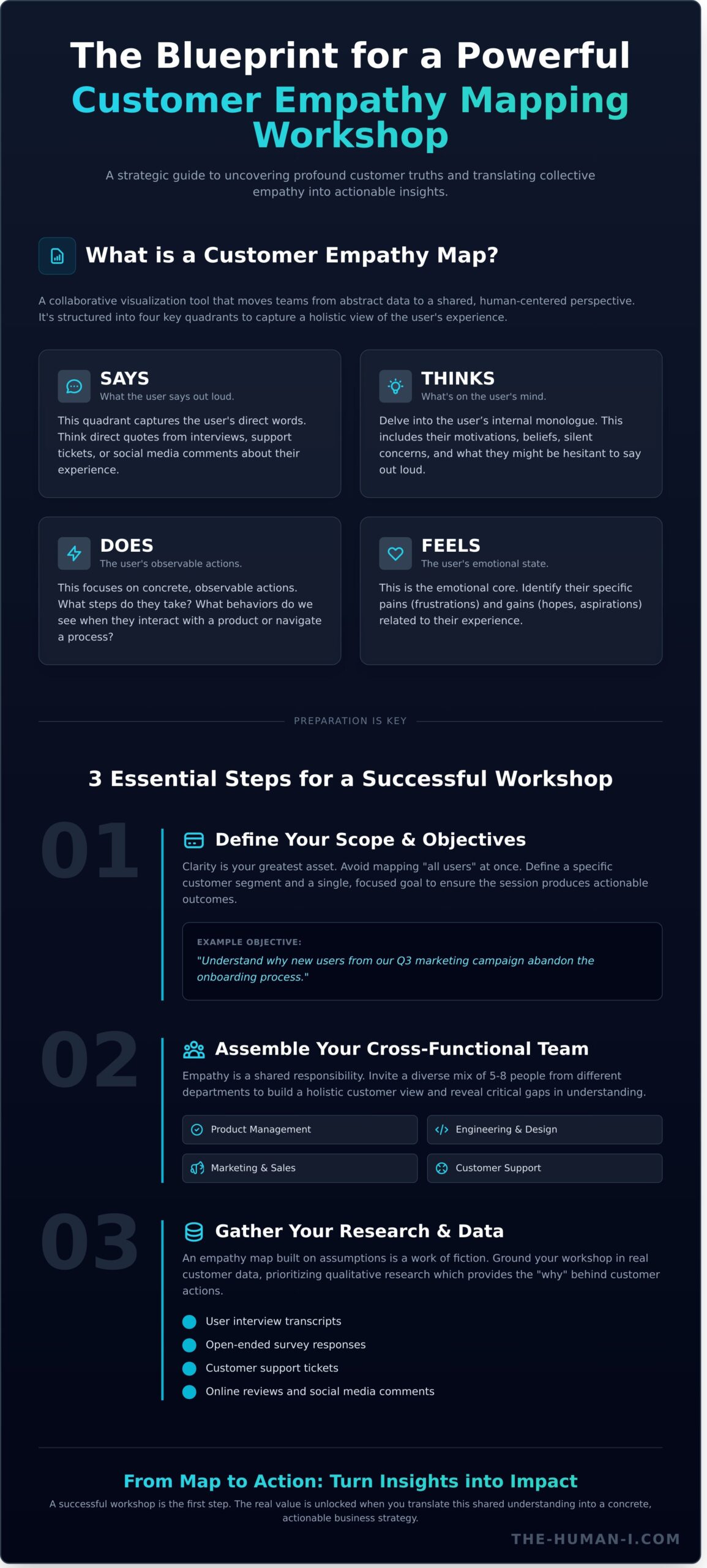
The power of an empathy map lies in its simple yet profound structure, which prompts teams to explore the customer’s world from multiple angles. The framework is typically broken down into four key quadrants that capture a holistic view of the user’s experience:
- SAYS: This quadrant captures the user’s direct words. Think direct quotes from interviews, support tickets, or social media comments. What are they literally saying about their experience?
- THINKS: Here, we delve into the user’s internal monologue. What is truly on their mind that they might be hesitant to say out loud? This includes their motivations, beliefs, and silent concerns.
- DOES: This focuses on concrete, observable actions. What steps do they take? What behaviors do we see when they interact with a product or navigate a process?
- FEELS: This is the emotional core. What is their emotional state? We identify their specific pains, frustrations, hopes, and aspirations (gains) related to their experience.
Beyond a Persona: How Empathy Maps Create Shared Understanding
While a persona provides a static snapshot, an empathy map is a dynamic tool for building alignment. The collaborative process of creating it together as a team is where the real value lies. It forces colleagues from different departments to externalize their individual knowledge about the customer, instantly revealing both shared insights and critical gaps in understanding. This exercise transforms abstract data into a tangible, human story that everyone can rally behind, making it a central tool in our customer experience solutions.
Preparing for a Successful Empathy Mapping Workshop
The success of your customer empathy mapping workshop is determined long before anyone enters the room. Thoughtful preparation transforms a potential brainstorming session into a strategic tool for uncovering genuine customer insight. Before sending the first calendar invite, it’s critical to establish a clear framework. Without precise objectives and the right inputs, even the most well-intentioned workshop can become a pointless meeting. The real work begins here.
Step 1: Define Your Scope and Objectives
Clarity is your greatest asset. Start by defining a specific customer segment and a single, focused goal. Avoid the temptation to map “all users” at once; this dilutes the outcome. A powerful objective is specific and actionable, such as, ‘Understand why new users from our Q3 marketing campaign abandon the onboarding process.’ This level of focus is a core tenet of effective Empathy Mapping in Design Thinking, ensuring the session produces a shared understanding that drives strategy.
Step 2: Assemble Your Cross-Functional Team
Empathy is a shared responsibility. Your workshop should include a diverse mix of perspectives to build a holistic customer view. Invite representatives from different departments who interact with the customer at various touchpoints:
- Product Management
- Engineering & Design
- Marketing & Sales
- Customer Support
An ideal group size is 5-8 people to encourage active participation from everyone. Be sure to assign a dedicated facilitator who can guide the conversation, keep the team on track, and remain neutral.
Step 3: Gather Your Research and Data
An empathy map built on assumptions is a work of fiction. Ground your workshop in real customer data. Prioritize qualitative research, which provides the “why” behind customer actions. Collect assets like user interview transcripts, open-ended survey responses, support tickets, and online reviews. While quantitative data can provide valuable context (e.g., ‘70% drop-off at step 3’), the qualitative details bring the user’s story to life. Our consulting expertise ensures this raw data is translated into actionable wisdom for your team.
Step 4: Prepare Your Tools and Environment
Whether your team is in-person or remote, the right tools facilitate collaboration and focus. For a physical workshop, you’ll need a large whiteboard, markers, and plenty of sticky notes in various colors. For a virtual session, prepare a digital whiteboard using a tool like Miro or Mural. In either case, have a large, clear empathy map template ready before the session begins, so the team can immediately start populating it with insights.
Facilitating the Workshop: A Step-by-Step Guide
A successful customer empathy mapping workshop depends on thoughtful facilitation. Your role is not to provide answers but to create a structured environment where insights can emerge organically. You are the guide, responsible for steering the conversation, managing time, and ensuring every voice contributes to the final picture. This structured agenda empowers your team to move from raw data to profound customer understanding.
Phase 1: Introduction and Goal Alignment (15 mins)
Begin by welcoming participants and clearly stating the session’s purpose: to build a shared understanding of a specific customer. Review the target user persona and the data provided (e.g., interview transcripts, survey results). Establish clear ground rules to foster psychological safety and creativity. Key rules include:
- Defer judgment-there are no bad ideas at this stage.
- Encourage wild ideas and build on the ideas of others.
- Stay focused on the customer persona we are discussing.
Phase 2: Silent Brainstorming (20-30 mins)
Introduce the empathy map’s four quadrants: Says, Thinks, Does, and Feels. Ask each participant to silently generate ideas for each quadrant, writing one thought per sticky note. This technique, often called brainwriting, prevents groupthink and allows introverted team members to contribute equally. Encourage everyone to pull direct quotes and concrete observations from the research to ground the map in real-world data, not assumptions.
Phase 3: Grouping and Synthesizing (30-45 mins)
Once individual brainstorming is complete, invite participants to place their sticky notes onto the large, shared empathy map canvas. As a group, begin clustering similar notes within each quadrant. This is where the facilitator’s guidance is crucial. Spark discussion by asking questions like, “What patterns are we seeing here?” or “Do we see any contradictions between what the customer says and what they do?” This collaborative process is where individual data points coalesce into meaningful themes.
Phase 4: Summary and Key Insights (15 mins)
With the map complete, lead a final review. The goal of this phase is to distill the exercise into actionable wisdom. Pose critical questions to the group: “What are the top three insights we’ve uncovered?” and “What surprised us the most about this customer?” Document these key takeaways prominently. These insights are the true output of the customer empathy mapping workshop, serving as the foundation for future strategic decisions.
From Map to Action: Turning Insights into Business Impact
An empathy map is a powerful tool for discovery, but its true value is unlocked only when insight translates into strategic action. A successful customer empathy mapping workshop doesn’t end when the sticky notes come down; it concludes when new initiatives are set in motion. This critical phase transforms raw observations into a measurable roadmap. Here, we provide a clear framework for bridging that gap, ensuring the wisdom gained empowers teams across your entire organisation to drive meaningful change.
Identifying Pains and Gains
Begin by synthesising the data from your map. Scrutinise the ‘Thinks & Feels’ quadrant to uncover your customer’s core challenges and aspirations. Systematically list these as:
- Pains: The frustrations, obstacles, and anxieties your customer experiences.
- Gains: The desired outcomes, successes, and benefits they are seeking.
Once documented, prioritise this list. Focus on the most severe pains and the highest-value gains to ensure your subsequent efforts are directed where they will have the greatest impact.
Generating ‘How Might We’ Questions
With your prioritised pains and gains, reframe the challenges into opportunities. The ‘How Might We’ (HMW) questioning technique transforms a problem statement into a launchpad for innovation. This simple shift in language opens the door to creative problem-solving.
For example, the pain point, “Our customer is confused by the complex pricing tiers,” becomes a strategic question: “How might we simplify our pricing to provide absolute clarity?” These HMW questions become the foundational prompts for focused ideation sessions.
Assigning Ownership and Next Steps
Insight without ownership rarely leads to change. To operationalise the outputs of your customer empathy mapping workshop, you must create a clear path forward. Document all key insights and HMW questions in a shared, accessible space. Assign specific opportunities to individuals or teams-from product to marketing to customer service-who are best equipped to explore them. This cross-functional accountability is vital. Finally, schedule a concrete follow-up meeting within two weeks to review progress and maintain momentum.
Need help turning raw insight into a coherent strategy? Contact our team to learn how we empower brands with actionable wisdom.
Advanced Facilitation: Overcoming Common Workshop Challenges
Executing a successful customer empathy mapping workshop moves beyond templates and into the realm of strategic facilitation. Real-world sessions are rarely straightforward, but navigating their complexities is where true insight is uncovered. This is the level of nuanced guidance our team brings to every engagement, turning potential roadblocks into opportunities for deeper understanding.
Here, we address three common challenges and provide expert strategies to overcome them.
Navigating a Lack of User Research
Ideally, your map is fueled by rich, qualitative data. But a lack of formal research shouldn’t be a blocker. Instead, frame the session as an assumption-mapping exercise. The goal is to articulate and consolidate the team’s collective hypotheses about the customer. The resulting map becomes a powerful tool not for validation, but for identifying the most critical assumptions that must be tested through future research.
Managing Dominant Voices and Groupthink
To prevent a few participants from steering the entire conversation, structure is key. Begin with silent, individual brainstorming where everyone writes their ideas on sticky notes before any discussion. This ensures all perspectives are captured. When it’s time to prioritize, use democratic techniques like dot-voting, where each person gets a set number of votes to allocate. As a facilitator, gently redirect conversations by saying, “Thank you for that perspective. I’d love to hear from someone else on this point.”
Mapping for Complex B2B Audiences
In a B2B context, ‘the customer’ is often a committee, not an individual. A single empathy map will fall short. The solution is to create separate maps for the key personas involved in the decision-making process. Consider mapping for:
- The End-User: Focused on daily usability, features, and workflow integration.
- The Economic Buyer: Concerned with ROI, budget, risk, and business-level pain points.
- The Technical Influencer: Worried about security, implementation, and compatibility.
This multi-map approach provides a holistic view of the entire buying ecosystem, revealing competing priorities and motivations that are crucial for shaping strategy.
Beyond the Map: Embedding Customer Insight into Your Strategy
You now have the framework to move beyond assumptions and truly understand the world through your customers’ eyes. Mastering the art of the customer empathy mapping workshop isn’t just about filling in quadrants on a canvas; it’s about fostering a culture of genuine curiosity. The true power of this process is unlocked not only through meticulous preparation and facilitation but in the strategic translation of those uncovered insights into decisive action that drives growth.
But turning raw insight into strategic wisdom can be a complex journey. At Human Instinct, we empower businesses across both B2B and B2C sectors to navigate this journey. Our proven frameworks combine data-driven insights with strategic wisdom, helping you build a foundation for sustainable, customer-led growth.
Discover how our strategic insights can transform your customer understanding. Your map is just the beginning; the journey to profound customer connection awaits.
Frequently Asked Questions
What’s the difference between an empathy map and a customer journey map?
An empathy map provides a snapshot of a customer’s internal world-what they think, feel, see, and hear-to uncover their mindset and motivations. In contrast, a customer journey map charts the chronological sequence of actions and touchpoints a customer has with your brand over time. Think of it as the difference between a character portrait (empathy map) and a plot outline (journey map). Both are vital tools for gaining a holistic customer perspective.
How long should a customer empathy mapping workshop typically last?
The ideal duration for a customer empathy mapping workshop depends on your objective’s complexity. A focused session on a single, well-researched persona can be highly effective in 90 minutes to two hours. For more complex scenarios, multiple personas, or if you are building the map from scratch with a large team, we recommend allocating a half-day (three to four hours). This ensures sufficient time for deep discussion, synthesis, and defining actionable insights.
Can you create an empathy map without direct user research? What are the risks?
You can create a preliminary empathy map without direct user research; this is often called an “assumption map.” It captures your team’s collective hypotheses about the customer. However, the primary risk is significant: you are building strategy on unverified beliefs, not data. These internal assumptions can be biased or entirely incorrect. It is crucial to treat this map as a starting point for validation, using real customer research to transform assumptions into genuine insight.
Who from our company should be invited to an empathy mapping workshop?
To gain the most value, your empathy mapping workshop should include a cross-functional team. Invite individuals who interact with customers at different stages, such as sales, customer support, and marketing. It’s also critical to include those who shape the product experience, like product managers, UX/UI designers, and even engineers. This diversity of perspectives is essential to uncover a complete and nuanced understanding of the customer’s world and build internal alignment.
How do you adapt an empathy map for a B2B audience with multiple stakeholders?
For a B2B audience, the key is to map the entire decision-making unit, not just a single user. We advise creating a distinct empathy map for each key stakeholder-for example, the end-user, the IT manager, and the CFO (the economic buyer). This strategic approach allows you to uncover the unique pains, gains, and influences of each role. By comparing these maps, you can identify potential conflicts and align your messaging to address the entire buying committee effectively.
What are the most common mistakes to avoid when facilitating this workshop?
The most common mistake is treating assumptions as established facts, leading to a strategy built on a weak foundation. Another pitfall is creating a map that is too generic and not focused on a specific, well-defined customer persona. Finally, many teams fail to translate the workshop’s output into concrete actions. Without a clear plan for how the insights will inform design, marketing, or strategy, the empathy map risks becoming an interesting but ultimately unused artifact.



