


Most product budgets are little more than expensive guesswork masquerading as spreadsheets. When 75% of new consumer products fail to meet their first-year revenue targets, according to Harvard Business School research, a traditional new product development budget template that only tracks costs is no longer enough for the 2026 fiscal cycle. You’ve likely felt the pressure of trying to prove ROI to a skeptical board while watching a 15% cost overrun swallow your prototyping phase because the initial market research was underfunded. It’s a common struggle to balance the books while trying to capture genuine human insight.
We’re here to help you shift from a defensive spending mindset to a strategy rooted in wisdom and data. This article promises to provide a defensible budget narrative that aligns every dollar with market discovery, significantly reducing your financial risk before the first prototype is even built. We’ll explore how to structure your 2026 funding to ensure your innovation is backed by the depth of understanding it deserves.
Key Takeaways
- Learn why your budget must serve as a strategic narrative, moving beyond basic cost-tracking to reflect your company’s true innovation priorities.
- Identify the essential categories for funding iterative prototyping, allowing you to budget for the necessary “failures” that lead to final success.
- Master the 70-20-10 rule for modern portfolios to balance financial rigor with the “moonshot” investments required for long-term stability.
- Follow a disciplined process to construct a new product development budget template that aligns your financial resources with deep market insight and brand strategy.
- Understand how to transform raw data into wisdom, using human instinct to turn a standard spreadsheet into a powerful engine for brand growth.
Beyond the Spreadsheet: Why Your NPD Budget Needs a Strategic Narrative
A spreadsheet is a cold document, but it tells a vivid story about what a company actually values. When you download a new product development budget template, you aren’t just filling in cells with projected costs. You’re making a series of strategic bets. Too often, leadership treats these templates as a defensive exercise in “safe” accounting. They focus on minimizing immediate risk rather than maximizing long term impact. This cautious approach is exactly why so many projects stall before they reach the prototype stage. True innovation requires a shift from defensive spending to bold, intentional investment.
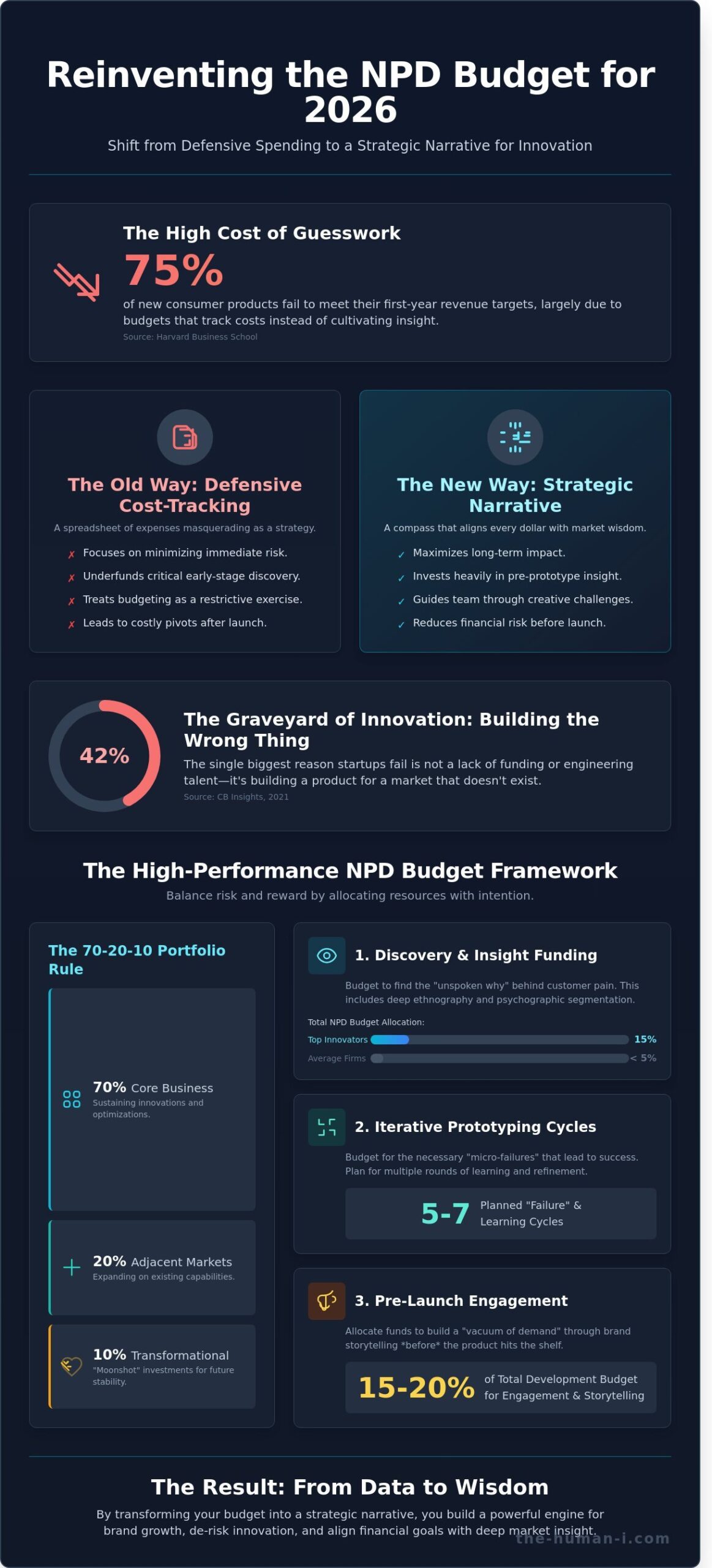
If you underfund the discovery phase, you’re essentially gambling with your firm’s future. Research from Harvard Business School indicates that 95% of new products fail to meet their first-year targets. This isn’t usually a failure of engineering or design; it’s a failure of insight. A budget should reflect the “wisdom” required to turn raw data into a product people actually want. Data tells you what happened in the past. Wisdom tells you what will happen next because you’ve taken the time to understand the human behavior driving the numbers.
Investing in the early stages of the new product development process is the only way to ensure your spreadsheet leads to a profitable reality. Without a narrative that connects your spending to a specific market need, your budget is just a list of expenses. It lacks the soul necessary to guide a team through the inevitable challenges of creation. A strategic budget acts as a compass, ensuring that every dollar spent is moving the needle toward a meaningful solution for your customers.
The High Cost of Blind Innovation
Market fit is the graveyard of the arrogant. CB Insights reported in 2021 that 42% of startups fail because there was simply no market need for what they built. A “cheap” initial budget that skips deep ethnography or consumer psychology often leads to an expensive $1.2 million pivot six months after launch. There’s a massive difference between looking for data and actually finding a transformative insight. You don’t want a team that just checks boxes. You want a team that finds the “unspoken why” behind customer pain points. This requires allocating funds for:
- Deep Consumer Ethnography: Going beyond surveys to watch how people actually live.
- Psychographic Segmentation: Understanding the values that drive purchase decisions.
- Iterative Prototyping: Budgeting for failure early so you can succeed faster later.
Aligning Financial Goals with Brand Evolution
Your NPD spend shouldn’t exist in a vacuum. It needs to pull the entire brand forward into a new era of relevance. If your new product doesn’t support a broader brand refresh strategy, it’s just noise in an already crowded market. Successful firms now allocate 15% to 20% of their total development budget to “engagement” and “brand storytelling” before the product even hits the shelf. This creates a vacuum of demand. To ensure your new product development budget template aligns with long term growth, consider Human Instinct’s approach to brand evaluation as your starting point. This ensures every dollar spent isn’t just a cost, but a brick in a much larger, more profitable brand architecture.
The Essential Categories of a High-Performance NPD Budget Template
A budget isn’t just a spreadsheet; it’s a strategic map. Integrating a clear product development strategy into your financial planning ensures every dollar spent serves a specific milestone. A high-performance new product development budget template must move beyond basic line items to account for the nuances of modern innovation. It’s the difference between guessing and knowing where your capital creates the most leverage.
Moving beyond surface-level market research requires a dedicated “Discovery & Insight” category. While many firms allocate less than 5% to early discovery, top-tier innovators set aside 15% of their total budget for this phase. This spend focuses on finding what’s hidden; the subtle shifts in consumer behavior that data alone might miss. It’s where insight, data, and wisdom meet to prevent costly pivots later in the cycle.
Design and prototyping shouldn’t be viewed as a linear path to a finished good. Instead, budget for iterative failure. Successful teams often plan for 5 to 7 “micro-failure” cycles during the prototyping phase. By allocating funds for rapid, low-fidelity testing, you ensure the final product is resilient. This approach reduces the risk of a macro-failure at launch, which a 2023 study by Harvard Business School suggests affects 95% of new consumer products.
Investing in Customer Experience Mapping
By 2026, 80% of B2B purchase decisions will be influenced by the digital experience alone. This makes CX mapping a non-negotiable budget line item. You’ll need to allocate funds specifically for identifying “key moments” in the user journey; those friction points where a customer either commits or churns. Data from 2024 shows that companies investing in journey mapping see a 31% reduction in long-term customer acquisition costs. It’s an upfront investment that pays dividends in retention.
Market Segmentation and Audience Identification
The cost of broad-market strategies is often death by a thousand cuts. Niche segmentation, while appearing more expensive initially due to specialized data requirements, delivers a 24% higher sales productivity rate. Budgeting for data-driven insights allows you to uncover stagnant-brand-saving audiences that competitors have overlooked. Market segmentation is the financial foundation of product-market fit because it dictates exactly where capital is deployed to win specific, high-value audience clusters.
Reputation and launch planning must begin long before the first unit is sold. Budgeting for perception measurement allows you to shape the narrative early. This includes sentiment analysis and focus groups that test brand resonance. If you uncover deeper market truths during this phase, you can adjust your messaging to align with actual customer desires rather than assumed needs.
Finally, every new product development budget template requires a “Wisdom Buffer.” This is a contingency fund of 20% reserved for unexpected market shifts or supply chain disruptions. It isn’t a slush fund; it’s a strategic reserve that provides the agility to pivot when the market moves faster than your original plan. This buffer ensures that a single unexpected variable doesn’t derail the entire project timeline.
Strategic Resource Allocation: Balancing Innovation Risk with Financial Rigor
Smart allocation isn’t just about spreadsheets; it’s about the courage to fund uncertainty. Most high-performing firms, roughly 80% according to 2022 industry benchmarks, adhere to the 70-20-10 rule. This framework dictates that 70% of your resources go to core products, 20% to adjacent opportunities, and 10% to transformational moonshots. Without this discipline, the urgent core business always cannibalizes the important future innovation. Your new product development budget template should explicitly categorize projects into these three buckets to prevent the safe bets from suffocating the breakthroughs.
Budgeting for moonshots requires a shift from tracking burn rate to measuring insight rate. Burn rate tells you how fast you’re spending cash; insight rate tells you how quickly you’re reducing uncertainty. If a team spends $100,000 in a month but can’t articulate a single new customer truth, the insight rate is zero. Senior talent plays a vital role here. Their wisdom allows them to spot when a project is spinning its wheels versus when it’s on the verge of a pivot. Effective Federal R&D Budgeting research highlights that long-term success depends on this strategic oversight rather than just throwing capital at every idea. Wisdom, in this context, is the ability to kill a project before it becomes a financial anchor.
Fixed vs. Variable Costs in the NPD Cycle
Distinguish between fixed infrastructure and variable costs like third-party research. Keep the variable side punchy. If you’re using a new product development budget template, ensure it allows for rapid reallocation. Avoid the sunk cost fallacy, famously known as the Concorde Effect from the 1970s. Just because you’ve spent $2 million doesn’t mean you should spend $2 million more on a failing concept.
Measuring Reputation Throughout Development
Reputation isn’t something you tackle at launch; it’s built during R&D. A 2020 Weber Shandwick study found that 63% of a company’s market value is tied to its reputation. Allocate budget early to track how your innovation affects brand perception. If your new product solves a sustainability issue, the narrative should be shaped by data gathered during the testing phase. This creates a cohesive market entry.
The role of senior talent is to provide the guardrails for these financial decisions. They aren’t there to micromanage the line items but to ensure the budget reflects the brand’s long-term instinct. When you empower experienced leaders to guide high-value decisions, you move away from reactive spending and toward intentional investment. This balance of financial rigor and creative freedom is what separates the market leaders from the also-rans. It’s about finding the signal in the noise of the data and having the financial flexibility to act on it immediately.
How to Construct Your New Product Development Budget Template
Building a budget isn’t about filling cells in a spreadsheet; it’s about mapping your strategic intent. Before you open your new product development budget template, you must audit your existing brand strategy. Statistics from Harvard Business School suggest that 95% of new products fail. Often, this happens because the budget didn’t account for the current market position. If your brand is currently perceived as a value leader, launching a luxury tier product requires a 40% increase in your initial awareness spend to shift consumer perception. Start by documenting these baseline realities.
Defining the Discovery Phase Milestones
The discovery phase is where you find the wisdom needed to justify every subsequent dollar. You shouldn’t move to production until you’ve answered the “why” behind the “what.” Budgeting for this involves a mix of qualitative and quantitative methods. For instance, allocate $12,000 for deep-dive ethnographic studies to uncover emotional drivers; then, spend $5,000 on quantitative surveys to validate those findings at scale. Establish “Go/No-Go” financial gates. If your research doesn’t identify at least a 25% “unmet need” score among your target segment, the budget stops there. This prevents the “sunk cost” fallacy from draining your resources.
Next, map the customer journey to identify both technical and emotional requirements. Technical costs like prototyping are easy to quantify. Emotional requirements, such as the tactile feel of packaging or the speed of a digital interface, are often overlooked. Devote 15% of your R&D budget specifically to these “delight” factors. They’re what turn a functional product into a brand legacy.
Assigning costs to market segmentation and reputation tracking is your next priority. In 2024, 63% of consumers buy based on beliefs and values. Your new product development budget template must include a line item for longitudinal reputation tracking. This ensures that as you develop the product, you aren’t inadvertently damaging the brand equity you’ve spent years building. Precision in segmentation saves money; it’s cheaper to own 80% of a niche than 1% of a generic market.
The Role of Storytelling in Budget Justification
A budget is a dry document until you wrap it in a narrative. When you present to internal stakeholders, don’t just talk about ROI. Use storytelling to frame research costs as “insurance” against market irrelevance. You’re not spending $50,000 on data; you’re investing in a shield that protects a $2 million launch. This approach aligns with Human Instinct’s expertise in strategic storytelling, where insight and data are transformed into a compelling vision. It makes the “ask” feel less like a cost and more like a strategic necessity. Finally, review your final numbers through the triad of Insight, Data, and Wisdom. Data tells you what happened, insight tells you why, and wisdom tells you what to do next.
Ready to move beyond the spreadsheet and into true market leadership? Unlock the wisdom behind your next launch.
From Data to Wisdom: Maximizing ROI with Human Instinct
You’ve downloaded the new product development budget template. It’s a logical first step. However, a spreadsheet is merely a container; it doesn’t generate the genius required to capture a market. Harvard Business School professor Clayton Christensen famously noted that of the 30,000 new consumer products launched every year, 95 percent of them fail. This staggering statistic suggests that the difference between the 5 percent that thrive and the majority that vanish isn’t found in the accuracy of their accounting. It’s found in the depth of the insight driving the investment.
A budget transforms into a growth engine only when it’s fueled by professional brand evaluation. We’ve observed companies allocate upwards of $250,000 to a launch phase only to realize, too late, that they’re solving a problem their customers don’t actually have. Human Instinct steps in to ensure your capital isn’t just spent, but strategically invested. We refresh stagnant or ailing brands by identifying the “white space” in the market that competitors have overlooked. We don’t just fill cells in a document; we shape the narrative that makes those numbers possible.
Innovation requires a shift in perspective. Most teams spend their time “looking for” a solution that fits their internal capabilities. We encourage you to focus on “finding” the path that resonates with human truth. This distinction is subtle but vital. When you stop looking for confirmation and start finding genuine market needs, your ROI ceases to be a projection and starts becoming a reality.
The Human Instinct Advantage
Our senior team doesn’t believe in the frantic pace that defines much of modern business. We’ve spent over 20 years in the disciplines of insight, strategy, and brand planning. We bring a wealth of experience that allows us to take a measured, unhurried approach to your NPD strategy. While your competitors are rushing to hit a quarterly deadline, we’re helping you pause to ensure the destination is actually worth the effort. Data provides the coordinates, but human wisdom provides the context. You can possess every user metric available and still fail to understand why a customer feels a disconnect with your brand’s story. We bridge that gap.
Next Steps for Your Innovation Strategy
Review our solutions for a deeper dive into market segmentation. Many businesses rely on broad demographic data that hasn’t been updated since 2019, missing the massive shifts in consumer behavior seen over the last 36 months. If your new product development budget template reveals a gap in projected engagement, it’s likely a sign that your segmentation needs a refresh. We help you uncover the specific triggers that drive loyalty in a crowded marketplace.
Success isn’t about the volume of data you collect. It’s about the wisdom you apply to it. We invite you to contact us to discuss the specific product development challenges your team is currently facing. Whether you’re struggling to define your audience or your brand feels stagnant, we provide the clarity needed to move forward with confidence. Let’s find the insight your brand has been looking for.
Mastering Your 2026 Innovation Roadmap
A spreadsheet shouldn’t just track costs. It should tell a story of where your brand is headed. By 2026, the most successful firms will move beyond static line items to embrace a new product development budget template that balances high-risk innovation with strict financial rigor. You’ve seen how to categorize essential costs and shift from raw data to strategic wisdom. It’s about more than just filling cells; it’s about the foresight to know which bets will pay off in a crowded market. Success requires a bridge between what the data says and what your intuition knows.
Our senior team brings a wealth of global experience from the Financial Services and Tech sectors to help you navigate these complex choices. We’ve earned “extraordinary” and “intelligent” feedback from clients because we don’t just look at numbers. We apply a unique triad of Insight, Data, and Wisdom to uncover what truly matters for your brand’s future. Stop guessing and start deciding with clarity. We help you find the opportunities that others merely look for.
Discover how Human Instinct turns data into market-winning wisdom
Your next big breakthrough is waiting to be found. Let’s build it together.
Frequently Asked Questions
What is the most commonly overlooked item in an NPD budget?
The most frequently neglected line item is the post-launch iteration budget, which should account for 15% of your total spend. Most teams burn their entire runway on the initial build. They forget that 80% of product success depends on refinements made in the first 90 days after real users touch the interface. Without this buffer, your new product development budget template remains a static document rather than a strategic roadmap for growth.
How much of my total budget should be allocated to market research?
You should allocate between 12% and 18% of your total budget to market research and insight gathering. Data from the 2023 Product Management Report suggests that projects investing less than 10% in upfront validation face a 50% higher failure rate. This investment provides the wisdom needed to pivot before you’ve spent 100,000 dollars on code that nobody actually wants to use.
Can I use a general project budget template for new product development?
Using a general project template is a mistake because it lacks the specific R&D and discovery phases required for innovation. NPD requires a non-linear approach that accounts for 20% to 30% variability in technical feasibility. A standard template often ignores the cost of intellectual property filings or the 15% contingency needed for pivoting based on user feedback during the prototype stage.
How do I justify a high discovery phase cost to my CFO?
Justify discovery costs by framing them as an insurance policy that prevents a 40% loss in late-stage rework. Tell your CFO that a 50,000 dollar discovery phase identifies technical blockers that would otherwise cost 200,000 dollars to fix after launch. Strategic insight at the start ensures capital is deployed on validated ideas, transforming the budget from a cost center into a calculated investment with a 3x higher ROI.
What is the difference between a startup budget and a corporate NPD budget?
The primary difference lies in the 25% overhead for compliance and legal reviews found in corporate budgets. Startups typically funnel 70% of their funds directly into building a Minimum Viable Product to find market fit quickly. In contrast, corporate NPD budgets must account for internal cross-charging and governance, which often adds 12 weeks to the development timeline compared to a lean startup environment.
How often should I update my product development budget template?
You must update your new product development budget template every 30 days or at the conclusion of every Stage-Gate milestone. Tracking spend in real-time reveals if your burn rate exceeds the 5% monthly variance threshold. Regular updates allow you to reallocate funds from underperforming features to high-growth opportunities, ensuring your strategy remains as fluid as the market you’re entering.
How does customer experience mapping affect the overall development cost?
Customer experience mapping adds roughly 10% to your initial research costs but reduces total development spend by 25% through precise feature prioritization. By visualizing the user journey, you identify the three core features that drive 80% of value. This prevents feature creep, which accounts for 30% of budget overruns in typical software projects, and ensures every dollar spent serves a specific human need.



