


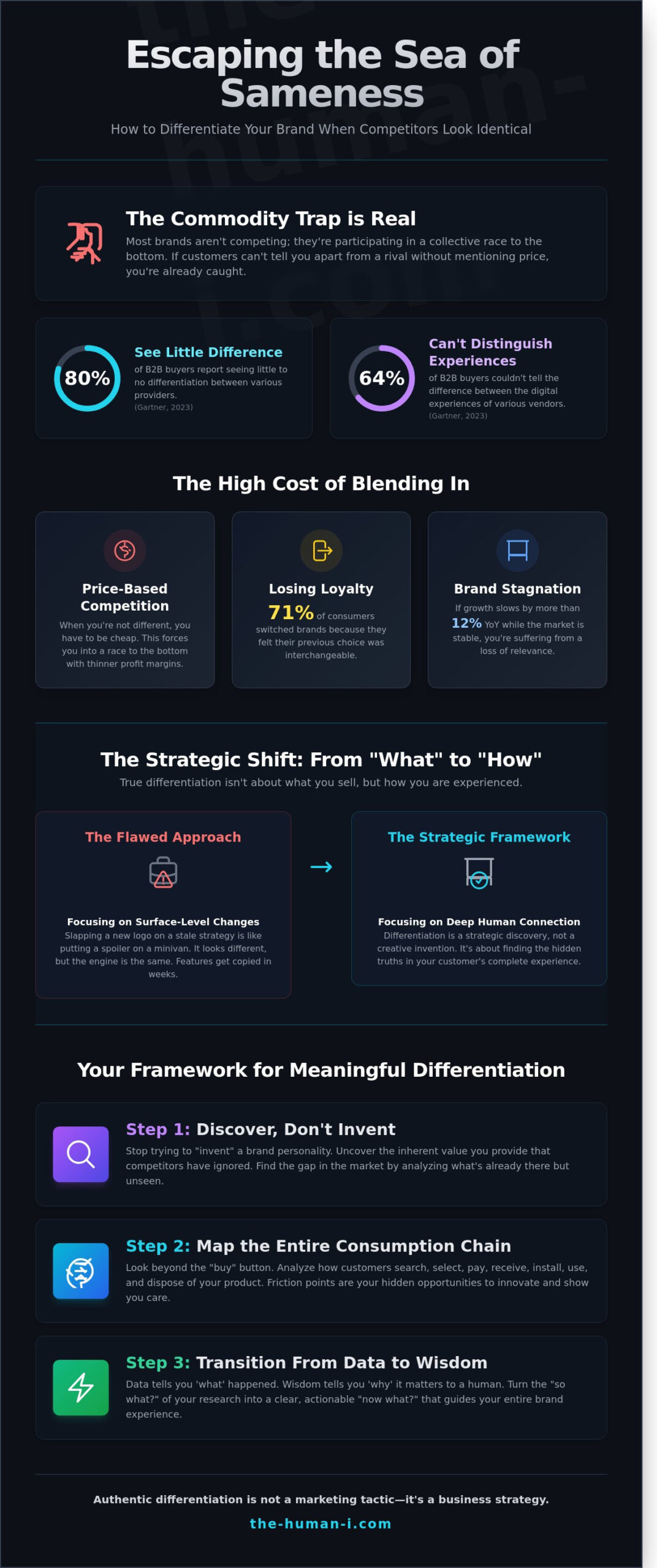
Most brands aren’t actually competing; they are participating in a collective race to the bottom where the only prize is a thinner profit margin. It’s an exhausting cycle. When 80% of B2B buyers in a 2023 Gartner study reported seeing little difference between various providers, the pressure to slash prices becomes a survival instinct. You’ve likely felt the frustration of stagnant growth despite having a mountain of data at your fingertips.
You know that generic marketing tactics won’t save a brand caught in the commodity trap. This guide will show you how to differentiate your brand from competitors by looking beyond the noise to find the intersection of data, insight, and genuine wisdom. We’ll move past the superficial to uncover a brand identity that feels found rather than invented.
We are going to walk through a clear strategic framework that replaces pricing pressure with deep human connection. By the end, you’ll have the tools to transform your market position into something truly extraordinary.
Key Takeaways
- Escape the “Sea of Sameness” by shifting your focus from what you sell to the unique advantage your audience actually perceives.
- Discover how to differentiate your brand from competitors by auditing the entire customer journey for the hidden contact points others ignore.
- Transition from drowning in data to leading with wisdom, turning the “so what” of research into a clear, human-centric “now what.”
- Validate your brand’s foundation with a three-step framework designed to ensure your differentiation is both authentic and sustainable.
- Learn to refresh a stagnant brand from the inside out, ensuring your team is aligned before you communicate your new vision to the market.
The Commodity Trap: Why Most Brands Fail to Stand Out
Most businesses believe they’re unique until they look at their competitors side-by-side. True brand differentiation isn’t a badge you pin on your chest. It’s the perceived advantage your target audience feels when they interact with your brand. If your customers can’t explain why they chose you over a rival without mentioning price, you’ve fallen into the commodity trap.
In 2023, research by Gartner highlighted that 64% of B2B buyers couldn’t distinguish between the digital experiences of various vendors. This “Sea of Sameness” happens when companies copy industry leaders instead of carving their own path. To escape this cycle, brands must master Product differentiation, which involves looking beyond the physical item to the psychological and strategic space it occupies in the market.
Surface-level changes often mask deeper issues. Slapping a new logo on a stale strategy is like putting a spoiler on a minivan; it looks different, but the engine is exactly the same. Logos and slogans are visual cues, not strategic anchors. When you focus on how to differentiate your brand from competitors, you have to look at the bones of the business. If your growth slowed by more than 12% year-over-year while your market remained stable, you’re likely suffering from brand stagnation. This isn’t a creative failure. It’s a symptom of lost relevance.
The Price of Being Identical
When you’re identical, you’re a commodity. In a 2022 survey, 71% of consumers switched brands because they felt their previous choice was interchangeable with others. This lack of distinction forces you into price-based competition. If you aren’t different, you’re just cheap. “Better” is a trap because it’s subjective and easily eclipsed. Being “different” is a binary state that protects your margins and builds genuine loyalty.
The Myth of the Unique Selling Proposition (USP)
The traditional USP is a relic of 1960s advertising. Today, features are copied in weeks, not years. In 2024, the “what” you sell is rarely enough to sustain a lead. You have to move from “what we sell” to “how we are experienced” by the human on the other side of the screen. Understanding how to differentiate your brand from competitors means finding the hidden truths within your data and wisdom.
Differentiation is a strategic discovery, not a creative invention.
Real insight comes from uncovering what’s already there but has been ignored by everyone else. We see many brands trying to “invent” a personality when they should be “discovering” their inherent value. This discovery process requires a mix of data and instinct to find the gap in the market that your competitors are too blind to see. Without this foundation, any attempt at marketing is just noise in an already crowded room.
The Consumption Chain: Uncovering Hidden Contact Points
Most brands spend 90% of their marketing budget shouting about the “buy” button. They obsess over the moment of transaction while ignoring the “I need this” phase and the “how do I get rid of this” phase. This narrow focus is a gift to your strategy. To understand how to differentiate your brand from competitors, you must look at the entire consumption chain. This is the full sequence of events from the first spark of a need to the final disposal of the product. It’s where hidden contact points live, waiting to be turned into competitive advantages.
Every step in this chain is an opportunity to provide value that a product alone cannot deliver. When you analyze how customers search, select, pay, receive, install, use, and even repair a product, you find gaps. A 2023 study found that 68% of customers leave a brand because they believe the company is indifferent to them. By identifying “key moments” that others ignore, you prove that you aren’t indifferent. You’re attentive. This shift from product-centric thinking to experience-centric thinking is where true brand equity is built.
Mapping the Experience Journey
Empathy isn’t a soft skill; it’s a strategic diagnostic tool. Mapping the journey requires you to step out of your boardroom and into the customer’s shoes. You aren’t just looking for clicks or conversions. You’re looking for the moment a customer feels confused, frustrated, or ignored. These friction points are actually invitations to innovate. If a customer finds it difficult to assemble a product, that’s a friction point. If they don’t know how to recycle the packaging, that’s a friction point.
This is where customer experience mapping services become vital. They provide the data and wisdom to see what others miss. By uncovering these hidden moments, you can shape a brand narrative that feels deeply personal. It’s about finding what the customer truly values rather than just looking for what you want to sell them. When you solve a problem the customer didn’t even realize they had, you stop being a vendor and start being a partner.
Capitalizing on Customer Touchpoints
Small changes in the consumption chain create massive impact. Consider how brands like Chewy differentiated themselves in a crowded market. They don’t just sell pet food; they send handwritten sympathy cards when a customer’s pet passes away. This touchpoint has nothing to do with the product and everything to do with the relationship. It’s a powerful lesson in how to differentiate your brand from competitors through service rather than price or features.
- Identify the “unboxing” experience: Is it a chore or a delight?
- Look at the “payment” phase: Can it be made more transparent or frictionless?
- Evaluate the “disposal” phase: How can you help the customer move on to their next need?
Consistency across these touchpoints is the glue that holds your brand together. If your delivery is fast but your customer support is slow, the brand promise breaks. You can find inspiration for these shifts in resources like 50 Ways To Differentiate Your Brand, which highlights how diverse these opportunities can be. Differentiation isn’t a one-time event. It’s a series of intentional choices across the entire chain. If you’re ready to look beneath the surface, you can uncover the insights that turn stagnant brands into market leaders.
From Data to Wisdom: The Human Instinct in Brand Strategy
Many leadership teams argue they’ve already reached data saturation. They point to dashboards overflowing with real-time metrics and customer heatmaps. However, a 2023 study by Gartner revealed that 54% of marketing leaders still fail to turn that data into actionable results. Having the numbers isn’t the same as having a plan. If data were the only requirement for success, every company with a Google Analytics account would be a market leader. The reality is that data is just the starting point, not the finish line.
To understand how to differentiate your brand from competitors, you must distinguish between three distinct stages of knowledge. Data is the “what.” It is the 14% bounce rate or the 2,500 newsletter signups that appear on your Monday morning report. Insight is the “so what.” It is the realization that users are bouncing because they don’t trust your checkout security, not because your prices are too high. Wisdom is the “now what.” It is the decisive, strategic action that defines your market position and creates a lasting competitive advantage. Wisdom is where the human instinct takes over from the algorithm.
True differentiation doesn’t come from looking harder at the same spreadsheets your rivals are staring at. It comes from discovery. Ferran Adria, the visionary chef behind El Bulli, famously noted that in creativity, it’s not what you look for that’s important but what you find. If you only look for what you expect, you’ll never see the hidden opportunities. This philosophy is central to our approach. We don’t just search for answers to pre-set questions; we find the underlying truths that haven’t been asked about yet. This is where brand evaluation consulting acts as the critical bridge. It moves you from passive observation to active strategy, transforming raw information into a sharp, competitive edge.
Applying this level of clarity is the only way to truly master how to differentiate your brand from competitors in a crowded marketplace. It requires a shift from being a “searcher” to being a “finder.” When you stop looking for confirmation of your existing biases, you start finding the gaps in the market that your competitors are too blind to see.
The Role of Storytelling in Strategy
Data is cold; stories are warm. A narrative gives your internal team a reason to care and a script to follow. When your strategy is wrapped in a story, it becomes an emotional hook that a spreadsheet can’t replicate. It aligns your culture, ensuring everyone from the CEO to the front-line staff understands the brand’s unique “why.” Storytelling disciplines help teams move past dry objectives and toward a shared vision that feels human and authentic.
Uncovering New Audiences
Broad demographics are dead. A 2023 report from Forrester suggests that up to 73% of enterprise data goes unused for analytics, often because it’s stuck in rigid categories like “males aged 25 to 40.” We look for human-centric psychographics instead. Why do they buy? What keeps them up at 2:00 AM? By uncovering the “why” behind customer behavior, you can find untapped niches that your rivals have completely ignored. Moving from “who” they are to “why” they care is the ultimate shortcut to growth.
A Strategic Framework for Meaningful Differentiation
Differentiation isn’t a creative exercise; it’s a rigorous filter. Most companies fail here because they fall in love with their own internal jargon rather than looking at the cold, hard reality of their operations. Understanding how to differentiate your brand from competitors requires moving beyond superficial slogans. You need a framework that separates genuine market advantages from mere wishful thinking. At Human Instinct, we believe that where insight, data, and wisdom meet, a brand finds its true north.
The Three-Test Evaluation
To determine if a differentiator has legs, you must run it through three uncompromising tests. First, ask if it’s true. This is the bedrock of your reputation. According to a 2021 Stackla report, 86 percent of consumers say authenticity is a key factor when deciding which brands they support. If your claim of “unparalleled service” is undermined by a slow support desk, you haven’t found a differentiator; you’ve found a liability. Real differentiation is rooted in the actual DNA of your business processes.
Second, ask if it’s relevant. A unique feature that solves a problem nobody has is just an expensive hobby. You must align your brand’s strengths with the specific pains identified in your customer segmentation. If your data shows that 65 percent of your audience prioritizes security over speed, then being the “fastest” in the market won’t move the needle. Relevance is the bridge between what you do and why they should care.
Third, ask if it’s provable. Claims are cheap, but evidence is expensive to build and impossible to ignore. A differentiator that isn’t provable is merely a claim, not a strategy. In professional services and B2B tech, this proof often comes through third-party validation or specific performance metrics. When you master how to differentiate your brand from competitors through this three-step lens, you stop competing on price and start competing on value.
B2B Market Segmentation Analysis
In the B2B world, differentiation becomes a multi-dimensional puzzle. You aren’t just selling to one person; you’re selling to a buying committee. Gartner research from 2022 shows the average B2B buying group involves 6 to 10 stakeholders. Each person in that group has a different definition of “value.” The CFO wants to see a 15 percent ROI within the first year, while the end-user just wants a tool that doesn’t crash during their Monday morning briefing.
Your differentiation strategy must be modular. You need a core brand narrative that remains consistent, but the specific proof points must shift depending on who you’re talking to. A 2023 study by Pavilion found that 74 percent of B2B buyers conduct more than half of their research online before ever engaging with a salesperson. This means your digital presence must provide the “wisdom” and “data” these different segments need to self-qualify. Don’t try to be everything to everyone. Instead, focus on being the specific solution to the most pressing problem for your most profitable segment.
True differentiation starts with a deep dive into what your customers actually value. If you’re ready to move past generic marketing and find your unique edge, it’s time to uncover the wisdom hidden in your data.
Refreshing the Stagnant: Your Next Strategic Move
Stagnation is a quiet predator. It doesn’t arrive with a roar; it creeps in through repetitive messaging and a reliance on what worked three years ago. When a brand loses its edge, the decline is visible in the data. According to the 2023 Kantar BrandZ report, brands with high differentiation grow their value 2.5 times faster than those perceived as “commodity” options. To reverse a decline, you must move beyond superficial fixes. True transformation begins with a rigorous brand evaluation. You need to look at the gaps between your current identity and the shifting needs of your audience. Exploring Human Instinct’s solutions provides the diagnostic tools necessary to uncover these hidden friction points.
Before you change a single word of your external marketing, you must achieve internal alignment. A 2023 Gallup study revealed that only 27% of employees strongly believe in their company’s brand promise. If your team doesn’t embody the new direction, your customers will sense the disconnect immediately. Differentiation is not a coat of paint applied by the marketing department; it is a fundamental shift in how every person in the organization thinks and acts. You must secure buy-in from the boardroom to the front line. This internal clarity ensures that when you finally speak to the market, your voice is unified and authentic.
Wisdom suggests that how to differentiate your brand from competitors is not a task you complete and archive. It is a continuous journey of discovery. Markets are fluid. A unique selling proposition that felt revolutionary in 2021 might be the industry standard by 2025. You must treat your brand strategy as a living document. Constant refinement allows you to stay ahead of the curve rather than reacting to it. Understanding how to differentiate your brand from competitors involves a persistent commitment to questioning your own assumptions and seeking fresh insights.
The Courage to Be Different
Differentiating requires the bravery to be “not for everyone.” Many leaders fear alienating certain segments, but trying to appeal to everyone usually results in appealing to no one. The 2022 Edelman Trust Barometer found that 64% of consumers are now “belief-driven buyers.” They want brands to take a stand. By narrowing your focus to win your core audience, you build a moat of loyalty that competitors cannot breach. We track this success through reputation measurement; specific metrics like Net Promoter Scores or brand sentiment analysis provide the hard data to prove your new strategy is working. The long-term ROI of a clear position far outweighs the temporary comfort of playing it safe.
Taking the First Step
Initiating a refresh requires a blend of data and creative intuition. Start by auditing your current touchpoints. Look for where the “wisdom” has gone stale. Often, the most profound insights are already present within your team but remain buried under layers of corporate habit. Our team at Human Instinct specializes in bringing these truths to the surface, as detailed in our about us section. An external perspective is vital here. It’s nearly impossible to see the “label” when you’re inside the bottle. A strategic partner provides the objective lens needed to identify your unique “Human Instinct.”
Ready to move from stagnant to standout? The process of reclaiming your market position starts with a single conversation. Whether you need a full strategic overhaul or a targeted brand evaluation, the right insight can change your trajectory. Reach out to our experts to begin your transformation and contact us today for a strategic consultation.
Transform Your Strategic Vision into Market Leadership
Standing out in a crowded market requires more than just a louder voice. It demands a shift from surface-level data to deep-rooted wisdom. Understanding how to differentiate your brand from competitors involves analyzing the 5 key stages of the consumption chain to identify exactly where your audience feels underserved. Most brands get stuck in the commodity trap. You can break free by integrating our 3 core disciplines of insight, strategy, and storytelling into a single, cohesive narrative.
Our senior team leverages over 20 years of collective experience to refresh stagnant brands through data-driven insights. We don’t just look at numbers. We use bespoke reputation measurement and brand evaluation to find what truly matters to your stakeholders. This approach helps our partners move beyond 2D metrics into 3D strategic clarity. It’s time to stop searching for answers and start finding them through a more human lens.
Uncover the wisdom your brand is missing; talk to Human Instinct.
Your brand has a unique story waiting to be told. Let’s find it together.
Frequently Asked Questions
How do I know if my brand is actually differentiated?
You know you’re differentiated when your Net Promoter Score (NPS) sits 20 points above the industry average of 32. True differentiation shows up in your conversion data; for instance, a 15% higher close rate than your closest rival indicates you’ve moved beyond a commodity. If customers stop asking about price and start asking about your specific methodology, you’ve found your edge.
What is the most common mistake in brand differentiation?
The biggest error is choosing a difference that customers don’t actually value. A 2023 study by Harvard Business Review found that 80% of companies believe they are differentiated, but only 8% of customers agree. Brands often focus on internal processes or minor features instead of solving a high-stakes problem. Differentiation fails when it’s built on vanity rather than deep customer insight and data.
Can a brand be differentiated solely on price?
Price is a temporary tactic, not a sustainable strategy. While brands like Ryanair or Walmart maintain low-cost leadership, they do so through massive operational efficiencies that 95% of businesses cannot replicate. Competing on price alone triggers a race to the bottom where margins shrink by 5% or more annually. Real wisdom lies in offering a value proposition that makes price a secondary consideration for your target audience.
How often should we evaluate our brand differentiation strategy?
You should conduct a formal strategy audit every 12 months. Markets move fast; a 2024 Gartner report suggests that competitive advantages now last 30% shorter than they did a decade ago. Review your positioning whenever a new competitor enters the market or if your organic lead volume drops by 10% over two consecutive quarters. Constant refinement ensures your brand doesn’t become stagnant or invisible.
Is brand differentiation different for B2B vs B2C companies?
The core principles remain the same, but the execution shifts from emotion to logic-backed wisdom. In B2C, you might differentiate on lifestyle or 24-hour delivery speeds. In B2B, the focus is often on risk mitigation and ROI; for example, showing how to differentiate your brand from competitors by offering a 99.9% uptime guarantee. B2B differentiation requires proving you are the safest, most insightful partner for long-term growth.
What happens if our competitors copy our differentiator?
If a rival mimics your move, you must immediately innovate on your customer experience. When 70% of a product’s features are identical across a category, the brand with the better wisdom and storytelling wins. Don’t just defend your old territory; use data to uncover the next pain point. By the time they’ve copied your 2023 strategy, you should already be executing your 2025 vision.
How does customer experience mapping help with brand positioning?
Journey mapping reveals the specific friction points where you can outshine the competition. If 60% of customers drop off during the onboarding phase, fixing that creates an immediate differentiator. Mapping allows you to see exactly how to differentiate your brand from competitors by identifying gaps in the standard industry service model. It turns abstract strategy into a concrete list of tactical improvements that customers actually feel.



