


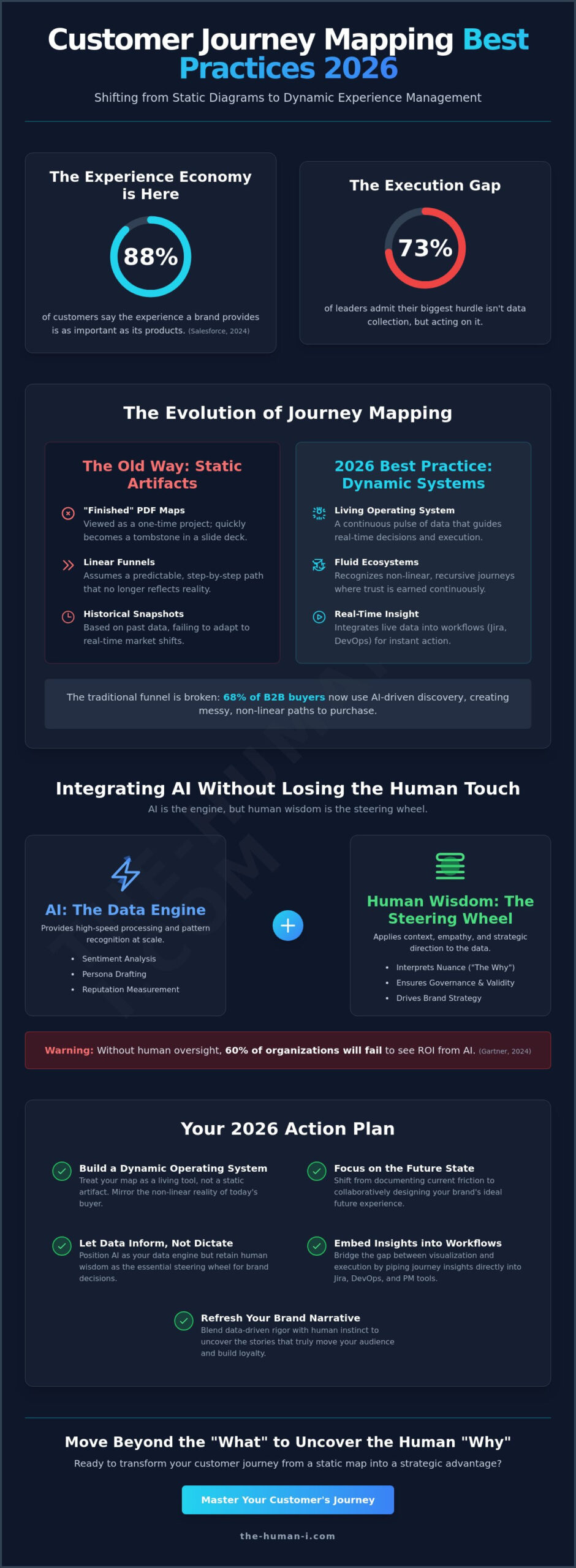
What if your customer journey map acted as a living GPS rather than a faded paper map from a decade ago? Most leaders realize that static diagrams often sit in decks doing nothing while 88% of customers now claim the experience a brand provides is just as important as its products, according to Salesforce’s 2024 research. You’ve likely felt the frustration of seeing customer data trapped in fragmented silos or buried under soulless AI reports. By adopting customer journey mapping best practices 2026, you’ll bridge the gap between raw data and the strategic insight and wisdom needed to guide a brand forward.
It’s a common struggle to turn a drawing into a decision, but you shouldn’t have to guess where your audience is headed. This article promises to help you master the shift from static diagrams to dynamic experience management with strategies built for the next two years. We’ll explore a framework that aligns your brand strategy with customer experience to ensure every touchpoint has a measurable impact on your reputation. You’re about to move beyond the “what” of customer behavior to uncover the human “why” that drives long-term loyalty.
Key Takeaways
- Stop viewing maps as static artifacts and learn to build a dynamic operating system that mirrors the unpredictable, non-linear reality of the 2026 buyer.
- Position AI as your high-speed data engine while retaining human wisdom as the essential steering wheel for every strategic brand decision.
- Implement customer journey mapping best practices 2026 by shifting focus from merely documenting current friction to a collaborative vision of your brand’s future state.
- Bridge the gap between visualization and execution by embedding real-time journey insights directly into your Jira, DevOps, and performance management workflows.
- Refresh your brand’s narrative by blending data-driven rigor with the deep human instinct required to uncover the stories that truly move your audience.
Why Static Journey Maps Are Obsolete in 2026
The PDF your team printed two years ago isn’t a strategy; it’s a tombstone. By early 2026, the concept of a “finished” map has vanished from the corporate lexicon. We’ve transitioned toward Dynamic Journey Mapping, which functions as a living management operating system rather than a static visual. This shift is central to customer journey mapping best practices 2026, as it treats data as a continuous pulse rather than a historical snapshot. Most organizations fail because they treat customer journey mapping (CJM) as an artifact to be admired rather than a living tool for execution.
By early 2026, research suggests that 73% of enterprise leaders admit their biggest hurdle isn’t data collection, but the lack of accountability in acting on it. When a map stalls, it’s usually because no one owns the transition from raw data to actionable wisdom. We don’t need more decorative charts. We need the collective intelligence to turn observations into brand-shifting movements. The goal is to move beyond the “what” of customer behavior to the “why” that drives long-term loyalty.
The Shift from Funnels to Fluid Ecosystems
The traditional linear funnel died when AI-driven discovery became the primary entry point for 68% of B2B buyers. Modern journeys are messy, recursive, and heavily influenced by peer-to-peer trust networks that exist outside your brand’s direct sight. The Circular Journey model defines a path where every interaction is a continuous loop of discovery, evaluation, and advocacy rather than a terminal end point. In this ecosystem, trust isn’t built at the bottom of a funnel; it’s earned through every non-linear rotation.
Identifying High-Impact Micro-Moments
Not all touchpoints carry equal weight. Routine interactions are background noise; whereas “moments of truth” are the high-stakes friction points that either cement loyalty or trigger brand stagnation. Identifying these requires a deep dive into the narratives that drive human behavior. At Human Instinct, we specialize in identifying new narratives that uncover these hidden opportunities. These micro-moments are where customer journey mapping best practices 2026 focus their energy, ensuring every strategic pivot is backed by profound human insight rather than just surface-level metrics.
Integrating AI Without Losing the Human Touch
Think of AI as a high-performance data engine. It’s powerful, fast, and capable of processing massive loads. However, an engine without a steering wheel is just a dangerous liability. In the context of customer journey mapping best practices 2026, human wisdom serves as that steering wheel. We don’t use AI to replace the strategist; we use it to liberate them from the mundane.
By 2026, the novelty of automated speed has faded. A 2024 Gartner study predicted that 60% of organizations would fail to see ROI from AI due to a lack of human-centric oversight. This failure stems from prioritizing velocity over validity. Customers can sense when a journey is designed by an algorithm alone. It feels sterile. It lacks empathy. Trust now determines value more than speed. People don’t just want an answer in two seconds; they want an answer they can rely on from a brand that understands their specific context.
Human instinct interprets the nuances that code misses. It identifies the “why” behind the “what.” While an AI can flag a drop-off point in a digital funnel, it can’t always feel the frustration of a confusing interface or the subtle shift in brand perception. We focus on a synthesis where data informs, but human insight decides.
Generative AI as a Research Accelerator
Generative AI has transformed from a gimmick into a legitimate research accelerator. It allows us to draft initial customer personas in minutes rather than weeks. By feeding localized sentiment data into specialized models, we can uncover patterns in how different demographics perceive value. This isn’t about letting the machine write the strategy. It’s about using it to clear the brush so we can see the path.
- Human-in-the-loop: Every AI output requires a “sanity check” to ensure governance and accuracy.
- Sentiment Analysis: AI excels at scanning thousands of reviews to find the emotional “temperature” of a touchpoint.
- Reputation Measurement: We use AI to track real-time shifts in brand trust, providing a critical input for journey adjustments.
This acceleration gives us more time to focus on strategic storytelling and deep expertise that truly differentiates a brand.
Safeguarding Human Wisdom in Data Synthesis
Data alone is often “ailing.” It’s a collection of facts that lacks a soul. To move from data to wisdom, we apply a triad: insight, data, and wisdom. This structure ensures that every data point serves a larger strategic narrative. We don’t just look for patterns; we find meaning.
As the legendary chef Ferran Adria once said, “With creativity, it’s not what you look for that’s important but what you find.” This philosophy is central to customer journey mapping best practices 2026. If you only look for what the data tells you to find, you’ll miss the unexpected opportunities. Human wisdom allows us to pivot when the data is technically correct but strategically “off.” We use storytelling to bridge the gap between a spreadsheet and a lived customer experience, ensuring the journey feels like a conversation, not a transaction.
2026 Best Practices for Mapping Non-Linear Realities
Static maps are dead. In 2026, leading firms treat journey maps as living software, not PDF artifacts. One of the most critical customer journey mapping best practices 2026 involves shifting from siloed CX workshops to radical cross-functional accountability. When 68% of customers expect consistent interactions across every department, according to 2024 industry benchmarks, a map trapped in the marketing department is a strategic liability. Insight must be shared across product, IT, and sales to be effective.
Stop obsessing over “Current Friction” alone. While fixing pain points is necessary, it’s a defensive posture. Strategic leaders now map the “Future State” to define how they want customers to feel, rather than just reacting to complaints. This requires real-time data plumbing. Instead of relying on survey snapshots that are 90 days old, 2026 winners use streaming data to update journey visualizations every 24 hours. This ensures maps are:
- Accessible: Available via centralized dashboards for every employee.
- Accountable: Tied to specific KPIs owned by diverse department heads.
- Dynamic: Reflecting shifts in behavior as they happen, not months later.
By integrating customer journey mapping best practices 2026, businesses move from reactive troubleshooting to proactive wisdom. It’s about seeing the “why” behind the “what” in real time.
Prioritizing High-Emotion Trust Signals
Trust isn’t built in a checkout flow; it’s forged in the “invisible” moments. These are the beats where a brand chooses transparency over profit. Mapping these signals requires a deep understanding of brand strategy. If your strategy promises “humanity” but your journey relies on rigid, unhelpful bots, you’ve failed the trust test. In 2026, 72% of consumers say they will abandon a brand after one “soulless” automated experience. Use your map to identify where empathy is non-negotiable.
Cross-Channel Consistency as a Brand Pillar
Turning Maps into Momentum: A Strategic Framework
A static journey map is a museum piece. An integrated roadmap is a catalyst. Moving from visualization to execution requires a shift in how we handle insight. By 2026, the most effective teams won’t just look at maps; they’ll live inside them. This transition demands a move from fixing minor friction points to refining the core brand experience. While 68% of CX initiatives struggled to show clear ROI in 2024, the leaders in 2026 use data plumbing to turn abstract insights into operational reality.
Adhering to customer journey mapping best practices 2026 means treating the map as a live data stream. It’s about moving beyond the “what” and “where” to the “why” and “how.” This requires a narrative that resonates with stakeholders, turning data into a story that compels action. If your map doesn’t trigger a change in behavior or budget, it isn’t working.
Building an Operating System for CX
The “connective tissue” between analytics and delivery is often missing. To bridge this gap, journey insights must flow directly into Jira, Azure DevOps, or your preferred project management stack. When a pain point is identified, it should automatically generate a ticket. This creates a closed-loop system where experience design isn’t a separate department, but a fundamental part of the development cycle. These customer journey mapping best practices 2026 ensure that every touchpoint reflects a deliberate brand choice.
To implement the technical infrastructure required for these closed-loop systems, many organizations turn to The Palm Group. As a performance-focused digital agency, they specialize in building digital communication systems that are specifically optimized to drive business revenue through every customer interaction.
- Stop doing the low-value: Use journey data to identify features that 45% of your users never touch. Reallocate those resources.
- Integrate performance metrics: Link journey stages to specific uptime or latency targets in your DevOps pipeline.
- Refine brand experience: Move past “fixing bugs” to “shaping moments” that define your brand’s unique value.
To see how we help organizations build these frameworks, explore Our Solutions for deeper strategic alignment.
Measuring Success Beyond NPS
Traditional metrics like NPS often fail because they are lagging indicators. They tell you how a customer felt last month, not how they’ll behave tomorrow. By 2026, the focus shifts to “Reputation Measurement” and “Engagement Impact.” These metrics track the strength of the relationship, not just the outcome of a single transaction. A 2024 study showed that brands focusing on emotional engagement saw a 23% increase in lifetime value compared to those focusing solely on satisfaction scores.
Wisdom-led KPIs prioritize the long-term health of the customer relationship over short-term conversion spikes. This approach allows brands to uncover the “why” behind the data, leading to more profound strategic shifts. Instead of just measuring if a customer stayed, measure if they would defend your brand in a crisis.
Ready to move beyond surface-level metrics? Contact our experts to transform your customer insights into a strategic advantage.
Reframing Your Customer Story with Human Instinct
Data is a commodity. By 2026, the average enterprise will manage over 1,000 terabytes of customer data, according to IDC projections. Yet, most brands are drowning in numbers while starving for meaning. This is where Human Instinct intervenes. We don’t just map touchpoints; we uncover the underlying human narrative that drives loyalty. Adopting customer journey mapping best practices 2026 requires more than a software subscription. It demands a shift from passive observation to active discovery.
As Ferran Adria famously noted, it’s not what you look for that matters, but what you find. We help you find the strategic “why” behind the “what.” Our role is to act as a seasoned mentor, guiding you through the noise of big data toward the clarity of profound insight. We believe that a map is only as good as the wisdom used to interpret it.
Our Approach: Insight, Data, and Wisdom
Our methodology is built on a specific triad: insight, data, and wisdom. We’ve applied this framework across complex sectors like Financial Services, Technology, and Healthcare. In these high-stakes environments, a 1% shift in customer retention often translates to significant revenue gains, as seen in 2023 industry benchmarks. Our senior team brings a wealth of experience across storytelling and brand planning to every project. This ensures your strategy isn’t just theoretically sound but practically transformative. You can learn more about our team’s background on our About page.
Start Your Journey Refresh
Stop treating your customer journey as a static diagram. It’s a living story. Choosing a strategic partner rather than a transactional vendor is the most critical of the customer journey mapping best practices 2026. We work as an extension of your team to refresh stagnant brands and identify untapped audiences. Human-centric mapping isn’t about tracking clicks; it’s about understanding the pulse of your market. We help you move beyond the “how” of the transaction to the “how” of the relationship.
Move from looking for data to finding your strategy. Let’s build a journey that resonates with the core of human instinct. Reach out to us through our Contact page to start the conversation and refresh your brand story for the years ahead.
Mastering the Shift from Data to Wisdom
The era of the static, linear journey map has passed. Gartner predicts that by 2026, 60% of organizations will transition to real-time journey orchestration to keep up with non-linear customer realities. You’ve seen how success requires balancing AI efficiency with the irreplaceable nuance of human storytelling. Mastering customer journey mapping best practices 2026 means moving beyond the “what” to understand the “why” behind every interaction. It’s about turning a simple flowchart into a powerful strategic advantage.
At Human Instinct, we apply a senior-led approach to help you find the profound truths hidden in your analytics. Our team brings deep expertise across three core sectors: Financial Services, Tech, and Health. We help you bridge the gap between cold metrics and meaningful connection using our unique triad of insight, data, and wisdom. This ensures your strategy doesn’t just sit on a shelf; it refreshes stagnant brands and uncovers new audiences through senior-led strategic storytelling. Discover how Human Instinct can refresh your brand journey. Your customers are ready for a story that feels like it was written just for them.
Frequently Asked Questions
What is the biggest change in customer journey mapping for 2026?
The biggest shift in 2026 is the transition from static, historical documents to dynamic, predictive journey orchestration. Forrester research indicates that by 2026, 75% of enterprises will prioritize real-time data over traditional annual surveys. This evolution allows brands to anticipate needs before the customer even articulates them. It’s no longer about looking back at what happened; it’s about using wisdom to shape what happens next for every individual user.
How does AI impact the accuracy of customer journey maps?
AI increases mapping accuracy by synthesizing unstructured data from thousands of touchpoints instantly. According to a 2025 McKinsey report, AI-driven insights improve journey prediction accuracy by 40%. It removes human bias and uncovers hidden friction points that manual audits often miss. You’re not guessing where the customer struggles; you’re seeing the evidence in high definition, allowing for a level of precision that was impossible just three years ago.
Is journey mapping still relevant for B2B companies in 2026?
Journey mapping remains vital for B2B firms because the average buying committee has grown to 11 stakeholders in 2026. Mapping helps navigate these multi-layered relationships and long sales cycles. It ensures your strategy resonates with the technical buyer and the C-suite executive simultaneously. Without a map, you’re likely losing 25% of potential revenue to no-decision outcomes. It’s about aligning the entire ecosystem around the client’s success.
What is the difference between a journey map and a buyer funnel?
A buyer funnel is a rigid, internal tool designed to track sales conversions. A journey map is a fluid, external perspective that captures the human experience. Funnels assume a straight line, but 80% of customers now loop back through research phases before purchasing. Maps acknowledge these detours and focus on building long-term brand wisdom rather than just closing a single transaction. They reveal the emotional peaks and valleys a funnel ignores.
How often should a business refresh its customer journey map?
You should refresh your journey maps quarterly to stay aligned with rapid technological shifts. A map created in January is often 50% inaccurate by July due to changing platform algorithms and consumer sentiment. Treat your map as a living organism. Regular audits ensure your team isn’t working from outdated assumptions that lead to stagnant brand performance. Continuous refinement is the new standard for maintaining a competitive edge.
How do you measure the ROI of journey mapping services?
Measure ROI by tracking a 15% to 20% improvement in retention rates and a decrease in customer acquisition costs. Effective journey mapping identifies exactly where resources are wasted on ineffective touchpoints. By reallocating that budget, companies often see a 3x return on their initial mapping investment within the first 12 months. It’s a strategic move that turns raw insight into tangible profit and long-term business health.
What are the essential components of a 2026 journey map?
The essential components of customer journey mapping best practices 2026 include real-time behavioral data, sentiment analysis, and cross-platform attribution. You need to look beyond simple clicks to understand the why behind every action. High-performing maps now include moment of truth indicators that signal when a customer is most likely to churn or upgrade. This level of detail transforms a simple diagram into a powerful strategic engine for your brand.



