


You’ve invested the resources and meticulously analyzed the data. Yet, the customer segments delivered to your team feel more like an academic exercise than a strategic roadmap for growth. Marketing struggles to act on them, sales finds them confusing, and you’re left questioning the return on your investment. This frustrating disconnect is a common symptom of a project derailed by entirely preventable errors, turning valuable data into a static report.
Understanding the most critical market segmentation mistakes to avoid is where insight and strategy begin to merge. In this guide, we move beyond the obvious checklist errors to uncover the seven strategic pitfalls that can render your entire effort useless. You will learn how to sidestep these failures and build a robust framework that transforms customer data into compelling, actionable insights-empowering your teams, justifying the investment, and shaping a decisive competitive advantage.
Key Takeaways
-
Anchor your segmentation to a clear business objective to ensure it drives strategic growth rather than becoming a purely academic exercise.
-
Move beyond surface-level demographics to uncover the core motivations and behaviors that truly define your most valuable customer groups.
-
Discover why the most common market segmentation mistakes to avoid involve creating segments that are statistically sound but commercially unviable or impossible to activate.
-
Learn to treat segmentation as a dynamic, ongoing process-not a one-time project-to keep your insights sharp and responsive to market changes.
Table of Contents
-
Strategic Mistake #1: Starting Without a Clear Business Objective
-
Lifecycle Mistake #5: Treating Segmentation as a One-Time Project
Strategic Mistake #1: Starting Without a Clear Business Objective
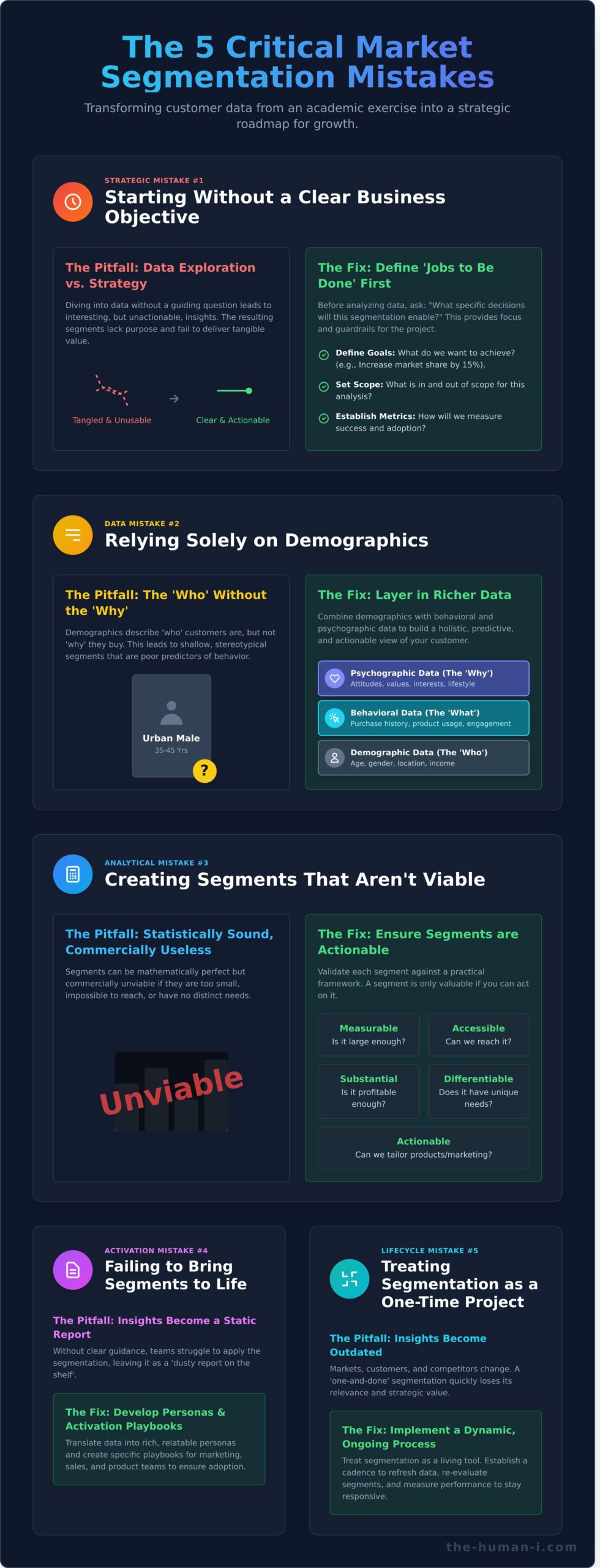
The most fundamental of all market segmentation mistakes to avoid is embarking on the project without a clearly defined business objective. Too often, teams treat segmentation as an end in itself-a fascinating data-driven exercise to see what patterns emerge. While intellectually stimulating, this approach almost always leads to insights that are interesting but ultimately unactionable. True market segmentation is not an academic pursuit; it is a strategic tool designed to empower specific business decisions. Without a commercial ‘why’ guiding the process, the resulting segments lack purpose and fail to deliver tangible value, becoming little more than a report that gathers dust.
The Pitfall: Confusing Data Exploration with Strategy
Diving into customer data without a guiding question is data exploration, not strategy. You will undoubtedly uncover correlations and patterns, but they won’t be tethered to a commercial outcome. Your objective dictates the entire methodology, from the variables you analyze to the clustering techniques you employ. For instance, a goal to ‘identify new growth markets’ requires a focus on unmet needs and lookalike audiences, whereas a goal to ‘improve customer retention’ demands an analysis of churn predictors, usage behaviour, and loyalty drivers. Treating both with the same generic approach yields generic, unusable results.
The Fix: Define Your ‘Jobs to Be Done’ First
To avoid this common pitfall, begin by defining the ‘jobs’ your segmentation needs to do. Before a single data point is analyzed, gather key stakeholders from marketing, sales, product, and leadership to answer one critical question: What specific decisions will this segmentation enable us to make? The answers provide the necessary focus and guardrails for the project. Formalize this by creating a project charter that outlines clear, measurable goals.
-
Goals: What do we want to achieve? (e.g., Increase market share in the SMB sector by 15%).
-
Scope: What is in and out of scope for this analysis?
-
Success Metrics: How will we know if the segmentation is successful and adopted by the business?
This initial alignment is the single most important step in ensuring your segmentation provides genuine strategic wisdom, not just a collection of data points.
Data Mistake #2: Relying Solely on Demographics
Demographic data-age, location, income, gender-is often the first layer of any segmentation model because it’s readily available and easy to understand. However, treating it as the only layer is one of the most common market segmentation mistakes to avoid. Demographics can tell you who your customers are, but they provide almost no insight into why they buy. This fundamental gap leads to shallow, stereotypical segments that are poor predictors of future behavior and fail to drive meaningful strategy.
The Pitfall: The ’35-45 Year Old Urban Male’ Trap
Consider the classic segment: the ’35-45 year old urban male’. This group contains vastly different individuals. One could be a frugal-minded father of three who values durability, while another might be a single tech enthusiast who prioritizes innovation and brand prestige. By grouping them together, you are forced to create generic messaging that resonates deeply with no one. This approach completely misses the underlying motivations, needs, and values that actually drive choice, resulting in wasted marketing spend and missed opportunities.
The Fix: Layer in Behavioral and Psychographic Data
True insight comes from moving beyond surface-level traits and combining demographics with more powerful data types. This multi-dimensional view is where a static persona transforms into a dynamic, actionable customer segment. The goal is to build a holistic picture by integrating:
-
Behavioral Data: This is the data of action. It reveals what customers actually do, not just what they say. Examples include purchase history, website interaction, product feature usage, and customer service engagement.
-
Psychographic Data: This uncovers the internal drivers of behavior. It includes a customer’s attitudes, core values, interests, and lifestyle choices.
By layering these datasets, you can create needs-based segments that are far more predictive and strategically valuable. This isn’t a new concept; as argued in the pivotal Harvard Business Review article Rediscovering Market Segmentation, the most powerful segmentation informs everything from product innovation to pricing. Our consulting expertise lies in uncovering these deeper human truths, turning complex data into the wisdom that empowers decisive action.
Analytical Mistake #3: Creating Segments That Aren’t Viable
Data analysis can produce statistically perfect clusters that, in practice, are strategically useless. This occurs when the segmentation process becomes a purely academic exercise, detached from the realities of your business operations. Creating segments that you cannot reach, measure, or serve profitably is one of the most common market segmentation mistakes to avoid. The goal is not simply to find differences in the data, but to uncover meaningful groups that empower your strategy. The ultimate aim is to strike the optimal balance between analytical precision and commercial practicality.
The Pitfall: Segments Are Not Mutually Exclusive or Actionable
A non-viable segment model quickly falls apart upon implementation. The most common symptoms include customers who seem to fit into multiple segments, causing confusion and diluted messaging. You may also find you’ve over-segmented your market into groups so small that the ROI on a targeted campaign would be negligible. Perhaps the most frustrating outcome is defining a segment by criteria you can’t actually identify in the real world-like a customer’s private motivation-making it impossible to know who belongs to the group.
The Fix: Apply the ‘MECE’ and ‘DAMP’ Frameworks
To ensure your segments are built on a foundation of business reality, test them against proven strategic frameworks. Before finalizing any model, ensure your segments are MECE: Mutually Exclusive (each customer fits in only one segment) and Collectively Exhaustive (all customers are accounted for). This creates clarity and prevents overlap.
More importantly, every segment must pass the DAMP test to confirm its strategic value. A truly viable segment is:
-
Differentiable: Its needs are distinct from other segments, and it responds differently to marketing efforts.
-
Actionable: You have the resources and capability to create a targeted strategy to reach and serve it.
-
Measurable: You can determine its size, purchasing power, and other key characteristics.
-
Profitable: It is substantial enough to be worth targeting and can generate a positive return.
Testing your segments against these criteria ensures your analytical insight translates directly into commercial action. The final step is to build a clear plan for identifying and tagging these segments within your CRM, bridging the gap between data and day-to-day execution.
Activation Mistake #4: Failing to Bring Segments to Life
The segmentation research is complete. A 100-page slide deck filled with charts and statistical models lands on everyone’s desk. And then… nothing happens. This is where powerful insights go to die. Of all the market segmentation mistakes to avoid, this one is the most common, because it invalidates all the rigorous work that came before. If your teams cannot understand, visualize, and empathize with the segments, they will never use them, leaving the critical gap between research and business impact unbridged.
The Pitfall: The ‘Ivory Tower’ Segmentation Project
This failure often begins when research is conducted in isolation, without meaningful input from the front-line teams who interact with customers daily. The result is a deliverable that is purely quantitative-a collection of data points and percentages that lack human context or a compelling narrative. Without a clear plan for how sales, marketing, or product development will apply these insights, the expensive project becomes little more than an academic exercise.
The Fix: Build Rich Personas and an Activation Playbook
To breathe life into data, you must embrace storytelling. The key is to move beyond spreadsheets and develop rich, relatable personas that make the data feel human. Give each segment a memorable name, a face, and a narrative that details their goals, motivations, and daily challenges. This qualitative layer makes the segments tangible for your entire organization.
From there, create a dedicated Activation Playbook-a practical guide that empowers your teams to act. This playbook should clearly outline:
-
Core Messaging: What value proposition resonates most strongly with this segment?
-
Channel Strategy: Where do they spend their time and how can you best reach them?
-
Content Hooks: What topics and formats will capture their attention and address their pain points?
-
Success Metrics: How will you measure engagement and conversion for this specific group?
This is precisely how we turn deep insight into decisive action. Our solutions are designed to translate complex data into a clear, actionable strategy, ensuring your segmentation project drives tangible growth instead of gathering dust.
Lifecycle Mistake #5: Treating Segmentation as a One-Time Project
Markets are living ecosystems, not static photographs. Customer needs evolve, competitive landscapes shift, and new technologies create unforeseen opportunities. Perhaps the most fundamental of all market segmentation mistakes to avoid is believing that a model developed two or three years ago still holds true today. An initial segmentation project provides a powerful snapshot in time, but relying on that outdated picture leads to strategies built on obsolete assumptions.
The Pitfall: The ‘Set It and Forget It’ Mentality
When segmentation becomes a dusty report on a shelf, businesses inevitably misallocate resources. Marketing budgets are spent targeting segments that have shrunk, changed their core motivations, or even disappeared. More critically, new and lucrative segments that have emerged in the interim are completely overlooked. The result is a slow, almost imperceptible degradation of marketing effectiveness as messaging, product development, and customer experience become increasingly misaligned with reality.
The Fix: Implement a Monitoring and Refresh Cadence
The most successful brands treat segmentation not as a project, but as a continuous strategic discipline. This requires a commitment to monitoring the health and relevance of your segments over time. By establishing a clear cadence for review and refinement, you ensure your customer understanding remains a source of competitive advantage. Key actions include:
-
Track Key Metrics: Continuously monitor the size, value, and core behavioral data of each segment to spot significant shifts as they happen.
-
Conduct Qualitative Check-ins: Use interviews or focus groups to periodically validate that your personas’ needs, pains, and motivations are still accurate and emotionally resonant.
-
Schedule a Refresh Cycle: Plan for a minor model refresh annually to make small adjustments and a major overhaul every 2-3 years to reassess the entire framework from the ground up.
-
Build a Customer-Centric Culture: True success comes from empowering your entire organization with ongoing customer insight, shifting the focus from project completion to perpetual learning.
This principle of continuous vigilance is critical across all business functions. Just as market segments evolve, so do digital threats. For modern companies, this means complementing strategic monitoring with automated security testing from platforms like Penetrify to ensure web applications remain secure against new vulnerabilities.
Effective segmentation is a dynamic process of discovery, not a static declaration. By embedding this iterative approach into your strategic planning, you build a resilient, customer-obsessed organization poised for sustained growth. At Human Instinct, we help brands build the wisdom and processes needed to keep their customer understanding sharp and relevant.
Where Insight and Strategy Meet: Mastering Your Market Segmentation
Effective market segmentation is not a static report; it is a dynamic strategic asset. The crucial lesson is to move beyond superficial data, anchoring your strategy in clear business objectives and a deep, human-centric understanding of your audience. By navigating the common market segmentation mistakes to avoid, you can ensure your segments are not only analytically sound but commercially viable and actionable. True success lies in treating segmentation as a continuous journey of discovery, not a one-time project.
At Human Instinct, our expertise is where insight, data, and wisdom meet. We leverage a proven framework across both B2B and B2C sectors to transform raw data into actionable, human-centric strategies that bring your customer segments to life. We empower your team to turn insight into impact.
Ready to build a segmentation that drives real growth? Contact our experts for a strategic consultation. Let’s uncover the clarity and confidence your brand needs to thrive.
Frequently Asked Questions About Market Segmentation
What is the difference between market segmentation and creating buyer personas?
Market segmentation is the foundational, data-driven process of dividing a broad market into distinct, quantifiable groups based on shared needs, behaviours, or characteristics. It provides the strategic "what." Buyer personas are the storytelling layer built on top of that data; they create a relatable, semi-fictional character to represent a key segment. Segmentation provides the statistical insight, while personas provide the human context to make that insight actionable for creative and marketing teams.
How often should a company update its market segmentation?
A robust segmentation should be revisited every 2-3 years to maintain its strategic relevance. However, you should accelerate this timeline following significant market disruptions, such as the entry of a major competitor, a technological shift, or a fundamental change in consumer behaviour. The goal is to ensure your understanding of the customer landscape is a current, living tool for decision-making, not a static snapshot from the past. Wisdom lies in adapting to change.
Can you have too few market segments? What’s the ideal number?
Yes, having too few segments can render them too broad and strategically useless. While there is no universal "ideal" number, a typical and manageable range is between three and seven segments. This provides enough granularity to develop distinct value propositions and targeted strategies without becoming too complex to implement effectively. The right number empowers focus and allows for meaningful resource allocation across your most valuable customer groups, avoiding an overly simplistic view of the market.
How do you ensure market segments are statistically valid and not just arbitrary groupings?
Statistical validity is non-negotiable for effective segmentation. It is achieved through rigorous quantitative analysis, such as cluster analysis, performed on robust survey or behavioural data. This ensures segments are genuinely distinct and homogenous within themselves. Beyond the data, a segment must also be strategically viable: measurable, substantial enough to pursue, accessible through marketing channels, and, most importantly, actionable for your business. Without this dual statistical and strategic validation, segments remain arbitrary hypotheses.
What’s the first step to fixing a failed segmentation project we’ve already completed?
The first step is a diagnostic audit to uncover the root cause of the failure. You must determine if the issue was flawed data, segments that weren’t truly distinct or actionable, or a breakdown in implementation and internal adoption. This critical review will pinpoint the specific market segmentation mistakes to avoid in the future. Only by understanding why the initial strategy failed can you build a new framework that is insightful, credible, and aligned with your core business objectives.
For a practical look at how this is done, you can visit michelboutinstudio to see how executive consulting helps organizations rebuild and launch successful growth strategies.
How do you get buy-in from leadership and other departments for a segmentation project?
Secure buy-in by framing the project around tangible business outcomes, not just research methodology. Involve key stakeholders from leadership, sales, and marketing from the outset to co-create objectives. Demonstrate how the resulting insights will directly empower their teams to make smarter decisions, drive growth, and enhance ROI. Present a clear business case that connects the segmentation strategy to competitive advantage and a deeper, more profitable understanding of your customers.



