


Does your brand feel inconsistent, struggling to stand out in a crowded market? Many businesses invest in beautiful logos and clever taglines, only to see their efforts fail to deliver tangible business results. This disconnect often stems from a common confusion: mistaking the appearance of a brand for its soul. If this resonates, it’s likely because the foundational element is missing: a clear, purposeful brand strategy.
The true engine of an enduring brand is this strategic core-the blueprint that gives your identity meaning and your business direction. In this guide, we move beyond the surface to uncover what a brand strategy truly is and why it’s your most valuable business asset. We will provide an actionable framework to help you build a strategy that clarifies your purpose, differentiates your position, and drives measurable growth. Prepare to transform your brand from a collection of assets into a powerful, cohesive force.
Key Takeaways
-
Move beyond logos and taglines by understanding how brand strategy functions as your core business blueprint, guiding long-term perception and growth.
-
Uncover the framework for transforming customer data and market insights into a coherent brand strategy that is discovered, not invented.
-
Identify the essential pillars every robust strategy must contain and learn how to embed them within your company culture for consistent execution.
-
Learn to measure true brand equity by connecting your strategic efforts to key business performance indicators (KPIs) that demonstrate real-world impact.
Table of Contents
-
Beyond the Logo: Defining Brand Strategy as Your Core Business Blueprint
-
The Human Instinct Framework: From Insight to Actionable Strategy
-
Measuring Brand Health: How to Know if Your Strategy is Working
Beyond the Logo: Defining Brand Strategy as Your Core Business Blueprint
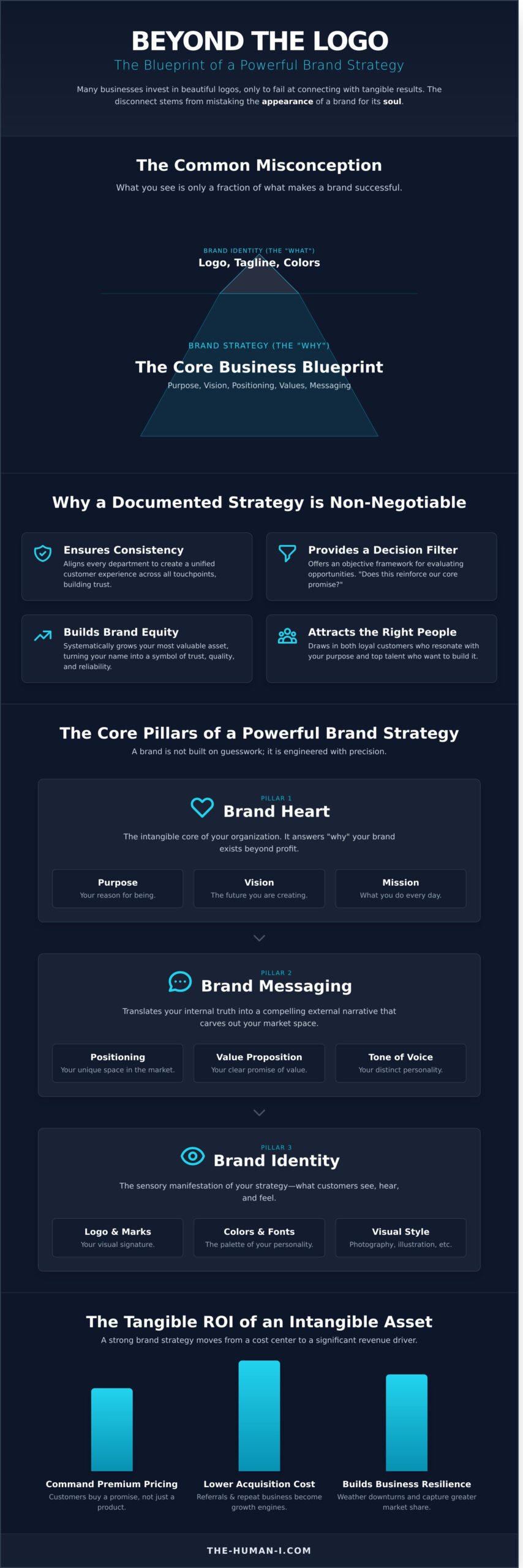
Many leaders mistake a compelling logo and a sharp color palette for a brand. While these elements form your brand identity-the tangible assets your audience sees-they are merely expressions of a much deeper discipline: your brand strategy. This is the long-term, deliberate plan for how you want your company to be perceived in the minds of customers, employees, and stakeholders. It’s the foundational ‘why’ that gives substance and direction to the visual ‘what’.
Think of it less as a marketing initiative and more as the central nervous system of your entire operation. A robust brand strategy informs every critical decision, from the features you prioritize in product development and the partners you align with, to the tone of a customer service email. It provides the guiding principles that empower your teams to act cohesively, ensuring every part of the business works in concert to build a specific, desired perception in the market.
Why a Documented Strategy is Non-Negotiable
Without a documented blueprint, a brand is left to interpretation, leading to inconsistency and diluted impact. A formal strategy is non-negotiable because it serves several critical functions:
-
Ensures Consistency: It aligns every department, from sales to HR, creating a unified customer experience across all touchpoints. This consistency is a cornerstone of effective Brand management.
-
Provides a Decision Filter: It offers an objective framework for evaluating opportunities. Does this new product line reinforce our core promise? If not, the strategy provides a clear reason to decline.
-
Builds Brand Equity: It systematically grows your most valuable intangible asset, turning your name into a symbol of trust, quality, and reliability.
-
Attracts the Right People: It draws in not only loyal customers who resonate with your purpose but also top talent who want to be part of building it.
The Tangible ROI of an Intangible Asset
While strategy feels abstract, its financial impact is profoundly concrete. A powerful brand, built on a clear strategy, moves from being a cost center to a significant revenue driver. Well-positioned brands can command premium pricing because customers aren’t just buying a product; they are buying a promise. This loyalty translates directly to a lower customer acquisition cost, as referrals and repeat business become primary growth engines. Ultimately, this strategic foundation builds resilience, allowing your business to not only weather economic downturns but also capture greater market share.
The Core Pillars of a Powerful Brand Strategy
A powerful brand is not built on guesswork; it is engineered with precision. At its foundation lies a set of core pillars that define its existence, articulate its value, and shape its expression. These foundational elements are the ‘what’ of your strategy-the immutable truths that guide every decision. They are deeply interconnected, building upon one another to move your brand from an internal set of beliefs to a tangible external presence that resonates with your audience.
Pillar 1: Brand Heart
The Brand Heart is the intangible core of your organization. It answers the fundamental question of "why" your brand exists and what it ultimately seeks to achieve. This internal compass provides direction and purpose, ensuring that growth is always aligned with a deeper meaning. It comprises:
-
Purpose: Your reason for being, beyond generating profit. It’s the impact you want to have on the world.
-
Vision: The future you are working to create. This is your long-term, aspirational goal.
-
Mission: What you do every day to make your vision a reality. It’s your strategic plan in action.
Pillar 2: Brand Messaging
Once the Brand Heart is defined, Brand Messaging translates that internal truth into a compelling external narrative. This is how you articulate your value and carve out a distinct space in the minds of your customers. Crafting this language requires a deep understanding of your audience and market, a topic frequently explored by publications like The Branding Journal. The key components include:
-
Positioning: Your unique, defensible space in the market relative to competitors.
-
Value Proposition: The clear, concise promise of value you deliver to your customers.
-
Tone of Voice: The distinct personality of your brand as expressed through words, which shapes how your audience feels.
Pillar 3: Brand Identity
Brand Identity is the sensory manifestation of your strategy-what customers see, hear, and feel. It transforms abstract concepts from your Heart and Messaging into tangible assets that create recognition and connection. A complete brand strategy ensures this identity is consistent across every touchpoint, from your logo to your customer service interactions. It is composed of:
-
Visual Identity: The collection of visual elements-logo, color palette, typography-that express your brand’s personality.
-
Experiential Identity: The cumulative experience a customer has with your brand across all touchpoints, shaping their perception and loyalty.
The Human Instinct Framework: From Insight to Actionable Strategy
An impactful brand strategy isn’t invented in a boardroom; it’s uncovered through rigorous inquiry. The most resilient and resonant brands are built on a foundation of truth, not assumptions. Our approach is a disciplined journey from scattered data points to profound wisdom, ensuring every strategic decision is rooted in the tangible reality of your market, your customers, and your organization. This process of discovery transforms strategy from a creative exercise into a powerful tool that de-risks major business investments and provides a clear, confident path forward.
Phase 1: Deep-Dive Discovery & Data Analysis
The first step is a comprehensive immersion into your world. We move beyond surface-level information to build a complete picture, gathering both quantitative and qualitative data to understand the complete landscape. This foundational phase involves:
-
Comprehensive Audits: A thorough review of your brand’s current performance, competitor positioning, and the wider market dynamics.
-
Human-Centric Research: Conducting in-depth stakeholder interviews and customer research to uncover motivations, behaviors, and unspoken needs.
-
Pattern Recognition: Identifying the critical patterns, cultural tensions, and unique opportunities that exist just below the surface.
Phase 2: Synthesizing Insight & Uncovering ‘The Big Idea’
Data is simply the raw material. The real value emerges when we translate what the data says into what it truly means for your business. In this collaborative phase, we facilitate workshops to align key teams around core insights. Together, we distill the complexity into a single, compelling truth-the central narrative or ‘Big Idea’ that will anchor your brand and galvanize your entire organization. See how our insight process transforms businesses.
Phase 3: Codifying the Strategy into a Usable Blueprint
An idea only becomes powerful when it’s made actionable. We codify the synthesized insights into a clear and practical blueprint. This document translates the central narrative into the core pillars of your brand strategy, including your purpose, positioning, personality, and key messaging. We develop clear guidelines and frameworks to ensure the strategy can be understood, embraced, and consistently implemented across every touchpoint of the organization, empowering your teams to bring the brand to life.
Bringing Your Strategy to Life: Activation and Governance
A meticulously crafted brand strategy is a powerful blueprint, but its true value is only realised through deliberate, intelligent action. The transition from concept to reality is where many brands falter, leaving valuable insight gathering dust on a shelf. Activation is the process of embedding your strategy into the very DNA of your organisation-shaping culture, guiding behaviour, and informing every decision. Simultaneously, governance provides the essential framework to protect its integrity and ensure consistency over time. This dual focus transforms a document into a living entity that drives growth.
Internal Launch: Winning Over Your Team First
The most resonant and successful brand activations begin from the inside out. Before you communicate your new direction to the world, you must first inspire and empower your own team. A thoughtful internal launch ensures every employee, from the C-suite to the front line, understands the ‘why’ behind the strategy and their specific role in delivering on its promise. By integrating core brand principles into onboarding, training programmes, and performance metrics, you equip your people to become your most credible and passionate brand ambassadors, capable of articulating your value with authenticity.
External Rollout: A Coordinated Approach
With internal alignment secured, the external rollout requires a coordinated and phased approach. This is far more than unveiling a new logo; it is a strategic demonstration of your brand promise across every customer touchpoint. The process involves a systematic and prioritised update of all assets-from your website and digital marketing channels to sales collateral, customer service scripts, and physical environments. Each interaction must be carefully orchestrated to ensure customers experience a consistent and compelling narrative that reinforces your unique position in the market.
Establishing Brand Governance
To safeguard your brand’s long-term health and consistency amidst market shifts and organisational growth, a robust governance system is non-negotiable. This framework provides the clear tools and defined processes to manage your brand effectively. Key components include:
-
Comprehensive Brand Guidelines: A central, accessible source of truth for visual identity, tone of voice, and messaging pillars.
-
Brand Champions: Appointing and empowering advocates within different departments to guide implementation and ensure compliance.
-
Regular Brand Audits: A structured process for reviewing brand health, tracking key metrics, and assessing performance against strategic goals.
This disciplined approach turns your initial brand strategy into a tangible competitive advantage. For a deeper understanding of how to activate and govern your brand, explore our strategic solutions.
Measuring Brand Health: How to Know if Your Strategy is Working
A successful brand strategy doesn’t exist in a vacuum; it drives tangible business results. To prove its value and guide future investment, you must move beyond vanity metrics and track the key performance indicators (KPIs) that truly reflect brand equity. The most effective approach uses a balanced scorecard, combining insight into what people think and feel about your brand with hard data on how their behaviour impacts business performance. This provides the wisdom to justify brand investment to any stakeholder.
Perception Metrics: What People Think and Feel
These qualitative metrics uncover the "why" behind customer behaviour, gauging your brand’s resonance and emotional connection within the market. Key indicators include:
-
Brand Awareness & Recall: Assessed through surveys and search volume analysis, this shows if you are top-of-mind when a customer has a need.
-
Brand Sentiment Analysis: Using social listening tools, this tracks the tone of online conversations-positive, negative, or neutral-surrounding your brand.
-
Net Promoter Score (NPS): A direct and powerful measure of customer loyalty, revealing how likely your customers are to recommend you to others.
Performance Metrics: How the Business Responds
These quantitative metrics connect brand health directly to financial outcomes and market position, proving that a strong brand is a commercial asset. Look for movement in:
-
Customer Lifetime Value (CLV): A strong brand fosters loyalty, leading to repeat purchases and a higher CLV. Are your customers staying longer and spending more?
-
Price Premium: The ability to command a higher price than competitors for a similar offering. This is a powerful indicator of superior perceived brand value.
-
Market Share & Category Ownership: As brand preference grows, so should your slice of the market, demonstrating clear leadership and authority in your category.
By continuously monitoring this blend of perception and performance data, you create a feedback loop that informs and refines your ongoing brand strategy. This holistic view provides the insight needed to make confident decisions and demonstrate a clear return on investment. Need help measuring your brand’s impact? Let’s talk.
From Blueprint to Legacy: Your Brand’s Enduring Future
As we’ve explored, building an enduring brand goes far beyond a logo or a tagline. It begins with a deep understanding of your core purpose and is brought to life through a disciplined framework that connects human insight to measurable business outcomes. Ultimately, a powerful brand strategy is a living blueprint-one that must be consistently activated, governed, and measured to ensure lasting relevance and growth.
Translating these principles into action requires a unique blend of expertise. At Human Instinct, we build the strategic foundation for your brand’s growth using our proven framework that turns data into actionable strategy. With deep experience across both B2B and B2C sectors, we are ready to help you shape your legacy. Discover how Human Instinct uses insight, data, and wisdom to build enduring brands. The journey to building an iconic brand starts today.
Frequently Asked Questions
What’s the difference between brand strategy, brand identity, and branding?
These terms are related but distinct. Brand strategy is the foundational plan-the "why" behind your brand, defining its purpose, audience, and market position. Brand identity is the tangible sensory expression of that strategy, such as your logo, color palette, and tone of voice. Branding is the ongoing action of applying your identity across all touchpoints to shape public perception and build recognition.
How long does it take to develop a brand strategy?
A comprehensive brand strategy project typically takes between 6 and 12 weeks. This timeline accommodates crucial phases like market research, competitive analysis, stakeholder interviews, and strategic development workshops. The final duration depends on the organization’s complexity, the depth of research required, and the efficiency of collaboration and feedback loops between the client and the strategy team.
Can a small business have a brand strategy, or is it just for large corporations?
A brand strategy is essential for businesses of all sizes. For a small business, it provides a critical framework for focus, differentiation, and consistent decision-making. It ensures that limited resources are invested effectively to attract the right customers and build a memorable presence. While the scale of implementation may differ, the foundational principles are universally vital for sustainable growth and competitive advantage.
How much does a professional brand strategy cost?
The investment for a professional brand strategy varies widely based on scope and provider. A foundational project with a boutique agency or consultant may range from $10,000 to $25,000. More in-depth engagements for larger organizations, involving extensive research and global considerations, can cost upwards of $50,000 to $100,000+. The price reflects the depth of insight and strategic rigor involved.
How often should a company revisit or refresh its brand strategy?
A brand strategy should be a living document. We recommend a light annual review to ensure alignment with current business objectives. A more significant refresh is typically warranted every 3 to 5 years, or in response to major market shifts, new competitive threats, or a fundamental change in your business model. This ensures your brand remains relevant, resonant, and effective in achieving its goals.
What is included in a final brand strategy document or deliverable?
A final brand strategy document is a comprehensive blueprint for your brand. Key components typically include a defined mission, vision, and core values; detailed target audience personas; a competitive landscape analysis; and a unique brand positioning statement. It will also articulate your brand personality, tone of voice, and core messaging pillars, providing a clear guide for all future marketing and communication efforts.



