


Does the task of mapping your customer’s journey feel more like a complex puzzle than a clear strategic tool? Many leaders see the profound value in walking in their customers’ shoes, yet hesitate, daunted by the path ahead. The fear is common: investing significant effort only to produce a beautiful chart that fails to inspire action. This is the critical challenge of the customer experience mapping process-transforming a theoretical exercise into a source of tangible business wisdom and measurable growth.
This guide is designed to bridge that gap between data and decisive action. We will demystify the entire journey, providing a strategic five-step framework that moves beyond simple observation to uncover profound customer insight. You will learn not only how to gather the right data, but how to shape it into a compelling story that highlights critical moments of friction and opportunity. By the end, you will have the confidence and the methodology to create a truly actionable map and the strategic narrative to secure enthusiastic buy-in from any stakeholder.
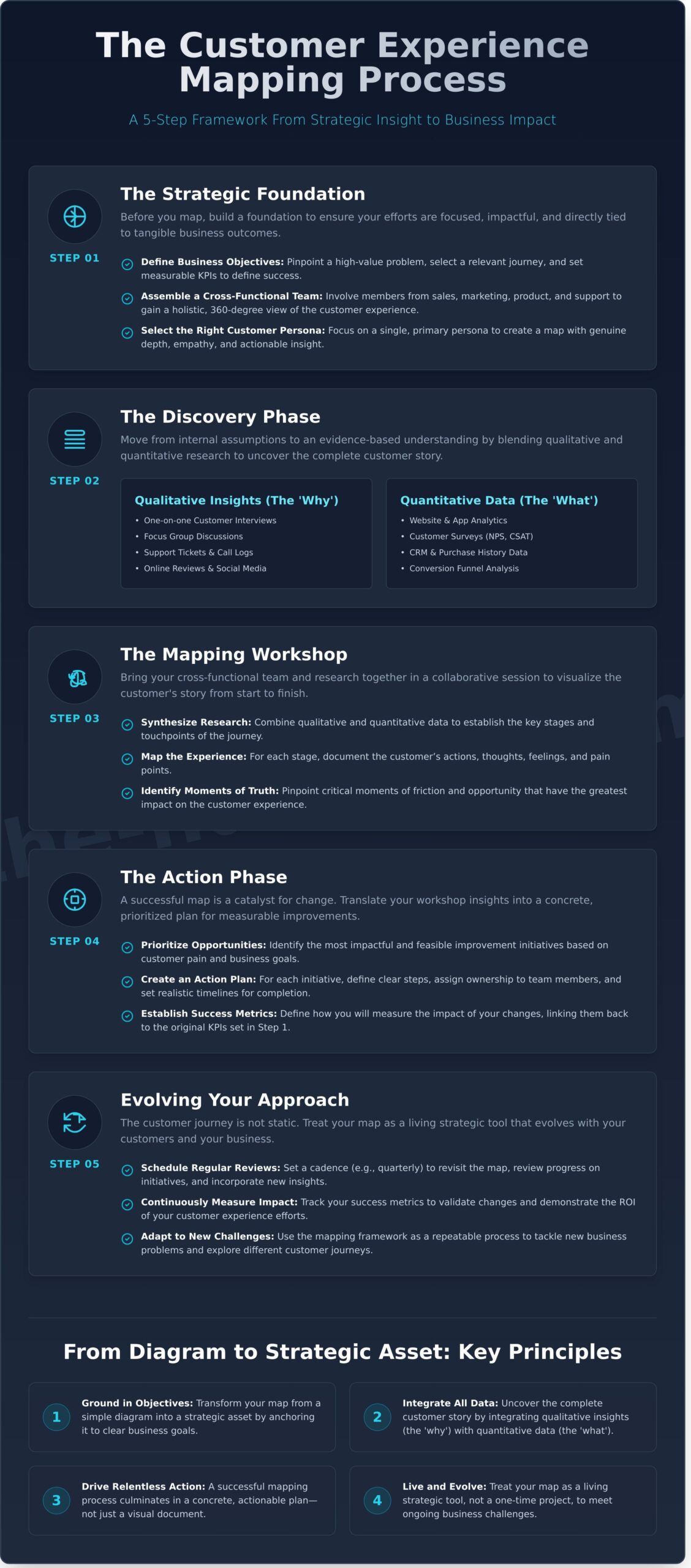
Key Takeaways
- Ground your initiative in clear business objectives to transform your map from a simple diagram into a strategic asset.
- Uncover the complete customer story by integrating qualitative insights (the ‘why’) with quantitative data (the ‘what’).
- A successful customer experience mapping process culminates in an actionable plan, not just a visual document. Learn to translate workshop insights into concrete improvements.
- Treat your map as a living strategic tool, not a one-time project, by evolving your approach to meet ongoing business challenges.
Step 1: The Strategic Foundation – Before You Map
A successful customer journey map is far more than a visually appealing diagram; it is a strategic tool born from clear intent. Before you open a template or draw a single line, laying a robust strategic foundation is the most critical phase of the entire customer experience mapping process. This initial step ensures your efforts are focused, impactful, and directly tied to tangible business outcomes, transforming a simple visual exercise into a catalyst for meaningful change.
Define Your Business Objectives and Scope
Every powerful map begins with a specific destination. Instead of attempting to map every possible interaction, anchor your initiative to a clear business problem you aim to solve. This focus provides direction and makes success measurable. Start by asking what challenge needs addressing-is it high customer churn, a complex onboarding process, or low feature adoption? From there, define the precise scope to keep your project manageable.
- Identify the Problem: Pinpoint a specific, high-value issue, such as high cart abandonment rates or low trial-to-paid conversions.
- Choose a Journey: Select a single customer journey that directly impacts this problem, like the initial purchase or the first-week onboarding experience.
- Set Clear Goals: Define what success will look like with measurable KPIs (e.g., “reduce support tickets by 15% in the first 30 days”).
- Define the Scope: Specify which customer segments and channels are included to maintain focus.
Assemble Your Cross-Functional Team
Customer experience is the cumulative result of interactions across multiple touchpoints, not the responsibility of a single department. To truly understand the multifaceted nature of Customer Experience, you must assemble a team with diverse perspectives. Involving members from sales, marketing, product development, and customer support provides a holistic view, uncovering insights that would otherwise remain siloed. Appoint a dedicated project lead to drive momentum and ensure collaborative success.
Select the Right Customer Persona
A map designed for “everyone” will ultimately serve no one. To create a journey with genuine depth and empathy, you must view it through the eyes of a specific customer. Start by selecting a single, primary customer persona that represents a significant segment of your audience. Use existing data-analytics, surveys, and interviews-to define their unique goals, motivations, and pain points. This focus prevents the map from becoming a generic and unactionable document.
Step 2: The Discovery Phase – Gathering Customer Insight & Data
An effective customer experience mapping process begins by moving from internal assumptions to an evidence-based understanding of your audience. This discovery phase is where raw data is transformed into actionable wisdom. The goal is to build a complete picture of what customers actually do, think, and feel at each stage of their journey, not what we believe they do. It requires a strategic blend of qualitative and quantitative research to uncover both the ‘why’ and the ‘what’ of customer behaviour. Explore our customer experience solutions to see how we gather the deep insight required for this critical phase.
Uncovering Qualitative Insights
Qualitative research provides the narrative and emotional context behind customer actions. It answers the crucial ‘why’ questions. To gather this rich, human insight, we focus on methods that encourage storytelling and direct feedback:
- One-on-one customer interviews to probe individual motivations and pain points in depth.
- Focus groups to explore shared experiences and generate new ideas within a guided discussion.
- Reviews of support tickets, call logs, and live chat transcripts for unfiltered, in-the-moment feedback.
- Analysis of online reviews and social media comments to understand public perception and organic conversations.
Leveraging Quantitative Data
While qualitative data provides depth, quantitative data provides scale. It validates our findings and reveals broad patterns of behaviour, answering the ‘what,’ ‘where,’ and ‘how many’ questions. Key sources include:
- Website and app analytics to track user flows, engagement metrics, and conversion paths.
- Customer surveys (NPS, CSAT, CES) to measure sentiment and satisfaction at scale.
- CRM data to analyze purchase history, customer lifetime value, and interaction frequency.
- Funnel analysis to identify specific drop-off points and areas of friction in the user journey.
Synthesizing Research into Key Themes
The final step of discovery is synthesis, where insight and data meet. By grouping individual data points from both sources, we can identify common themes and the critical ‘moments that matter’ for customers. This approach aligns with foundational Customer Journey Mapping principles, which stress the importance of validating findings across multiple sources. To build genuine empathy and bring the data to life, we anchor these themes with direct customer quotes that capture the core emotion of each experience.
Step 3: The Mapping Workshop – Visualizing the Journey
This is the pivotal stage where qualitative data and customer personas transform into a tangible, visual narrative. The mapping workshop is a collaborative session designed to bring the customer’s story to life. By gathering stakeholders from across your organization-from marketing and sales to product and customer support-you break down internal silos and foster a shared, empathetic understanding of the customer’s reality. The goal is to shift the focus from your internal processes to the customer’s actual experience.
Whether you use a large physical whiteboard with sticky notes or a digital collaboration tool, the medium should encourage dynamic input. This is not a passive presentation; it’s an active, hands-on part of the customer experience mapping process where your team collectively uncovers the truth of the journey, step by step.
Structuring the Customer Journey Map
A well-structured map provides the framework for your insights. You will typically organize the map into horizontal “swimlanes” that track different facets of the experience across key phases. This structured approach, similar to the framework outlined in the UK Government Communication Service guide, ensures a comprehensive view. Key components include:
- Phases: The high-level stages of the customer lifecycle (e.g., Awareness, Consideration, Purchase, Service, Loyalty).
- Actions & Goals: What the customer is actively doing and trying to achieve in each phase.
- Thoughts & Questions: The customer’s internal monologue-their uncertainties, questions, and considerations.
- Emotional State: The emotional highs and lows, capturing feelings like excitement, confusion, frustration, or relief.
Plotting Touchpoints, Channels, and Pain Points
With the structure in place, your team can begin populating the map with specific details gathered from your research. This involves pinpointing every interaction and its context. The objective is to identify not just what happens, but where and how it feels for the customer. Focus on plotting:
- Touchpoints: Every point of interaction between the customer and your company (e.g., viewing an ad, reading a review, receiving an invoice).
- Channels: The specific platform or medium where each touchpoint occurs (e.g., social media, website, email, in-store).
- Pain Points: Clearly mark moments of friction, high effort, or negative emotion. These are your primary opportunities for improvement.
- Moments of Delight: Highlight positive experiences that exceed expectations and build loyalty.
Step 4: The Action Phase – From Insights to Impact
A customer journey map is a powerful diagnostic tool, but its true value is realized only through decisive action. This is the pivotal stage where raw data and emotional insights are transformed into strategic initiatives that deliver tangible business results. An effective customer experience mapping process doesn’t end with a beautiful diagram; it begins a cycle of continuous improvement. This phase ensures your investment generates measurable ROI by bridging the gap between observation and impact. At Human Instinct, our consulting expertise empowers organizations to navigate this critical step, turning complex journey maps into clear, strategic action plans.
Identifying and Prioritizing Opportunities
With your map highlighting key pain points and moments of truth, the next step is to brainstorm solutions. Group potential improvements by common themes-such as communication gaps, process inefficiencies, or product limitations-to see the bigger picture. To move forward effectively, prioritize these opportunities using a simple but powerful impact/effort matrix. This framework helps you identify ‘quick wins’ (high impact, low effort) to build momentum and secure stakeholder buy-in, while also planning for more significant, long-term strategic projects.
Developing a Strategic Action Plan
An idea without a plan remains just an idea. To bring your prioritized opportunities to life, you must build a formal action plan. This roadmap for change should be clear, accountable, and communicated across the organization. Key components include:
- Clear Ownership: Assign each initiative to a specific individual or team responsible for its execution.
- Success Metrics: Define measurable KPIs to track progress. For example, reducing cart abandonment by 10% or improving NPS scores for a specific touchpoint.
- Timelines and Milestones: Set realistic deadlines for each phase of implementation to maintain momentum.
Measuring and Iterating on Improvements
The customer experience mapping process is cyclical, not linear. Once changes are implemented, it is crucial to measure their effect. Track your predefined KPIs to see if the solutions had the desired impact and gather fresh customer feedback on the new experience. Treat your journey map as a living document, scheduling regular reviews (e.g., quarterly or bi-annually) to update it with new insights and refine your action plan. This iterative approach ensures your organization remains agile and consistently aligned with evolving customer needs.
Step 5: Evolving Your Approach – Advanced Experience Frameworks
Completing your first customer journey map is a foundational achievement, but it is only the starting point. True strategic maturity is demonstrated not by having a single map, but by understanding that different challenges require different visualization tools. The customer experience mapping process evolves from a singular project into a dynamic strategic discipline when you can confidently select the right framework for the right purpose.
Distinguishing between customer-facing views and the internal operations that support them is crucial. This nuanced understanding allows you to move beyond simply identifying pain points to diagnosing their root causes and uncovering profound opportunities for innovation.
Journey Map vs. Experience Map: What’s the Difference?
While often used interchangeably, these maps serve distinct strategic functions. A Customer Journey Map is highly focused, tracking a specific customer persona as they attempt to achieve a single goal with your organization, such as making a purchase or resolving a support ticket. In contrast, an Experience Map takes a wider, brand-agnostic view of a general human experience, like “commuting to work” or “planning a family vacation.” Journey maps are ideal for optimizing existing interactions, while experience maps are powerful tools for discovering unmet needs and identifying entirely new product or service opportunities.
Service Blueprints: Mapping Your Internal Processes
When a journey map reveals a customer pain point, a Service Blueprint helps you discover why it’s happening. This framework is essential for diagnosing internal issues, as it visually connects customer actions (the frontstage) to the backstage employee actions, support systems, and internal processes that deliver the experience. By visualizing this entire ecosystem, you can pinpoint operational inefficiencies, identify resource gaps, and align your internal teams to better support customer needs with precision and clarity.
When to Partner with an Experience Mapping Expert
As your organization tackles more complex, multi-channel journeys, the value of an external perspective grows exponentially. Consider partnering with a specialist when you need to:
- Gain an Unbiased View: Experts provide a crucial outside-in perspective, challenging internal assumptions and uncovering insights that internal teams may overlook.
- Leverage Proven Methodologies: A seasoned partner brings robust research expertise and established frameworks to ensure your insights are built on a foundation of reliable data and deep wisdom.
- Drive Alignment and Accountability: An expert facilitator can unite cross-functional stakeholders, foster a shared understanding of the customer, and help embed accountability for implementing improvements throughout the organization.
Our team of experts guides businesses through this complexity, transforming the customer experience mapping process from an exercise into a powerful engine for strategic growth.
From Insight to Impact: Activating Your Customer Journey Map
Mastering the customer journey is far more than just plotting touchpoints on a diagram. As we’ve explored, it begins with a solid strategic foundation and is fueled by genuine, deeply-gathered customer insight. The true power of the customer experience mapping process is only unlocked when these visual discoveries are translated into measurable actions that systematically address pain points and uncover hidden opportunities for delight. This is not a static exercise to be completed and filed away, but a dynamic framework for continuous improvement and sustainable brand growth.
Translating raw data into a coherent, actionable strategy requires a unique blend of insight and wisdom. At Human Instinct, our proven, data-driven process is designed to do just that. With extensive expertise across both B2B and B2C sectors, we help you uncover the human story within your data, empowering your organization to move beyond the map and shape a truly customer-centric future that drives measurable results.
Contact us to transform your customer insights into a strategic advantage.
The path to a more connected and resilient brand is clearer than you think.
Frequently Asked Questions
What are the most common mistakes in the customer experience mapping process?
The most critical error is relying on internal assumptions instead of genuine customer insight. Teams often create an “inside-out” map that reflects company processes, not the customer’s actual experience. Another frequent mistake is treating the map as a final deliverable rather than a living strategic tool. Without a clear plan to act on the uncovered insights and address friction points, the entire exercise loses its strategic value and fails to deliver meaningful change.
How long does it typically take to create a customer journey map?
The timeline varies based on scope and the depth of research required. A high-level map based on existing data might be drafted in a one-day workshop. However, a comprehensive map, enriched with new qualitative research like customer interviews, typically takes four to six weeks. This allows for thorough data collection, synthesis of insights, and collaborative validation with key stakeholders to ensure the map is both accurate and actionable for the business.
What are the best tools or software for customer journey mapping?
The ideal tool supports the quality of your insight, not the other way around. For collaborative workshops and initial drafting, digital whiteboards like Miro or Mural are excellent. For more structured and data-rich maps, dedicated platforms such as Smaply or UXPressia offer specialized templates. Ultimately, the best tool is one that facilitates clear storytelling and empowers your team to easily share and act upon the customer insights you’ve uncovered.
How do you choose which customer journey to map first?
This is a strategic decision rooted in business impact. Begin by identifying journeys that have the most significant effect on key metrics like revenue, customer retention, or operational cost. Prioritize journeys that are either causing the most friction (e.g., a high volume of support tickets) or represent the greatest opportunity for growth. Aligning your first map with a critical business objective ensures early buy-in and demonstrates immediate value.
What is the real business ROI of investing in customer experience mapping?
The ROI extends far beyond “happier customers.” It provides strategic clarity, uncovering precisely where to invest resources for maximum impact. This leads to tangible outcomes: increased customer loyalty and lifetime value, reduced service costs by fixing root problems, and higher conversion rates by removing friction. Ultimately, it shifts decision-making from guesswork to an insight-led strategy, which is a direct driver of sustainable business growth and competitive advantage.
Can you create a journey map without talking to actual customers?
While you can create a map based on internal knowledge-often called an “assumption map”-it lacks the essential ingredient: authentic customer insight. Such a map reflects your organization’s perspective, not the customer’s reality, and is prone to significant blind spots. To uncover the “why” behind customer behavior and identify genuine moments of truth, direct customer research is non-negotiable. True strategic wisdom is found in real human stories, not internal hypotheses.



