


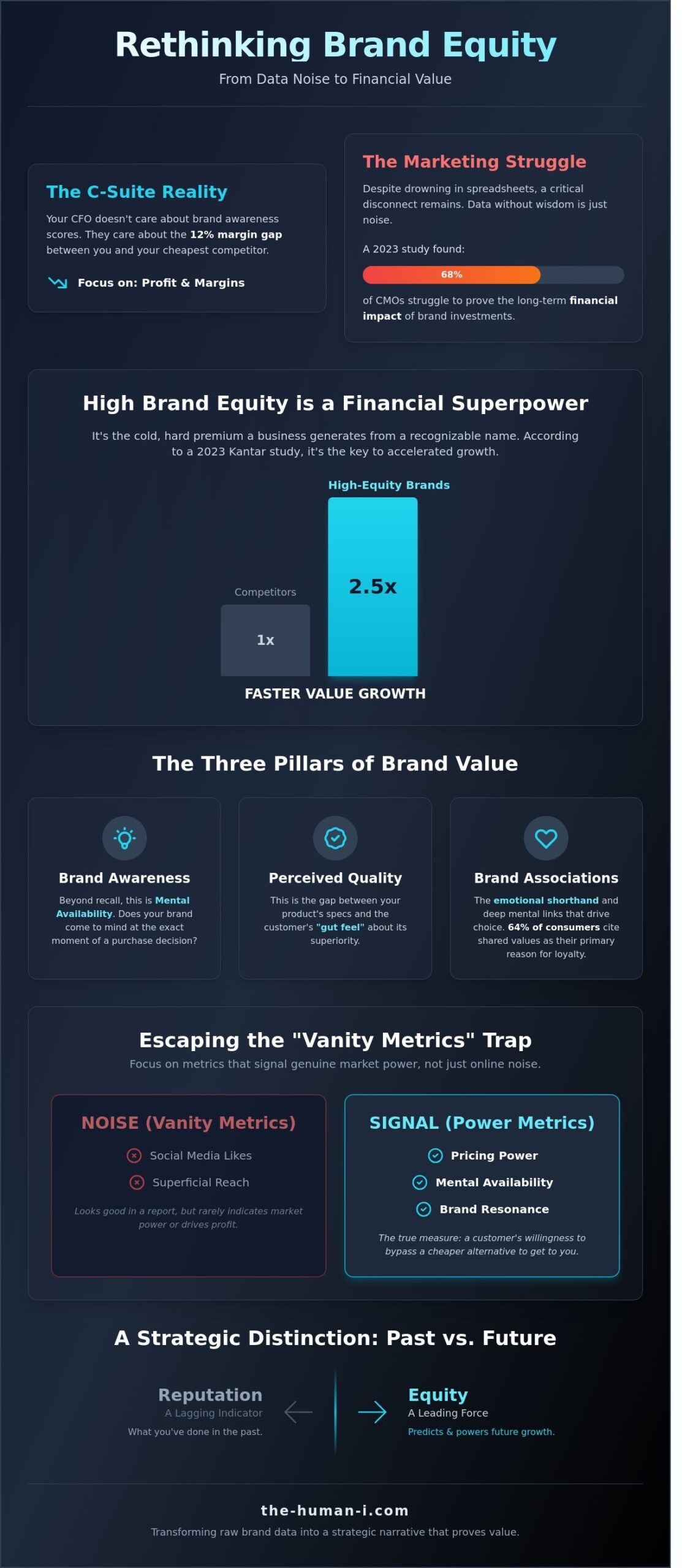
Your CFO doesn’t care about your brand awareness scores; they care about the 12% margin gap between you and your cheapest competitor. Most marketing teams are currently drowning in spreadsheets, yet a 2023 study found that 68% of CMOs still struggle to prove the long-term financial impact of their brand investments. It’s a common trap to focus on volume rather than value. If you’re tired of seeing stagnant growth despite high reach, it’s time to rethink how you are measuring brand equity metrics. Insight is only as good as the action it inspires; data without wisdom is just noise.
We agree that “big data” often feels like a heavy anchor rather than a strategic compass. You need more than just numbers; you need the ability to tell a story that resonates in the boardroom. This article promises to help you transform raw brand data into a strategic narrative that proves value and drives long-term business growth. We’ll provide a clear framework for evaluation and show you exactly which metrics correlate with your 2024 financial performance, moving your brand from a cost center to a profit driver.
Key Takeaways
- Understand the true premium of your brand name and why traditional tracking often fails by simply “looking” at data instead of “finding” insight.
- Build a holistic framework that bridges the gap between quantitative data and qualitative storytelling to capture brand salience in a crowded market.
- Distinguish between reputation as a lagging indicator and equity as the leading force that predicts and powers long-term business expansion.
- Learn a structured approach to measuring brand equity metrics by anchoring your tracking model in clear business objectives and audience nuances.
- Transform your evaluation process from a dry spreadsheet exercise into a journey of discovery that uncovers the strategic wisdom hidden within your data.
What is Brand Equity Measurement in a Data-Drenched Market?
Brand equity isn’t a vague marketing concept; it’s the cold, hard premium a business generates from a recognizable name compared to a generic equivalent. Think of it as the financial and emotional “extra” that allows a company to charge more for the same raw materials. A 2023 study by Kantar revealed that brands with high equity grow their value 2.5 times faster than their competitors. Despite this, many leadership teams struggle with measuring brand equity metrics because they mistake data collection for actual insight.
Traditional tracking often fails because it focuses on the act of looking rather than the art of finding. Teams spend 40 hours a week staring at dashboards without uncovering the “why” behind the numbers. We believe that understanding brand equity requires a shift from surface-level observation to a deeper search for wisdom. It’s the difference between seeing a drop in sales and understanding that your brand’s emotional shorthand has lost its resonance with a younger demographic.
Effective measurement splits into two distinct camps: consumer-based metrics and financial valuations. Consumer metrics track how people think, feel, and act. Financial valuations look at the balance sheet to see how much of the company’s market cap is tied directly to the brand name itself. At Human Instinct, we bridge this gap by blending data with the human wisdom needed to refresh stagnant brands. We don’t just provide a report; we provide a roadmap for transformation.
The Three Pillars of Brand Value
Brand awareness is the first pillar, but it goes beyond simple recall. We focus on mental availability and salience. Does your brand come to mind at the exact moment of a purchase decision? Perceived quality is the second pillar. It represents the gap between your technical specifications and the customer’s “gut feel.” Finally, brand associations act as the emotional shorthand. These are the deep-seated mental links that drive choice before the logical brain even engages. In a 2022 consumer survey, 64% of respondents stated that shared values were the primary reason they stuck with a brand.
Why “Vanity Metrics” are Ailing Your Strategy
Many brands are currently drowning in “vanity metrics” like social media likes and superficial reach. These numbers look great in a board meeting, but they rarely indicate genuine market power. High awareness can actually be a liability if it isn’t paired with positive sentiment or perceived value. If 80% of your target market knows your name but only 5% would consider buying from you, your brand equity is in the red. Measuring brand equity metrics effectively means ignoring the noise of the “like” button and focusing on metrics that signal pricing power and long-term loyalty. Genuine market power is found in the willingness of a customer to bypass a cheaper, closer alternative just to get to you.
- Mental Availability: The probability that a buyer will notice, recognize, or think of a brand in buying situations.
- Pricing Power: The ability to increase prices without a corresponding drop in demand.
- Brand Resonance: The intensity of the psychological bond that customers have with the brand.
We see measurement as a journey of discovery. It’s about finding the hidden levers that move a brand from being a commodity to being a category leader. By moving past the superficial, we help you identify the specific insights that refresh your strategy and empower your team to make bolder, wiser decisions.
The Core Framework: Measuring Brand Equity Metrics Effectively
Measuring brand equity metrics isn’t about looking at a single dashboard once a quarter. It’s a continuous process of blending hard data with the messy, beautiful reality of human behavior. To truly understand your brand’s value, you need a framework that balances the “what” with the “why.” This means moving away from ad-hoc snapshots and toward longitudinal tracking. A 2023 study by Kantar revealed that brands with consistent, long-term measurement strategies grew their value 2.5 times faster than those focusing on short-term bursts. You don’t want a single photo of your brand; you want a high-definition film that shows movement over time.
In our current digital environment, brand salience is the first hurdle. With approximately 10,000 marketing messages reaching the average consumer daily, being “top of mind” is a survival trait. However, salience alone is hollow. You must track brand meaning alongside brand strength. Strength tells you how much weight you carry in the market; meaning tells you if people actually like what you stand for. You can find a deeper dive into how these elements interact by examining the three sets of brand equity metrics that define modern market leadership. Without this balance, you risk being a brand that’s well-known but poorly understood.
Quantitative Metrics: The Hard Data
Numbers provide the floor for your strategy. Start with the Market Share Premium. This calculates the price elasticity your brand allows. If a generic competitor sells for $50 and you sell for $65 without a drop in volume, your equity is worth exactly $15 per unit. Next, focus on Customer Lifetime Value (CLV). This is the ultimate financial health check. A 2022 report from Bain & Company suggests that increasing retention by just 5% can lead to a profit boost of up to 95%. Finally, don’t just rely on Net Promoter Score (NPS). While NPS gives you a numerical rating, brand sentiment analysis uses natural language processing to categorize the emotional tone of mentions, providing a 360-degree view of your reputation.
Qualitative Insights: The Human Element
Data tells you that a customer left; storytelling tells you why. Qualitative research allows you to uncover the “unmet needs” that surveys often miss. Through deep-dive audience interviews, you might find that 42% of your churn isn’t due to price, but a specific friction point in your digital checkout. Mapping customer sentiment to specific touchpoints in the journey reveals where the brand promise is being kept and where it’s being broken. This is where insight and strategy converge to refresh stagnant brands. By listening to the narrative behind the numbers, you identify opportunities for innovation that a spreadsheet simply cannot see. It’s about finding the wisdom within the data to shape a more resilient future.
Brand Reputation vs. Brand Equity: A Strategic Distinction
Reputation is a lagging indicator; equity is a leading one. This distinction is the cornerstone of any sophisticated brand evaluation. While reputation tells you if people trust your past actions, equity tells you if they’ll pay a premium for your future ones. Many leaders fall into the trap of believing a clean PR record or high favorability scores guarantee market dominance. They don’t. A brand can be widely respected but commercially irrelevant. Measuring brand equity metrics requires looking beyond sentiment to understand the actual commercial pull of the brand in a competitive landscape.
In our strategic consulting work, we often see this disconnect. A positive reputation is a “permission to play,” but equity is the “will to win.” Understanding how to build and measure brand equity involves separating these two forces. Reputation is about corporate character; equity is about consumer value and perceived utility. For instance, Nokia in 2011 serves as a stark example. At that time, Nokia held a 70% favorability rating in many global markets. Consumers respected the brand’s history of durability and reliability. However, their brand equity in the burgeoning smartphone category was effectively zero. They had a great reputation, but they lacked the equity to drive future sales in a shifting market.
Conversely, look at Ryanair. The airline frequently ranks at the bottom of customer satisfaction surveys and faces constant criticism for its service model. Despite this “poor” reputation, its brand equity in the “ultra-low-cost” category is massive. They own the mental real estate for “cheapest flight,” which ensures they remain the first choice for millions of travelers regardless of sentiment. They aren’t loved, but they’re chosen, and that choice is driven by equity.
Measuring Reputation in 2026
By 2026, reputation measurement will focus heavily on ESG and corporate character as tangible financial assets. A 2021 PwC study revealed that 76% of consumers will stop buying from companies that mistreat the environment, employees, or the communities where they operate. In volatile markets, trust becomes a hedge against uncertainty. We quantify corporate character by analyzing the “authenticity gap” between a brand’s marketing claims and its operational reality. This isn’t just about ethics; it’s about the bottom line. High-trust brands see a 25% increase in employee productivity and significantly lower customer churn during economic downturns.
Protecting Equity During a Brand Refresh
Refreshing a brand is a high-stakes operation where you must distinguish between “sacred” assets and “stagnant” ones. Sacred assets are the visual or emotional cues that trigger instant recognition and trust. Stagnant assets are the ones that anchor you to an outdated version of yourself. In 2010, Tropicana famously lost $30 million in sales in just two months after removing its iconic orange-with-a-straw imagery. They mistook a sacred equity asset for a stagnant design element. Using data-driven insights ensures you don’t alienate the core audience while reaching for a new one. Brand Dilution is the loss of distinctiveness through over-extension. Every strategic move must reinforce your core promise rather than stretching it until it snaps.
How to Build a Custom Brand Tracking Model
Off-the-shelf tracking models often fail because they treat every brand like a commodity. To find true value, you need a bespoke architecture. Measuring brand equity metrics effectively requires a structure that mirrors your specific commercial reality. It’s not just about tracking awareness; it’s about understanding the “why” behind the “what.”
Step one is always about clarity. You must define your business objectives before you even look at a spreadsheet. A 2023 study by Gartner revealed that 70% of CMOs struggle to prove long-term brand value because their KPIs aren’t tied to specific outcomes. Are you trying to justify a price premium, or are you looking to lower your cost per acquisition? Your model should reflect that specific goal from the start.
Integrating Market Segmentation
Brand equity isn’t a monolithic score. It fluctuates wildly across different demographics and sectors. If you’re looking at a global average, you’re likely missing the nuances that drive growth. Using B2B market segmentation allows you to identify high-equity pockets where your brand promise resonates most deeply. For example, a fintech brand might have 40% higher trust scores among Gen Z users compared to Boomers. If you don’t segment, that insight stays buried. Tailoring your metrics to your sector is vital; what matters in Finance (security and stability) is secondary in the Health sector (empathy and efficacy).
The Role of Customer Experience Mapping
Every interaction is a moment of truth. Every touchpoint either builds your brand equity or erodes it. You can’t separate the brand from the experience. We’ve seen that a 15% increase in customer lifetime value often stems from fixing a single friction point in the user journey. By integrating CX data into your tracking model, you identify exactly where the brand promise meets reality. You can explore our solutions for mapping these critical journeys to ensure your operational reality matches your marketing claims. Without this link, your brand is just a logo; with it, it’s a living entity.
The final step is establishing what we call a “Wisdom Loop.” Data is just noise without a framework for action. This loop ensures that findings from your tracking don’t just sit in a PDF; they inform strategy. When the data shows a dip in “perceived innovation,” the Wisdom Loop triggers a collaborative session between product and marketing teams. It turns a static report into a dynamic tool for change. This approach moves you beyond mere observation and into active brand management. It’s the difference between looking at a map and actually driving the car.
Building a custom model is an investment in long-term clarity. It removes the guesswork and replaces it with a strategic roadmap. If you’re ready to move beyond surface-level stats, you can uncover deeper brand insights with Human Instinct today.
From Data to Wisdom: The Human Instinct Approach
Measuring brand equity metrics shouldn’t feel like an autopsy. Most organizations approach brand evaluation as a spreadsheet exercise, focusing on historical data that tells them where they’ve been rather than where they’re going. At Human Instinct, we view this process as a journey of discovery. While raw data provides the foundation, wisdom is what turns those numbers into a competitive advantage. It’s the difference between seeing a 5% dip in brand sentiment and understanding the specific cultural shift that caused it.
We help brands find what actually matters within their mountains of information. Research by the Marketing Accountability Standards Board indicates that 72% of CMOs struggle to communicate the financial value of their brand to the board. This gap exists because metrics lack a soul without a narrative. We apply a discipline of storytelling to every data point, ensuring that your stakeholders don’t just see numbers; they see a clear path to growth. When you bridge the gap between hard data and human behavior, you stop tracking and start transforming.
Refreshing Stagnant Brands
Ailing businesses often possess plenty of data but lack a coherent story. In 2023, we worked with a legacy retail brand that had seen a 14% decline in customer loyalty over eighteen months. The data showed they were losing ground, but it didn’t explain why. By adopting a wise mentor perspective, we looked past the transactional metrics to uncover a narrative of “lost relevance” among younger demographics. We didn’t just provide a report; we delivered a growth roadmap that shifted their positioning from “traditional” to “timeless.” This strategic pivot led to a 22% increase in brand recall within six months. Interpreting complex data requires more than an algorithm; it requires the human instinct to spot the “why” behind the “what.”
Your Next Strategic Move
The first step in any meaningful brand audit is identifying exactly where insight is missing. You might have high awareness but low conversion, or perhaps your brand premium is eroding despite steady sales. These are symptoms of a deeper disconnect that standard tracking tools often miss. We invite you to move beyond the surface level of measuring brand equity metrics and begin a deeper evaluation of your brand’s true health. If you’re ready to turn your data into a strategic weapon, you should contact for a consultation to begin the evaluation process.
The marketplace doesn’t stand still. By 2026, the brands that win won’t be those with the most data, but those that possess the deepest understanding of the human instinct behind every click. Insight is your most valuable currency; spend it wisely.
Turning Raw Data into Strategic Momentum
Your brand isn’t a static figure on a balance sheet; it’s a living entity that demands more than passive monitoring. True clarity comes from distinguishing between surface-level reputation and deep-rooted equity. When you build a custom tracking model, you stop chasing generic KPIs and start focusing on the unique levers that move your specific audience. Success in measuring brand equity metrics isn’t about the size of your database. It’s about the depth of the wisdom you extract from it.
Human Instinct draws on a wealth of experience across three core disciplines: Insight, Strategy, and Storytelling. We’ve built a proven track record refreshing stagnant brands in the Financial Services, Automotive, and Tech sectors by finding the “why” behind the “what.” We don’t just look for data points; we uncover the human truths that empower growth. It’s time to move past the dashboard and start leading with a seasoned perspective that turns raw numbers into a clear path forward.
Discover how Human Instinct transforms brand data into strategic wisdom.
The path to a more resilient brand is yours to take.
Frequently Asked Questions
What are the top 3 metrics for measuring brand equity?
The three most vital pillars for measuring brand equity metrics are brand awareness, perceived quality, and brand loyalty. Awareness tracks how many people recognize your name, while quality measures the value they assign to your products. According to a 2023 Kantar study, brands scoring in the top 10 percent for perceived quality grow three times faster than their competitors. These data points create a clear picture of market strength.
How does brand equity differ from brand value?
Brand equity is the psychological perception of your brand in the customer’s mind, whereas brand value is the hard financial price tag attached to it. Think of equity as the “why” and value as the “how much.” For instance, Interbrand’s 2023 report valued Apple at 502 billion dollars. This massive number exists because of the deep equity built through decades of consistent storytelling and product design. One is about sentiment; the other is about the balance sheet.
Can you measure brand equity without expensive market research?
You don’t need a six figure budget to gather wisdom about your brand. Use proxy data like Google Trends to track search volume or run a 500 dollar targeted survey on platforms like SurveyMonkey. Analyzing your Net Promoter Score provides a direct line into customer sentiment for a fraction of the cost. These tools help you uncover measuring brand equity metrics without the heavy price tag of traditional global agencies. It’s about being smart with the data you already have.
How often should a company conduct a brand evaluation?
Conduct a deep dive brand evaluation every 6 months to ensure your strategy stays aligned with market shifts. While you should monitor digital signals monthly, a biannual review allows enough time for brand building efforts to show real results. A study by the Ehrenberg-Bass Institute suggests that brand metrics rarely shift overnight. Checking too often leads to knee-jerk reactions. Stick to a twice yearly schedule to find the meaningful patterns in your data.
What is the relationship between brand equity and customer loyalty?
Brand equity acts as the foundation that makes long term customer loyalty possible. When people perceive high value in your brand, they’re more likely to stay through price hikes or minor service hiccups. A 2020 KPMG report found that 86 percent of loyal customers will recommend a brand to their peers. This organic growth is the direct result of high equity. You can’t have one without the other; equity is the promise and loyalty is the proof.
How do digital metrics like share of voice impact brand equity?
Digital metrics like Share of Voice serve as leading indicators for future growth and brand presence. If your brand owns the conversation online, you’re likely to see a rise in equity over the following quarters. Research from Les Binet and Peter Field shows that a 10 percent increase in Share of Voice typically leads to a 0.5 percent gain in market share. Tracking these digital signals helps you shape a more proactive strategy. It’s the data that predicts where your brand is heading.
Why do most brand tracking models fail to provide actionable insight?
Most brand tracking models fail because they prioritize vanity metrics over deep human insight. They collect mountains of data but forget to tell a story that leads to action. A 2021 Marketing Week survey revealed that 70 percent of marketers struggle to link their brand metrics to actual ROI. When you focus on “what” instead of “why,” you lose the ability to make strategic changes. Wisdom comes from understanding the instinct behind the numbers, not just the numbers themselves.



