


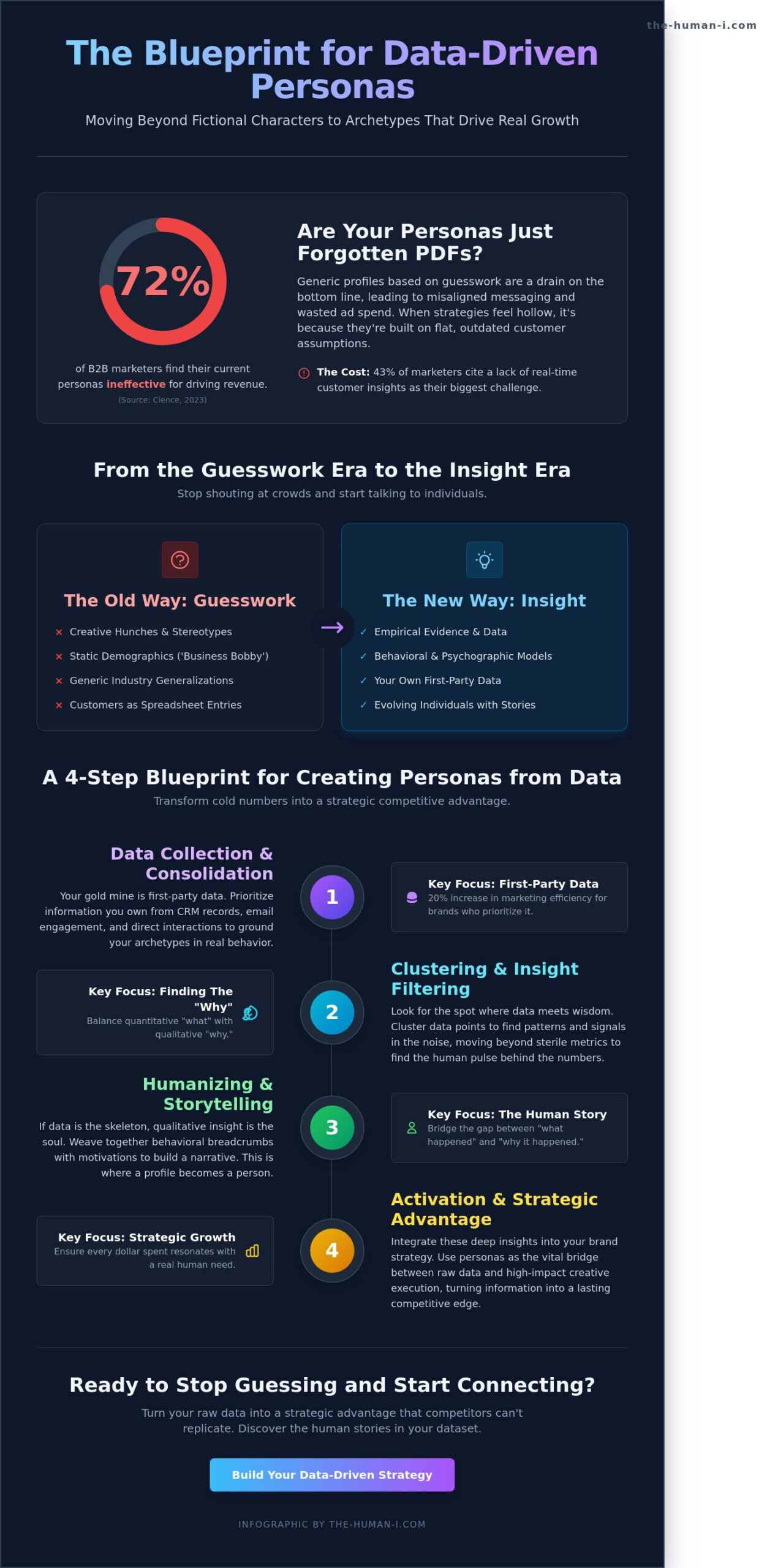
Most marketing personas are little more than fictional characters living in a forgotten PDF. A 2023 study by Cience revealed that 72% of B2B marketers find their current personas ineffective for driving actual revenue. We’ve reached a point where creating customer personas from data must evolve from a spreadsheet exercise into a genuine journey of discovery. It’s time to stop guessing and start listening to what your systems are actually telling you about the people behind the clicks.
You probably know the feeling of staring at a dashboard of inconsistent metrics that refuse to paint a coherent picture of a real person. It’s frustrating when sales and marketing can’t agree on who the customer is, leading to strategies that feel hollow. We’ll show you how to move beyond generic templates and use your first-party data to build personas that drive strategic growth and internal alignment. You’re about to discover a clear framework for data collection that turns cold numbers into human insight and wisdom.
Key Takeaways
- Move beyond creative hunches by grounding your audience archetypes in empirical evidence and behavioral shifts.
- Bridge the gap between the “what” and the “why” by prioritizing your own first-party data over generic industry generalizations.
- Learn the discipline of “clustering” data points to transform sterile metrics into actionable human stories.
- Follow a precise four-step blueprint for creating customer personas from data to identify the archetypes that drive strategic growth.
- Discover how to use deep insight to refresh stagnant brands and turn raw information into a lasting competitive advantage.
Beyond ‘Business Bobby’: Why Data-Driven Personas Are Non-Negotiable
Most marketing teams have a ‘Business Bobby’ or ‘Marketing Mary’ pinned to their office wall. These profiles usually rely on creative hunches or outdated stereotypes rather than hard facts. That approach is dead. A modern, effective persona is a semi-fictional characterization rooted in empirical evidence. We’ve shifted from the ‘Guesswork Era’ to the ‘Insight Era,’ where data informs every single touchpoint. It’s no longer enough to know someone’s job title. We need to understand their digital footprint.
This evolution is a core component of a modern brand strategy. We’ve moved beyond static demographics like ‘lives in London’ to complex behavioral and psychographic models that explain how people actually think and act in the wild. Creating customer personas from data allows a brand to stop shouting at crowds and start talking to individuals.
The Cost of ‘Flat’ Personas
Generic profiles are a drain on the bottom line. According to data from the CMO Council, 43% of marketers say their biggest challenge is a lack of real-time customer insights. This gap leads to misaligned messaging and massive amounts of wasted ad spend. When brands rely on outdated customer assumptions from 2021, they become stagnant and predictable. They treat customers like static entries on a spreadsheet rather than evolving individuals.
Personas act as the vital bridge between cold, raw data and high-impact creative execution. Without them, your creative team is flying blind. If you don’t know who you’re talking to, you’re just making noise. High-performing brands use these insights to ensure every pound spent on media actually resonates with a real human need.
Finding the Human in the Dataset
Our philosophy at Human Instinct is simple: we look for the spot where data meets wisdom. Numbers tell you what happened, but they rarely explain the motivation. There is a massive Insight Gap between knowing a customer’s age and knowing their ‘why.’
Creating customer personas from data is a journey of discovery, not just an administrative task to finish before a campaign launch. It requires looking past the surface metrics to find the human pulse. When you close that gap, you stop guessing and start connecting. You aren’t just building a profile; you’re uncovering a story that allows your brand to speak with authority and empathy. This is how you turn cold metrics into a strategic advantage that your competitors can’t replicate.
The Anatomy of Insight: What Data Should You Actually Collect?
Most businesses drown in data but starve for meaning. For effective creating customer personas from data, you need to look beyond the surface level of broad demographics. Third-party generalizations are often just noise; relying on “average” industry reports from 2022 won’t help you win in 2024. Your gold mine is first-party data. This is the information you own: CRM records, email engagement, and direct interactions. Every interaction should be based in research that reflects real behavior, not industry assumptions. A 2023 study showed that brands prioritizing first-party data saw a 20% increase in marketing efficiency.
When you begin creating customer personas from data, you’re essentially building a bridge between spreadsheets and human psychology. You must balance the “what” with the “why.” By leveraging website analytics and social listening, you can see where people linger and where they leave in frustration. This is about finding the signal in the static.
Quantitative: The Behavioral Breadcrumbs
Numbers tell us what happened. They’re the digital footprint of your customer’s journey. Start by analyzing transaction history and churn rates. If 15% of your users drop off after the second month, that’s a persona trait, not just a metric. In B2C, we often look at impulse and lifestyle. In B2B, the focus shifts to the “job to be done.” A software engineer isn’t just buying a tool; they’re buying a way to skip a 3-hour manual update. Track Customer Lifetime Value (LTV) to identify your “whales.” High-value personas often share 3 to 4 specific behavioral markers, such as frequenting your technical documentation pages or engaging with specific webinars. These KPIs define the boundaries of your segments.
Qualitative: The Soul of the Persona
If quantitative data is the skeleton, qualitative data is the soul. It explains the “why” behind the click. You find this through customer interviews and reputation measurement. Don’t just ask if they liked the product. Use open-ended survey questions to find the emotional hook. Ask what their biggest frustration was 10 minutes before they decided to search for your solution. This reveals pain points that analytics can’t see.
Customer experience mapping helps you visualize these hurdles and emotional peaks. By examining these narratives, we can leverage our expertise to find the deep-seated market stories that drive true loyalty. If you want to move beyond cold metrics, it’s time to listen to the voices behind the screens. Explore how we turn these human voices into strategy.
The Wisdom Filter: Turning Raw Datasets into Human Stories
Data clustering is often mistaken for a purely mathematical exercise. In reality, it’s the bridge between cold numbers and human behavior. When creating customer personas from data, you’re looking for clusters of intent rather than just demographic buckets. You might find that 35% of your users aren’t simply buying a product; they’re seeking a solution to a specific, recurring anxiety. Clustering allows you to see these patterns of behavior that a standard spreadsheet hides.
The most common barrier to progress is the “data deluge.” Many marketing teams feel paralyzed by the sheer volume of metrics available. According to a 2023 Gartner study, 47% of digital marketers struggle to act on data because it’s disorganized. If you feel you have too much data, you don’t have a storage problem; you have a filter problem. You don’t need to use every metric. You only need to use the ones that reveal a choice. Start by ignoring 80% of the noise and focus on the 20% of behaviors that drive genuine engagement.
Strategic focus also requires knowing who to ignore. This is where the “Anti-Persona” becomes vital. By defining the profiles of customers who are a poor fit for your brand, such as “The Discount Chaser” or “The High-Maintenance Skeptic,” you save your creative and financial resources. It’s about narrowing the field so your message hits with maximum impact.
Moving from Segmentation to Storytelling
Segmentation tells you where someone lives, but storytelling tells you why they can’t sleep. A creative team can’t design an impactful campaign for a “35 to 45-year-old male.” They design for “David,” a mid-level manager whose primary motivation is professional legacy but whose core fear is being replaced by automation. As Ferran Adria famously noted, with creativity, it’s not what you look for that’s important but what you find. Storytelling is the discipline that turns a data cluster into a person your team can actually empathize with.
Validating Your Narrative
A persona is a living document, not a static monument. You must pressure-test these narratives against qualitative feedback from your front-line sales staff and direct customer interviews. Market conditions shift at an incredible pace. A 2022 industry report indicated that 65% of customer personas become outdated within a single year. We help brands stay ahead of these shifts through our brand evaluation and refresh solutions, ensuring your insights remain grounded in the current reality of your audience’s lives.
A 4-Step Blueprint for Creating Personas from Data
Turning raw metrics into a living strategy requires a methodical bridge between what people do and why they do it. This isn’t about guessing; it’s about structured discovery. By following this blueprint, creating customer personas from data becomes a repeatable exercise in empathy and strategic precision.
Step 1 & 2: Collection and Clustering
Success begins with a rigorous audit of your internal ecosystem. Export your CRM data to identify high-value segments based on lifetime value or retention rates. Complement these internal numbers with external audience intelligence tools like SparkToro to uncover what your customers read and who they follow online. Research from Cintell suggests that 3 to 5 personas typically account for 90% of a brand’s target audience; any more creates a fragmented strategy that’s difficult for teams to execute effectively.
During this phase, look for deviations that signal a new market segment. If a 12% segment of your user base uses your product in a way you didn’t originally intend, you’ve found a cluster. These anomalies are often where the most profound growth opportunities hide. We don’t just look for patterns; we look for the stories those patterns are trying to tell us about human behavior and unmet needs.
Step 3 & 4: Drafting and Deployment
When drafting your narrative dossier, abandon the tired cliches. “Marketing Mary” or “Digital Dave” are caricatures that teams ignore because they lack depth. Instead, use strategic descriptors like “The Efficiency Architect” or “The Risk-Averse Scaler.” These names immediately signal a customer’s primary psychological driver and professional stance. Include their specific media habits, their 2024 professional goals, and the friction points that keep them awake at night.
A 2022 study by ITSMA found that 71% of companies that exceed lead and revenue goals have documented personas. However, documentation is useless without socialization. You must embed these personas into the organizational DNA. Encourage a persona-first culture where every product development meeting starts by asking how a new feature serves a specific archetype. This ensures that every decision is filtered through the lens of human insight rather than corporate ego. When creating customer personas from data, the goal is to make the data speak a language your entire team understands.
Ready to move beyond the spreadsheet and find the human behind the click? Explore our strategic solutions to see how we transform data into brand wisdom.
From Data Points to Strategic Advantage
Creating customer personas from data is the antidote to brand stagnation. When a brand feels “off” or growth plateaus, it’s usually because the internal mental model of the customer has drifted away from reality. A 2023 report by McKinsey found that organizations using consumer insights to inform their strategy outperform peers by 85 percent in sales growth. This isn’t a coincidence. It’s the result of replacing guesswork with a rigorous synthesis of metrics and meaning.
Data provides the skeleton, but insight provides the skin and soul. While many firms get bogged down in the “what,” the most successful brands focus on the “why.” They don’t just see a 12 percent bounce rate; they see a frustrated parent who can’t find a checkout button while holding a toddler. This shift from cold numbers to human stories is what allows a brand to refresh its messaging and reclaim its market position.
Why a Strategic Partner Matters
Objectivity is the hardest thing to maintain from the inside. Internal teams often struggle with confirmation bias, looking for data that proves their existing ideas are right. This is where a strategic partner becomes essential. Our team brings a wealth of experience across brand planning and storytelling, offering the external perspective needed to spot patterns that insiders miss.
The accuracy of your personas directly impacts your long-term brand reputation. If your segmentation is 20 percent off, your marketing spend is 20 percent wasted. Professional insight ensures that the personas you build are not just caricatures, but actionable archetypes. We help you find what is important rather than just looking for what is convenient. This precision protects your budget and your brand’s voice.
Ready to Uncover Your Audience?
The future of market research isn’t a choice between machines and people. It’s about the marriage of the two. AI can process a billion rows of data in seconds, yet it lacks the discernment to understand the nuance of human emotion. True strategic advantage lives where insight, data, and wisdom meet. If you’re ready to move beyond basic templates and generic demographics, it’s time for a deeper look at your audience architecture.
We invite you to reach out for a brand evaluation or a comprehensive segmentation audit. Let’s look at the numbers together and find the human story they’re trying to tell. You can contact us to begin a conversation about your specific challenges. Don’t let your data sit silent.
Data gives you the map; wisdom shows you the path.
Moving From Raw Metrics to Human Truth
Data isn’t just a collection of numbers sitting in a spreadsheet. It’s the pulse of your audience. When you move beyond “Business Bobby” caricatures, you start to see the real motivations driving your customers. Creating customer personas from data isn’t about collecting more info; it’s about applying a wisdom filter to what you already have. By focusing on our strategic triad of insight, data, and wisdom, you turn raw metrics into actionable narratives that actually move the needle.
Human Instinct brings deep expertise in Financial Services, Tech, and Health & Beauty sectors to every project. We’ve built a proven track record in brand evaluation and market segmentation by looking for what truly matters rather than just what’s easy to track. You don’t need more data points. You need a clearer vision of the people behind them.
Let Human Instinct help you find the wisdom in your data. Contact us today.
Your data is ready to tell a story. It’s time to start listening.
Frequently Asked Questions
What is the difference between a buyer persona and market segmentation?
Market segmentation groups your audience by broad attributes, such as the 35% of your users who live in London. Personas bring those numbers to life by defining the specific motivations and human stories behind the data. Segmentation categorizes the crowd; personas humanize the individual within it. One identifies a slice of the pie, while the other explains why that slice is hungry.
How much data do I really need to create an accurate persona?
Start with a sample of 15 to 20 in-depth customer interviews to identify recurring behavioral patterns. You don’t need millions of data points to be effective. You need enough to reach a point of saturation where no new insights emerge. Creating customer personas from data requires combining these qualitative conversations with existing CRM metrics to validate your findings without drowning in noise.
Can I use AI to create customer personas from data?
You can use AI to cluster 10,000 data points into segments or summarize transcripts from 50 interviews quickly. Tools like ChatGPT or specialized analytical software speed up the synthesis of raw information. However, AI lacks the wisdom to understand the emotional why behind a purchase. Use it as a powerful research assistant, but let a human strategist craft the final narrative to ensure it feels authentic.
How often should we update our data-driven personas?
Aim for a full review every 12 months to ensure your insights stay fresh. Consumer behavior isn’t static. It shifts with economic changes or new technology launches. If your company pivots its product line or a global event like the 2020 lockdowns occurs, update them immediately. Stale personas lead to tone-dead marketing. Keep your data current to maintain a competitive edge.
What are the most important data points for B2B personas?
Prioritize the Job to be Done and the specific hurdles that prevent a lead from achieving their quarterly KPIs. In B2B, you’re looking for the three main pain points that keep a Director of Operations awake at night. Don’t just track job titles. Look at their decision-making power and the internal stakeholders they must convince before signing a contract. Focus on the pressures they face daily.
What is an “anti-persona” and why do I need one?
An anti-persona is a detailed profile of the customer who isn’t a fit for your brand, such as a price-shopper who drains support resources. Identifying these characters helps your team avoid wasting 15% to 20% of the marketing budget on leads that will never convert or stay loyal. It provides strategic clarity by defining the boundaries of your target market and protecting your margins.
How do I get my sales team to actually use these personas?
Involve sales reps early in the research phase so they feel ownership of the final result. Instead of a 40-page slide deck, give them 1-page battle cards that highlight specific talking points for each persona. When sales sees that creating customer personas from data leads to a 10% increase in lead quality, they’ll adopt them as essential tools rather than corporate homework.



