


Every new product begins as an act of faith, but its success should never be left to chance. The path from a promising concept to a market-leading reality is paved with critical decisions, yet many teams are paralyzed by uncertainty. Which research method will uncover genuine customer needs? How do you justify the investment? This guide is designed to cut through that complexity, providing a clear and strategic look at the essential new product development research methods that transform ambiguity into actionable insight.
Here, we move beyond a simple list of techniques. We will provide a practical framework that maps specific qualitative and quantitative approaches to each stage of the development process. You will learn not just what these methods are, but when and why to use them. By the end, you will have the confidence to make data-driven decisions, mitigate the risk of failure, and launch innovative products that truly meet the needs of your customers.
Key Takeaways
- Frame research not as a cost, but as the primary tool for mitigating risk and empowering confident decision-making.
- Uncover a strategic framework that matches specific new product development research methods to each stage of the innovation process.
- Learn to pair qualitative methods that reveal deep human context with quantitative data to validate your findings at scale.
- Discover how to transform raw data into strategic wisdom, building a cohesive narrative that guides your product from concept to launch.
The Foundation: Why Strategic Research is Non-Negotiable in NPD
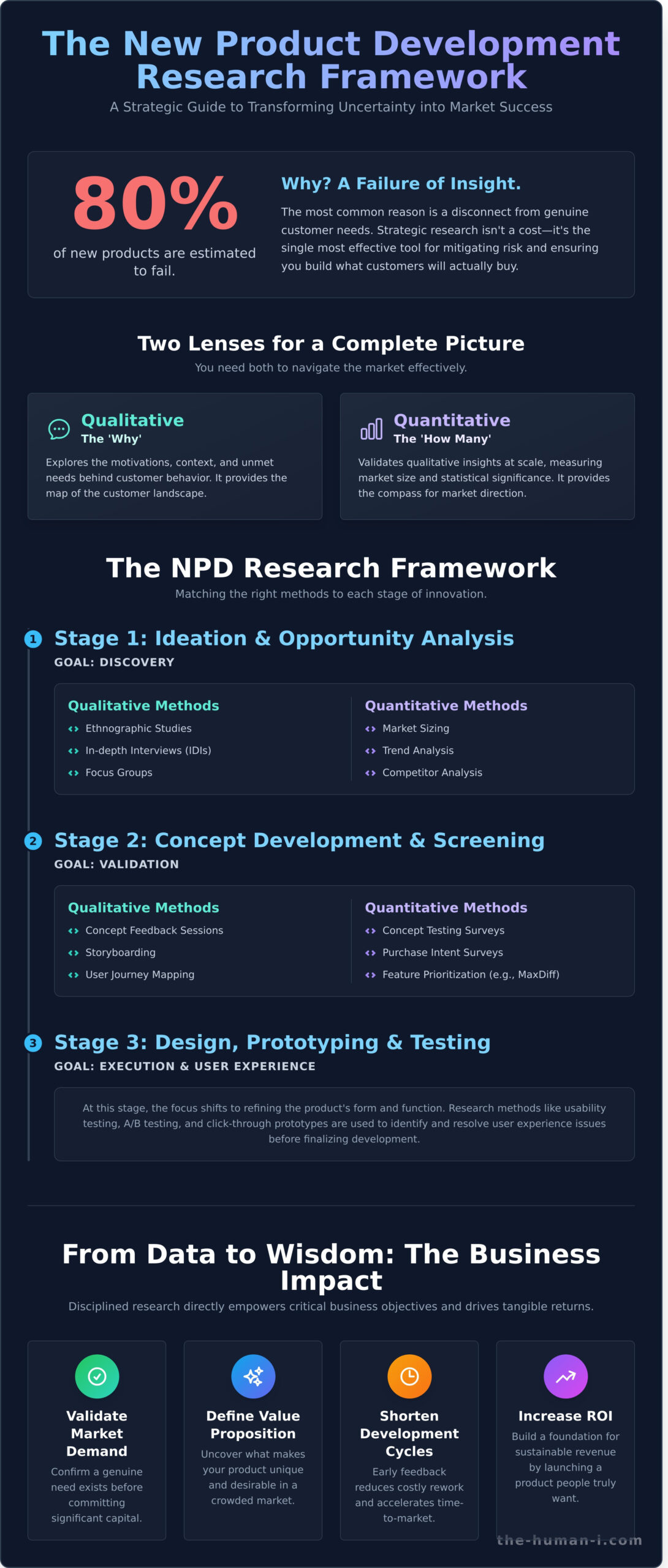
Consider a sobering reality: studies suggest that as many as 80% of new products fail. This isn’t a failure of innovation, but often a failure of insight. The most common reason for this high attrition rate is a fundamental disconnect between the product and any genuine customer need. In this high-stakes environment, strategic research is not a cost center; it is the single most effective tool for mitigating risk. The difference between success and failure often lies in the rigor of the new product development research methods employed from day one.
The core purpose of this research is to move beyond internal assumptions and align product features with the authentic problems and desires of the target market. The antiquated ‘build it and they will come’ approach is a gamble few businesses can afford to take. A modern, insight-led strategy recognizes that successful new product development (NPD) is a disciplined process. It uses a calculated mix of research methods to build a holistic view of the market, ensuring that what you build is what customers will actually value and buy.
Qualitative vs. Quantitative: Understanding the ‘Why’ and the ‘How Many’
A complete market picture requires two distinct but complementary lenses. Qualitative research explores the ‘why’ behind customer behavior-their motivations, context, and unmet needs. Quantitative research then validates these insights at scale, measuring the ‘how many’ and ‘how much.’ Think of qualitative insight as the map revealing the terrain of customer needs, while quantitative data is the compass pointing toward the most viable market direction. You need both to navigate effectively.
Connecting Research to Key Business Outcomes
Disciplined research isn’t an academic exercise; it directly empowers critical business objectives. It provides the wisdom to make confident strategic decisions that drive tangible returns. Specifically, research helps to:
- Validate Market Demand: Confirm a genuine need exists before committing significant capital.
- Define a Compelling Value Proposition: Uncover what makes your product unique and desirable in a crowded market.
- Shorten Development Cycles: Early feedback reduces costly rework and accelerates time-to-market.
- Increase ROI: By launching a product people truly want, you build a foundation for sustainable revenue and growth.
Ultimately, effective new product development research methods transform the process from an exercise in guesswork into a strategic, data-informed journey toward market success.
The NPD Research Framework: Matching Methods to Stages
A structured approach is essential for navigating the complexities of product innovation. We frame our work around the classic four-stage New Product Development (NPD) process, a proven roadmap from initial spark to market success. Each stage presents unique questions and risks, demanding a specific toolkit of new product development research methods to answer them. The goal is not to follow a rigid, linear path, but to build a cycle of learning that iteratively reduces uncertainty and builds confidence. Our consulting solutions are designed to provide the critical insight needed to navigate this entire lifecycle.
Stage 1: Ideation & Opportunity Analysis
This foundational stage is about discovery-uncovering unmet consumer needs and identifying viable market gaps. The focus is on deep, empathetic understanding. A mix of qualitative and quantitative techniques, including various consumer research methodologies, helps shape the strategic direction.
- Qualitative: Ethnographic studies, in-depth interviews (IDIs), and focus groups to explore the ‘why’ behind consumer behaviours.
- Quantitative: Market sizing, trend analysis, and competitor analysis to define the commercial landscape.
Stage 2: Concept Development & Screening
Here, promising ideas are transformed into tangible concepts for evaluation. The objective is to validate these concepts with the target audience, separating the winning ideas from the ones destined to fail. This stage prioritizes clear consumer feedback to refine the value proposition before significant investment is made.
- Qualitative: Concept feedback sessions, storyboarding, and user journey mapping to bring the idea to life.
- Quantitative: Concept testing, purchase intent surveys, and feature prioritization to gauge market appeal.
Stage 3: Design, Prototyping & Testing
With a validated concept, the focus shifts to execution and user experience. This hands-on stage is about refining the product’s form and function to ensure it is intuitive, effective, and desirable. The goal is to identify and resolve usability issues before development is finalized, saving costly revisions later.
- Qualitative: Moderated and unmoderated usability testing and prototype walkthroughs for direct user feedback.
- Quantitative: A/B testing of design elements, preference testing, and Kano model surveys to optimize features.
Stage 4: Go-to-Market & Post-Launch Optimization
The final stage ensures the product launches with maximum impact and has a mechanism for continuous improvement. Research here validates critical launch elements like messaging and pricing while establishing a baseline for in-market performance. It’s about starting strong and adapting quickly based on real-world data and customer wisdom.
- Qualitative: Post-launch interviews and customer feedback analysis to understand the user experience.
- Quantitative: Pricing research (e.g., Van Westendorp) and brand tracking surveys to measure market reception.
A Deeper Look at Key Qualitative Research Methods
While quantitative data tells you what is happening, qualitative methods uncover the critical why. They provide the rich, human context essential for understanding the motivations, emotions, and nuanced behaviors that drive customer decisions. Deploying these new product development research methods effectively provides the wisdom needed to avoid costly assumptions and rework, which research from the University of Pennsylvania shows can significantly impact new product development cycle time. The success of these techniques, however, hinges on the skill of the moderator or interviewer to probe beyond surface-level answers and uncover genuine insight.
In-Depth Interviews (IDIs)
An In-Depth Interview is a one-on-one, guided conversation designed to explore a topic in profound detail. This method is unparalleled for navigating complex B2B buying processes or discussing sensitive personal subjects where individual honesty is paramount. Its key advantage lies in the ability to probe deeply into personal motivations and decision-making logic. Pro Tip: Develop a comprehensive discussion guide to ensure all key topics are covered, but empower the interviewer to deviate and explore unexpected avenues as they arise.
Focus Groups
Focus groups bring together a small, curated group of target users for a moderated discussion. They are exceptionally useful for brainstorming new concepts, gauging initial reactions to ideas, and observing the group dynamics that can influence purchasing behavior. The primary benefit is the spontaneous interaction and idea-building that occurs between participants. Caution: A skilled moderator is crucial to navigate potential pitfalls like ‘groupthink,’ where consensus overrides authentic opinion, or dominant personalities who can overshadow quieter voices.
Usability Testing
This method involves observing real users as they attempt to complete specific tasks using a product or prototype. Usability testing is the definitive way to identify friction points, confusing workflows, and pain points within a user interface before launch. Its greatest strength is revealing the often-surprising gap between what people say they will do and what they actually do when faced with a new system. Remember: The goal is to test the product’s intuition, not the user’s intelligence.
A Deeper Look at Essential Quantitative Research Methods
While qualitative research uncovers the deep ‘why’ behind customer behavior, quantitative methods provide the ‘what,’ ‘how much,’ and ‘how many.’ They are designed to validate initial hypotheses across a larger, statistically relevant audience, transforming insightful observations into measurable data. This numerical evidence is crucial for building a robust business case and making major investment decisions with confidence. Effective quantitative work, however, hinges on rigorous sampling and thoughtful survey design, cornerstones of powerful new product development research methods.
Surveys & Questionnaires
Surveys are structured sets of questions distributed to a large sample of your target market. They are exceptionally effective for measuring customer attitudes, purchasing intent, and feature preferences at scale. Their primary advantage lies in their ability to deliver statistically significant data in a cost-effective manner. You can quickly gauge the size of a market opportunity or prioritize features based on broad customer feedback. Pro tip: To maximize response rates in today’s mobile-first world, keep your surveys concise, focused, and fully responsive on all devices.
Conjoint Analysis
Conjoint analysis is a sophisticated statistical technique used to understand how customers value the different components or features of a product. By presenting respondents with a series of product choices, it simulates the real-world trade-offs they make during a purchase. This method is unparalleled for optimizing product configurations, creating effective feature bundles, and setting a price point that maximizes revenue. This advanced method is a core part of our NPD expertise, allowing us to model market preference with remarkable accuracy.
A/B Testing
Also known as split testing, A/B testing is the practice of comparing two versions of a single variable-such as a webpage headline, a call-to-action button, or an email subject line-to determine which performs better. It is one of the most direct new product development research methods for optimizing user experience and conversion rates. The key advantage is its ability to provide definitive, data-backed answers to specific design questions. However, it requires a live product or a high-fidelity prototype and sufficient user traffic to yield statistically significant results.
From Data to Wisdom: Integrating Research into Your Strategy
Executing a series of research activities is a critical first step, but the true value is unlocked in the synthesis. Raw data, on its own, is simply noise. The goal is to transform isolated findings into a cohesive narrative that combines insights from every stage of your research. This is where data, insight, and wisdom meet to create a powerful, sustainable competitive advantage. An insight-driven approach informs not only the product’s features and design but also the core messaging for marketing and the strategic focus for your sales teams.
Building a Research Roadmap
A research roadmap is a strategic plan that outlines what you need to learn, when you need to learn it, and why. It is a living document that aligns your investigative efforts with critical business decisions and product milestones. To build an effective roadmap:
- Align questions with decisions: Tie each research activity directly to a key business question or upcoming product gate.
- Prioritize by impact: Focus first on research that addresses the riskiest assumptions and has the highest potential impact on success.
- Evolve continuously: Update the roadmap as you gather new insights, as the market shifts, and as your product strategy matures.
Synthesizing and Socializing Insights
To ensure your research drives action, you must move beyond static reports and deliver compelling, story-driven presentations. Bring the customer’s voice to life for your entire organization using tools like detailed personas and customer journey maps. Creating a central, accessible repository for all findings builds invaluable institutional knowledge. When insights from your new product development research methods are shared across departments, they empower marketing, sales, and leadership to operate from a unified, customer-centric strategy.
Partnering with Experts for Deeper Insight
Sometimes, an objective external perspective is required to see the complete picture and challenge internal biases. Experienced consultants can design and execute the complex new product development research methods needed to uncover profound truths about your market and customers. At Human Instinct, our team excels at translating raw data into clear, actionable strategic recommendations that empower confident decision-making.
Ready to build your next product with confidence? Contact us to learn more.
From Insight to Impact: Mastering Your NPD Strategy
As this guide has shown, successful product innovation is not a matter of chance-it’s a discipline built on strategic inquiry. The most critical takeaways are twofold: first, that research is the non-negotiable foundation of the entire process, and second, that success depends on skillfully matching the right qualitative and quantitative new product development research methods to each stage of the journey. The ultimate goal is to elevate raw data into actionable wisdom.
But turning research into revenue requires a partner who understands this nuanced process. Our proven frameworks are designed to deliver clarity, not just data. Our holistic approach-where insight, data, and wisdom meet-has empowered brands across B2B and B2C sectors to uncover critical customer truths and build strategies that drive growth. We turn complex findings into your competitive advantage.
Ready to build a product that resonates and succeeds? Let’s discuss how our insight-driven approach can de-risk your next product launch. Your next market-defining product is waiting to be discovered.
Frequently Asked Questions
What is the difference between market research and product research in NPD?
Market research focuses on the strategic landscape-the “who” and “where.” It aims to uncover market size, identify target audiences, and analyse competitors to validate the commercial opportunity. Product research, in contrast, focuses on the tactical solution-the “what” and “how.” It validates the product concept, tests features, and assesses usability directly with potential customers. One defines the opportunity, while the other shapes the solution that captures it.
How much should a company budget for new product development research?
There is no single figure, as the budget should align with the project’s scale and risk. A common guideline is to allocate 5% to 15% of the total new product development budget to research. Factors influencing this include the level of product innovation, market uncertainty, and the strategic importance of the launch. Investing wisely in insight upfront mitigates the far greater cost of market failure later on, turning data into a strategic asset.
How do you conduct NPD research for a completely new or innovative product?
For truly innovative products, research must shift from validation to discovery. The focus is on uncovering latent needs, not just testing a predefined solution. Methods like ethnographic studies, in-depth interviews, and a “Jobs-to-be-Done” analysis are essential. These qualitative approaches provide the deep human insight required to understand underlying motivations and behaviours, forming the foundation for a product that doesn’t just improve on the existing market-it creates a new one.
What are the most common mistakes companies make in NPD research?
A frequent error is mistaking assumptions for insight, leading teams to skip foundational discovery and jump directly to building a solution. Another is relying solely on quantitative data without the qualitative context that explains the “why” behind the numbers. The most damaging mistake, however, is confirmation bias-using research to validate a predetermined idea rather than to genuinely challenge it. Effective new product development research methods require an open, inquisitive mindset.
How long does a typical NPD research project take?
The timeline varies significantly with the project’s scope and complexity. A foundational discovery phase, including in-depth interviews and market analysis, might take four to eight weeks. In contrast, a more focused activity like concept testing or a series of usability tests could be completed in two to four weeks. It is crucial to view research not as a single event but as an ongoing process that provides critical insight at each stage of the development lifecycle.
Can Agile methodologies and formal user research coexist?
Yes, they are highly complementary. Formal, foundational research-such as creating user personas or journey maps-provides the strategic “North Star” that guides the entire Agile team. This initial insight ensures everyone is solving the right problem. Agile research, like rapid usability testing within sprints, then provides the continuous tactical feedback needed to refine the solution iteratively. One sets the direction, while the other helps navigate the journey efficiently.



